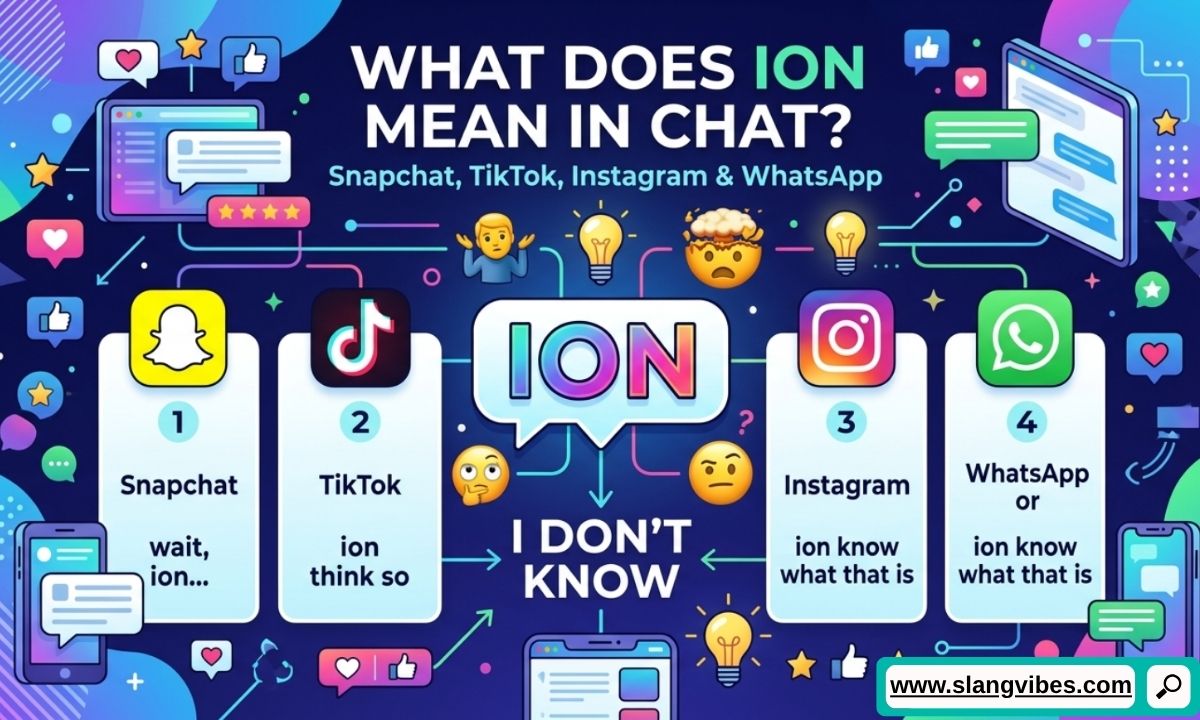
Ion meaning in chat is one of those small texting mysteries almost everyone runs into eventually. Picture this: you open a group chat and someone drops a one-word reply, “ion.” No punctuation, no follow-up, nothing. Your brain goes straight to ninth-grade chemistry class before it lands on the obvious answer. If this sounds familiar, you’re far from alone, since stopping mid-conversation to ask “wait, what does that mean?” feels awkward. So here’s the fast version before we go deeper: ion is internet slang for “I don’t,” and once you spot it once, you’ll see it everywhere.
Ion Meaning in Chat: The Quick Answer
Quick Answer: In texting slang, “ion” stands for “I don’t.” It’s a phonetic spelling, meaning it’s written the way it sounds when someone says “I don’t” fast in casual speech, not an actual acronym with a hidden meaning behind each letter.
Ion meaning in chat comes down to speed and sound. Say “I don’t” out loud quickly a few times and you’ll notice it starts to blur into something close to “eye-own.” That’s the whole trick. People who type fast in casual chats picked up on this and started writing it the way it sounds instead of spelling out the full phrase.
You’ll see it stand in for phrases like:
- “Ion know” (I don’t know)
- “Ion like that” (I don’t like that)
- “Ion want to go” (I don’t want to go)
The ion abbreviation works because it saves keystrokes without losing meaning, which is honestly the whole point of most texting slang. It’s short, it reads fast, and once you know the pattern, your eyes stop tripping over it.
Where Ion Comes From (The Real Origin Story)
Ion didn’t appear out of nowhere. The pronunciation pattern behind it comes from African American Vernacular English (AAVE), where sounds and rhythms in spoken English often get compressed in ways standard written English doesn’t reflect. “I don’t” naturally softens into something close to “ion” in fast, casual speech, and this has been true in spoken language long before texting existed.
What changed is the writing part. As texting and social media grew, people started typing words the way they sound rather than the way textbooks spell them. AAVE has shaped a large share of modern internet slang and meme culture, from “finna” to “bussin,” and ion fits right into that pattern. Gen Z picked it up widely, and it spread from group chats into captions, comments, and video text overlays.
Knowing where a word comes from matters, especially with slang tied to a specific dialect. Using ion casually in your own texts is one thing; understanding it didn’t start as a random internet abbreviation gives you a fuller picture of why it sounds the way it does and why it caught on so fast. This origin is part of why ion meaning in chat feels so natural to type once you know it, since it mirrors real spoken English rather than an invented internet shortcut.
Ion vs ION: Lowercase and All Caps Mean Different Things
Here’s a detail most guides skip, and it trips people up more than you’d expect. Lowercase “ion” and all-caps “ION” don’t always mean the same thing.
Lowercase “ion” is the one covered above: “I don’t.”
ION, written in capitals, often stands for “In Other News,” a phrase used to shift topics mid-conversation or mid-post. This version shows up more with older internet users, on X (formerly Twitter), or in longer captions where someone pivots to a new subject.
A side-by-side look:
| Message | Meaning |
|---|---|
| “ion feel like cooking tonight” | I don’t feel like cooking tonight |
| “ION… did anyone else see the game last night?” | In other news… did anyone else see the game last night? |
The easy rule of thumb: if the sentence reads like a personal opinion or refusal, it’s “I don’t.” If it reads like someone changing the subject, it’s “In Other News.” Context does almost all the work here, so once you read the rest of the sentence, the confusion clears up fast.
Read Also: Moots Meaning in Text: Simple Explanation for Social Media Users (2026)
Ion Meaning in Chat on Snapchat, TikTok, Instagram & WhatsApp
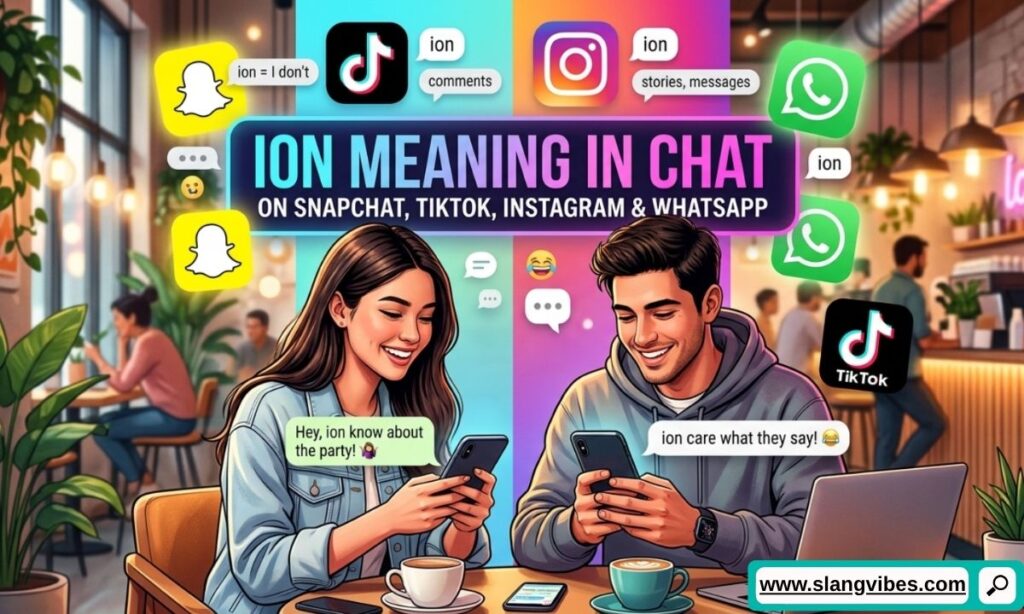
Ion meaning in chat stays fairly consistent across platforms, though the tone shifts a bit depending on where you see it.
Snapchat Snapchat conversations move fast, and ion fits right into that rhythm. A typical exchange looks like this:
A: You still coming over later? B: ion think so, my mom’s making me stay in
TikTok Ion meaning on TikTok shows up mostly in comments and captions, often paired with humor or a reaction.
Comment: “ion know why this scene lives in my head rent free 💀”
Instagram Instagram mixes younger and older users, so ion meaning on Instagram appears in DMs and comments, but with slightly wider variation in how formal or casual it reads.
DM: “ion mind either way, you pick the restaurant”
WhatsApp Ion meaning on WhatsApp leans more personal, since WhatsApp chats often include family members alongside friends, so tone tends to soften a little.
“ion have data right now, call you when I’m home”
Across all four apps, the meaning barely changes. What shifts is who’s reading it and how casual the setting feels.
Ion vs Similar Slang (Comparison Table)
Ion isn’t the only phonetic shorthand floating around group chats. Seeing it next to similar terms helps clear up when to use which one.
| Term | Meaning | Vibe |
|---|---|---|
| ion | I don’t | Neutral, casual |
| idk | I don’t know | Slightly more formal-casual |
| finna | Going to / about to | Energetic, AAVE-rooted |
| ain’t | Is not / am not | Direct, informal |
| fr | For real | Emphasis, agreement |
The difference between ion and idk comes down to feel more than meaning. “Idk” reads a touch more standard since it’s been around online for years, while ion carries a more phonetic, spoken-word energy. Neither one is wrong; they simply hit differently depending on the conversation.
How to Reply When Someone Texts You “Ion”
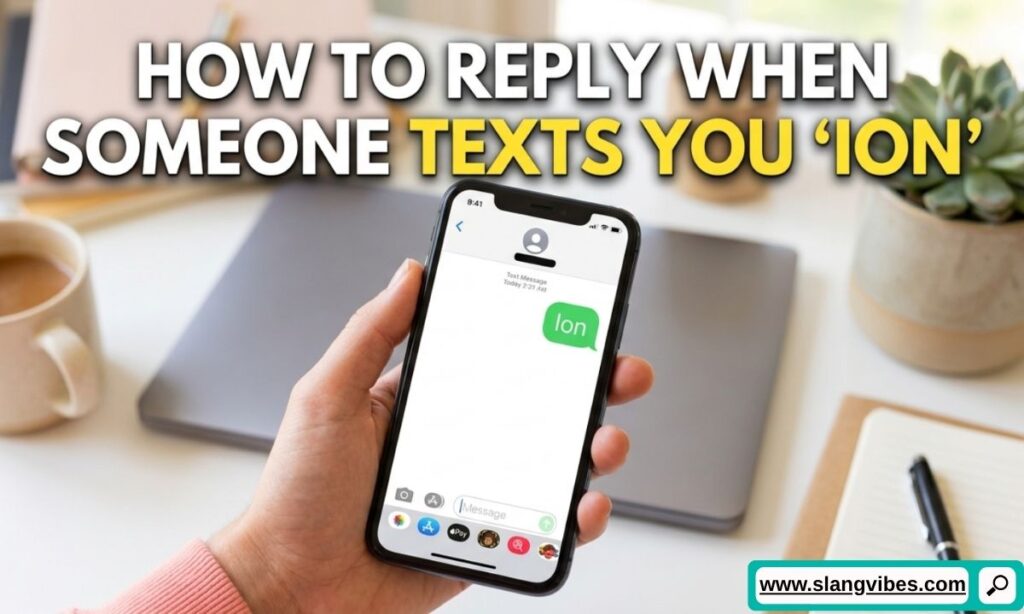
Replying to ion depends entirely on tone, since the same three letters can read as playful, dismissive, or genuinely uncertain.
Here are a few real examples across different situations:
Friend group chat (playful):
A: ion think pineapple belongs on pizza B: opinion rejected, we’re not friends anymore 😭
Dating text (soft, considerate):
A: ion know if I’m free Friday yet, can I let you know tomorrow? B: totally fine, no rush
Sibling text (dismissive):
A: you cleaning your room today? B: ion feel like it A: not optional lol
Coworker chat (rare, only in casual work culture):
Read More Articles: POS Meaning in Text: What It Really Means on Snapchat, TikTok & More
A: ion mind covering the shift if you’re stuck B: appreciate it, thank you
Common Mistake: Reading every “ion” as disinterest or rejection. Tone from the rest of the message and the relationship between texters usually matters more than the word itself.
When NOT to Use Ion (Professional & Formal Settings)
Knowing ion meaning in chat is one thing; knowing when to leave it out matters equally. Ion belongs in casual texting slang, not formal writing. Skip it in work emails, school assignments, cover letters, or any message going to someone who doesn’t share the same texting shorthand.
It also helps to think about who’s reading the message. Older relatives, coworkers outside your close circle, or non-native English speakers might read “ion” and genuinely have no idea what it means, since it isn’t standard English and won’t show up in a dictionary lookup the way “idk” sometimes does. In those situations, spelling out “I don’t” avoids confusion and reads as more considerate, not less casual in spirit.
Ion in the UK vs the US: Is It Used the Same Way?
Ion started in American internet slang, rooted in AAVE, and it’s spread widely through US texting culture and social platforms. What’s interesting is how fast it’s crossed over into UK youth slang too, largely through TikTok and shared meme culture, where trends move between US and UK Gen Z audiences within days rather than months.
UK usage tends to mirror the American meaning closely: “I don’t.” The frequency runs slightly lower outside the US, and UK texters sometimes mix ion with regional slang of their own, but the core meaning holds steady on both sides of the Atlantic. If you see it in a UK group chat, read it the same way you would in an American one.
Read New Article: LMS Meaning in Text: What It Really Means on Snapchat, TikTok & Instagram (2026)
Frequently Asked Questions About Ion Meaning in Chat
In lowercase, yes, nearly every time. All-caps “ION” is the exception, standing for “In Other News” instead.
Not inherently. Tone and context shape how it reads far more than the word itself does.
Close, but not identical. Ion means “I don’t,” while idk means “I don’t know.” They overlap in casual use but aren’t perfect swaps.
It comes from AAVE pronunciation patterns, where “I don’t” naturally compresses into a sound close to “ion” in fast, spoken English.
It’s safer to spell out “I don’t” in those cases, since ion isn’t standard English and might read as confusing rather than casual.
Bottom Line
Ion meaning in chat comes down to one simple phrase hiding behind three letters: “I don’t.” Once you catch the pattern, spelled the way it sounds rather than the way it’s traditionally written, you’ll read it instantly whether it shows up on Snapchat, TikTok, Instagram, or WhatsApp. Keep an eye on lowercase versus all-caps, read the tone around it, and save it for casual conversations rather than formal ones. The next time that one-word text lands in your chat, you won’t need a second to figure out what it means.

Alex Carter is a language enthusiast and internet culture expert at SlangVibes. He explains the latest slang terms and text meanings in simple, clear English so everyone stays in the loop.