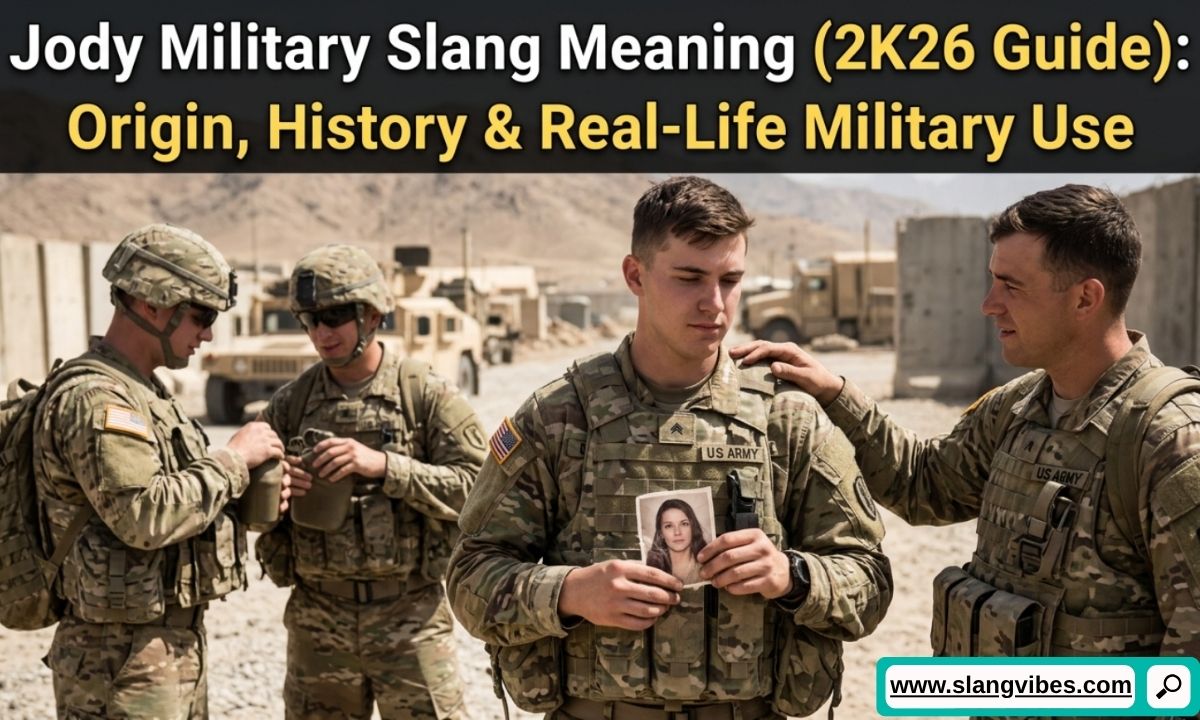
Picture a group of recruits jogging in formation before sunrise. A drill instructor calls out a rhythmic chant, and one name keeps popping up in the lyrics: Jody. Nobody explains who he is. New recruits repeat the words and laugh along, even though half of them have no idea what the joke means. Jody military slang meaning comes up in almost every branch of the U.S. armed forces. Outside military circles, hardly anyone knows how to explain it. The short answer: Jody is the fictional guy back home who’s supposedly stealing your girlfriend while you’re away. Here’s where the term came from, how service members use it today, and why it’s stuck around for decades.
Quick Answer: Jody is a nickname for an imaginary civilian man who stays home and supposedly moves in on a deployed service member’s partner. Troops use the name mostly in running cadences and barracks jokes, not as a literal accusation.
What Does Jody Military Slang Meaning Mean?
The Jody military slang meaning boils down to one idea. Jody is a stand-in name for the guy who has it easy while someone else serves overseas. He isn’t a real person. He’s a folk character, a punchline built into military culture over generations.
Troops use “Jody” as shorthand for a civilian who dates, marries, or otherwise moves in on a service member’s partner. This usually happens during deployment. The name shows up in running cadences, barracks conversations, and casual jokes among friends. It also works as a verb. Getting “Jodied” means someone back home ended a relationship or moved on while you were away.
This slang word carries a mix of humor and unease. Nobody wants to become the guy left behind. Nobody wants their partner to fall for a Jody either. The joke lets service members poke fun at a real fear instead of sitting with it quietly. The word doesn’t always point at one specific person, either. Troops often use it as a general warning about distance and time apart, not an accusation aimed at anyone real.
Military nicknames like this one work because they turn something uncomfortable into shared humor. Troops from every branch recognize the name right away, even without serving together. It’s part of everyday soldier slang passed down from senior members to new recruits. It works like an inside joke everyone eventually gets let in on.
Jordan: You nervous about the deployment? Sam: More nervous about Jody showing up at my door. Jordan: Ha, tell your girl you’ll be back before he gets comfortable. Sam: Sounds like a plan.
Where the Jody Military Slang Meaning Comes From
The Jody military slang meaning traces back further than most people expect. The name grew out of a blues character called Joe the Grinder, first recorded in a 1939 blues song. In blues slang from the era, “to grind” meant something explicit. Joe the Grinder was the guy who slept with another man’s woman while he worked or traveled far from home.
Military historians and folklorists trace the shift from “Joe the Grinder” to “Jody” back to World War II. Black soldiers carried the phrase into military service. Over time, the name got clipped and reshaped into “Jody.” The Journal of American Folklore documented the Jody character as early as the 1960s. It described him as the mythical figure who steals a soldier’s girl, liquor, and car the moment he gets drafted.
Language researchers who track military slang list documented uses of the name stretching back to the 1940s. These citations predate Vietnam by a couple of decades. This timeline matters, since it corrects a common myth. Plenty of people assume Jody started during the Vietnam War. The term was already well established by then. Vietnam gave it wider exposure. More cadences and war stories reached the public through news coverage and films from the era.
Every branch eventually picked up some version of the joke. The Army gets credit for popularizing it most, thanks to its cadence traditions. Dictionaries of military and folk slang list the term alongside other WWII-era phrases which survived into modern service. By the time later generations of service members learned the term, Jody had already become a fixture of military vocabulary. Training passed the word down, rather than any single war inventing it.
Read More: DW Meaning in Text: What It Really Means on Snapchat, TikTok & Instagram (2026)
Jody Military Slang in Cadences: How Jody Calls Work
Jody calls are the running cadences chanted during marches and formation runs. A cadence keeps everyone moving in step and breathing in rhythm, which makes long runs easier to survive. Drill instructors lead the chant, and recruits repeat each line back. New recruits often don’t know the words at first, so they mumble along until they catch the rhythm. The chant distracts tired legs and lungs, and it builds unit cohesion at the same time. Jody often shows up as the villain of these chants, a running joke troops share while covering miles together.
The Call-and-Response Pattern
Most Jody calls follow a simple format. A leader shouts a line, and the group echoes it back. This pattern keeps the pace steady, since everyone’s feet hit the ground on the same beat. Lyrics cover everything from home life to training struggles, often with dark humor mixed in. Jody usually appears as the guy enjoying life back home while troops train or deploy far away.
A Typical Jody Call Example
Here’s a simplified version of the pattern, without borrowing from any single copyrighted cadence:
Instructor: I don’t know but I’ve been told Recruits: I don’t know but I’ve been told Instructor: Jody’s living in my home Recruits: Jody’s living in my home Instructor: Drivin’ my truck and wearin’ my clothes Recruits: Drivin’ my truck and wearin’ my clothes
Cadences like this show up in movies too. The running scene in Stripes uses a version of this pattern for comic effect. This scene helped introduce the term to audiences outside the military, decades before social media did the same job.
How Jody Military Slang Meaning Evolved Through the Decades
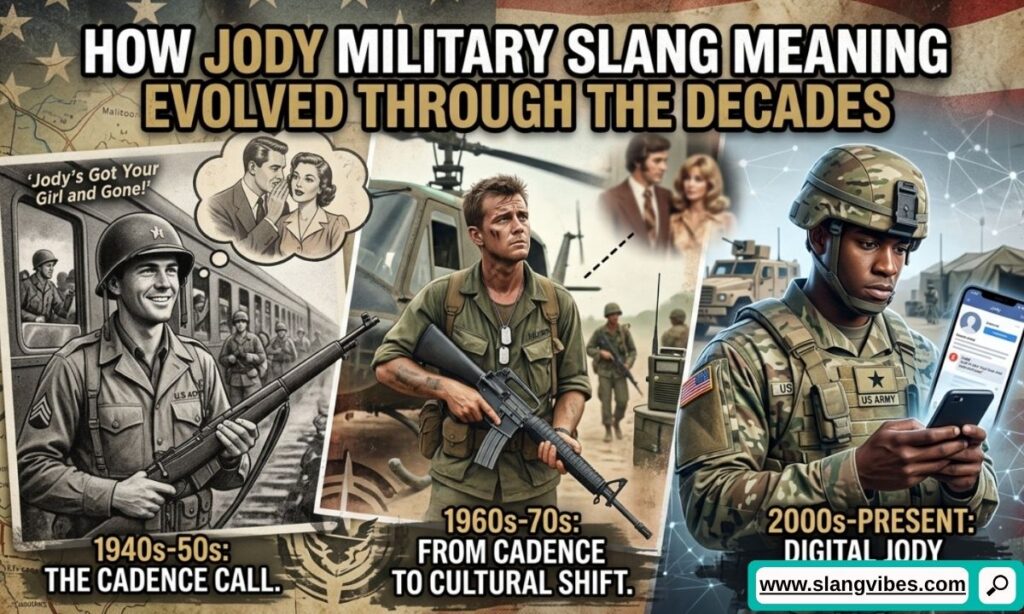
The Jody joke didn’t stay the same over eight decades of use. Each era added its own flavor to the tradition.
World War II introduced the character through Black soldiers who brought blues slang into training camps and units. Korea kept the tradition alive, though records from the era are thinner.
Vietnam gave Jody his biggest audience. News coverage, war memoirs, and films carried military cadences into mainstream culture during the 1960s and ’70s. Civilians who never served started hearing about Jody through movies and books.
The Gulf War and the years after brought a shift in tone. Deployments got shorter for many troops, and communication home improved with better phone access and, later, email. Homecoming culture changed too, with yellow ribbons and welcome-home parades becoming common sights outside military bases. The fear behind the joke softened somewhat, even though the humor stuck around.
Post-9/11 conflicts stretched deployments long again, sometimes over a year at a stretch. Social media and video calls changed how couples stayed connected. Still, the old anxiety behind the Jody joke never fully disappeared. Troops today still use the name, even with instant messaging closing some of the distance older generations dealt with. Some units now joke about a “digital Jody,” a stranger sliding into a partner’s comments or DMs instead of showing up at the front door.
Each generation reshaped the joke to fit its own reality. The core idea stayed untouched: someone else might be moving in while you’re gone.
Devon: Big brother’s deployment starts Monday. Riley: Tell him I’ve got eyes on his girlfriend. No Jody sneaking around on my watch. Devon: He’ll appreciate the backup.
Branch-by-Branch: How Jody Military Slang Meaning Changes Across the Military
The Jody military slang meaning stays fairly constant across the armed forces, yet each branch adds its own spin. Word choice, cadence style, and tone shift depending on who’s chanting.
| Branch | Cadence Style | Tone |
|---|---|---|
| Army | Long call-and-response chants during ruck marches | Gritty, traditional |
| Marine Corps | Fast-paced, punchy cadences with “Oorah” instead of “Hooah” | Aggressive, competitive |
| Navy | Fewer running cadences, more sea-story style jokes | Dry, understated |
| Air Force | Lighter use overall, often borrowed from Army tradition | Casual, less frequent |
Army units lean on Jody calls the most, thanks to a long tradition of ruck marches and formation runs. Marines swap “Hooah” for “Oorah” and tend to chant faster, punchier lines. Navy sailors deal with long stretches at sea rather than marching. Jody jokes show up more in conversation for them than in formal cadence. Air Force personnel use the term less often overall, though it still pops up when Army-trained instructors lead physical training.
The Coast Guard and National Guard borrow heavily from Army tradition too. Many of their instructors trained under Army drill sergeants at some point in their careers. This cross-pollination explains why the cadence style feels familiar no matter which uniform someone wears.
Regardless of branch, the underlying worry stays the same. Someone you love is home without you, and there’s a name for the guy who might take advantage of the distance.
Maria: Ryan left for his rotation this morning. I already miss him. Priya: Watch out for Jody while he’s gone. Maria: If Jody shows up, he’s getting a slammed door. Priya: Love the energy.
Read Also: IMR Meaning in Text: What It Really Means on Snapchat, TikTok & Instagram (2026)
Related Military Slang Terms Every Jody Story Touches

Jody never travels alone. A handful of related military slang words share the same emotional territory or often get mentioned in the same conversation.
A Dear John Letter is the breakup letter version of the Jody story, a message ending a relationship while someone’s still deployed. Where Jody is a joke about a hypothetical, a Dear John Letter is the real, painful version of the same fear.
Blue Falcon means something different: a teammate who betrays or throws a friend under the bus, not a romantic rival. People sometimes mix the two up, but they describe separate problems, one about loyalty at home and one about loyalty in uniform. A unit might have a Blue Falcon problem and a Jody joke running at the same time, and nobody would confuse which word applies to which situation.
Barracks slang like this spreads fast because troops live, train, and eat together for months at a stretch. A new word introduced by one squad leader spreads across a whole company within weeks. A few more terms round out the everyday soldier slang picture:
| Term | Meaning |
|---|---|
| Hooah | An Army expression of agreement or motivation |
| Pog | Slang for someone in a non-combat support role |
| Fobbit | A soldier who rarely leaves a forward operating base |
| Joe | A generic nickname for an enlisted soldier |
| High Speed | Someone highly motivated and squared away |
| Soup Sandwich | Someone or something completely disorganized |
| Boot | A new, inexperienced service member |
| Salty | A veteran troop with a jaded, experienced attitude |
These terms don’t mean the same thing as Jody. Still, they show up in the same barracks conversations, forming the everyday military vocabulary outsiders rarely get taught.
When Not to Use It: Context and Common Mistakes
Jody works fine as a joke among troops who trust each other. It doesn’t always land well outside this setting, though.
The biggest mistake civilians make is bringing up Jody around a military family dealing with a real breakup or infidelity. What sounds like harmless barracks humor turns hurtful fast for someone going through the pain behind the joke. Timing and audience matter more than the words themselves.
Formal settings are another place this slang doesn’t belong. Official briefings, reports, and professional emails call for plain language, not folklore about imaginary romantic rivals. Save Jody jokes for casual conversation among people who already get the reference.
Another mistake shows up when civilians try the joke without knowing the tone. A recruiter or HR staffer working with veterans, for example, might hear the word tossed around and repeat it in a setting where it lands flat or comes across as mocking. Context built the joke, and context keeps it funny. Strip away the context, and the same words sound like an odd insult instead of an inside joke.
Riley: My cousin got back from deployment. He thinks a Jody stole his girlfriend. Casey: Is he joking, or is this serious? Riley: Half joking, half not. It’s a sore subject right now. Casey: Skip the jokes at dinner tonight then.
Reading the room goes a long way here. Among service members who share the same experience, the joke builds connection. Among people outside the group, or during a real breakup, the same words land as tone-deaf instead of funny. A good rule of thumb: let a service member bring up the term first, rather than leading with it yourself.
Jody in Pop Culture, Military Families, and Online Today

The Emotional Side for Military Families
Behind every Jody joke sits a real fear. Deployment means months or years apart, spotty communication, and long stretches of uncertainty. The joke gives troops a way to laugh at a fear instead of carrying it quietly.
Military spouses and partners deal with their own version of this anxiety. Some military spouse communities talk openly about the pressure of proving loyalty from a distance, even though most relationships survive deployment without any Jody drama at all. Trust and steady communication carry couples through the hard stretches far more often than betrayal does.
The joke exists because the fear is common, not because betrayal happens as often as the humor suggests. Most military marriages and relationships hold up fine through deployment. Military family support groups and chaplains often point new spouses toward communication habits, such as video calls, shared calendars, and honest check-ins, which keep couples close despite the distance. The Jody character sticks around mostly as comic relief, a shared villain everyone laughs at together.
Online military spouse groups sometimes turn the joke into a running bit of their own, posting memes about “watching out for Jody” while a partner deploys. The humor works the same way it does inside the barracks. It gives people something lighter to hold onto during a hard stretch of waiting.
Jody in Movies, Memes, and Military TikTok
Jody calls reached mainstream audiences through film. Stripes features a version of the cadence for laughs, and other war movies and documentaries have used similar chants to add authenticity to training scenes.
More recently, military content creators keep the term alive online. Deployment vloggers, military spouse influencers, and veteran TikTok accounts reference Jody in memes and short videos, often riffing on the old cadence jokes with new twists. Gen Z service members and their followers come across decades-old military vocabulary through these clips, sometimes without knowing the term goes back to the 1940s.
This online life keeps the slang word from fading out with older generations. A term coined by WWII-era soldiers now shows up in comment sections and duet videos, showing old military humor still resonates with people who never served a day. Podcast hosts and veteran-run YouTube channels bring up the term too, usually while explaining older cadences to younger listeners who grew up without ever hearing one live.
Meme formats have given the word a second life outside its original setting. Short clips pair the name with unrelated betrayal jokes, stretching the meaning well past deployment and military service. The word, once limited strictly to barracks humor, now shows up wherever people joke about someone moving in on a relationship, military background or not.
Alex: Why’s Marcus so bummed today? Priya: His girlfriend broke up with him for his roommate. Alex: Brutal. He got Jodied for real. Priya: Poor guy didn’t even deploy anywhere.
Read New Article: NGL Meaning in Text: What It Really Means + Examples (2026)
Frequently Asked Questions
It means the person’s partner supposedly moved on with someone else while they were away. The line comes straight from classic Jody call lyrics and gets repeated as a running joke among troops.
Yes. Service members across every branch still use the name in cadences, barracks jokes, and everyday conversation, even though the character himself has never been a real person. Younger troops pick up the term from senior soldiers within their first weeks of training.
Cadences need a villain the whole group recognizes instantly, and Jody has filled the role since World War II. The name gives troops a shared punchline while they run or march together.
Some units use flipped versions of the joke aimed at female service members’ partners, though there’s no single standardized name for it the way “Jody” works for men. Names and details shift from unit to unit. The core joke, someone moving in while a service member’s away, stays the same either way.
Yes, in casual settings among people who already know the reference. Skip it around anyone dealing with a real breakup or deployment-related heartbreak, since the joke won’t land the same way for them.
Conclusion
Jody military slang meaning goes back further than most people realize, rooted in 1930s blues slang and reshaped by generations of service members since World War II. The name never belonged to a real person. It’s a folk character built to give troops something to laugh about instead of a fear they’d rather not sit with quietly.
Today, the term shows up everywhere from formal cadences to group chats to military TikTok accounts. Every branch adds its own flavor, yet the core idea stays put: someone back home might be moving in while you’re gone. This fear rarely turns into reality for most couples. The humor around Jody exists partly as a reminder to stay connected despite the distance.

Alex Carter is a language enthusiast and internet culture expert at SlangVibes. He explains the latest slang terms and text meanings in simple, clear English so everyone stays in the loop.