My cousin texted me a warning last summer. “Heads up, the opps will be at the cookout.” I pictured a street feud and almost stayed home. She meant her ex-friends and one stolen parking spot. The mix-up taught me something. The OPP slang meaning changes with the speaker, the song, and the setting. One version points to rivals. Another points back to a 1991 hit. Both versions still turn up in chats today. This guide breaks down both, shows real text examples, and tells you when to skip the word. Think of it as a friendly translator for your group chat. By the end, you’ll read every opp mention with confidence.
Read Also: HMB Meaning in Text: 2k26 What It Really Means in Chats, Social Media, and Online Culture
What Is the OPP Slang Meaning?
Opp starts as shorthand for opposition. Today, people use it for a rival, an enemy, or anyone working against them. The plural, opps, covers a whole group. Short answer: if you see opps in a recent text or caption, think rivals. Most readers meet this version first.
The second meaning looks back to 1991. Naughty by Nature released a hit song called “O.P.P.” The letters stood for other people’s property. The song joked about sneaking around with someone else’s partner. Music references note the final word was a polite stand-in for a cruder phrase. Many older Millennials still sing the hook when they spot the acronym.
Context decides which OPP slang meaning you’re reading. Rap talk, gaming trash talk, and group-chat drama point to rivals. A throwback joke or a flirty warning points to the song. Tone helps too. Rival talk sounds tense or playful. Song talk sounds cheeky. Here’s a quick dating-text example.
Maya: Did you see Chris comment on her photo again?
Jess: Yep. She’s officially your opp now.
Maya: Ha, I’m not even mad. Only curious.
Jess: Sure. Keep your eyes open.
Notice how opp works here. Nobody feels threatened. It labels a rival for someone’s attention, and the tone stays light. Casual use like this is the most common version in everyday texting, especially between close friends.
Where Did OPP Slang Come From?
The OPP slang meaning grew from two separate sources, and each has its own timeline. The song came first. Naughty by Nature released “O.P.P.” in August 1991, and it reached No. 6 on the Billboard Hot 100. The track became a crossover hit, and many people still recognize the hook today.
The rivals meaning arrived later. Chicago drill artists, Chief Keef among them, used the short form as early as 2011. The word spread across social media in the late 2010s. By then, TikTok and Instagram users were typing opps into captions and comments. In the UK, drill fans use the word the same way.
Fun Fact: Many younger readers meet the slang first and the song second. The two share three letters and little else.
The word itself shortens opposition or opponent, much like pro shortens professional. This habit of clipping long words drives plenty of slang. Opp follows the same path from lyrics to group chats. Origin stories for slang rarely follow a clean line. Sources differ on exact dates, so treat early timelines as approximate.
Short slang spreads fast online. Typing opp takes three letters, and everyone in the thread gets the point. This convenience helps explain why the term moved from rap lyrics into sports talk, gaming lobbies, and everyday jokes. Both meanings still live side by side.
Read New Article: Mexican Slang for Homie (2K26 Guide): 19 Real Words Mexicans Actually Use for “Friend”
OPP Slang Meaning in Texts and Group Chats
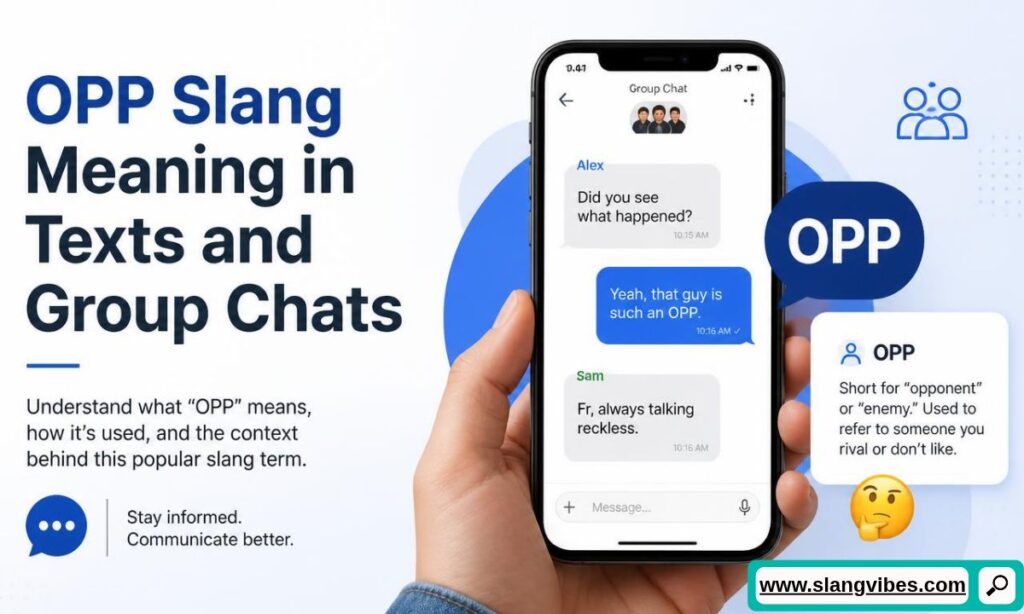
In texts, tone matters more than spelling. People type opp or opps, and some write ops. All three carry the same meaning in a rival context. Lowercase is standard. Capital letters usually signal either shouting or the old song.
Emoji shifts the mood fast. The OPP slang meaning moves with the symbol beside it. A skull 💀 or a laughing face 😂 makes the word playful. A snake 🐍 flags a fake friend. No emoji at all often signals a more serious tone. Here’s how three common patterns read.
| Example | Meaning | Tone |
|---|---|---|
| “my opps saw the post 💀” | Rivals noticed it | Dramatic and funny |
| “he’s my opp in fantasy football 😂” | Friendly rival | Light and teasing |
| “watch out for the opps 🐍” | Warning about fake people | Guarded |
Group chats stretch the word further. Friends call a sibling or a pet an opp for a quick laugh.
Tyler: Who invited Dana to trivia night?
Priya: Not me. She’s the opp from last season.
Tyler: We lost by one point 💀
Priya: Wear your game face.
Notice the skull emoji. It tells everyone Tyler is joking. Without it, the same message reads as real frustration.
Out loud, the word sounds different. Saying opps in conversation works with friends who know rap or gaming. Outside those circles, it sometimes sounds forced. Typing feels safer because text removes the performance.
Read Also: Scouser Slang Explained: The Ultimate Guide to Liverpool Words & Phrases (2026)
How OPP Slang Shows Up on TikTok, Instagram, and X
The OPP slang meaning stays steady across apps, but each platform adds its own flavor. Creators and commenters reach for the word because it packs a whole rivalry into three letters. Here’s how it tends to appear on each platform.
- TikTok: A creator tells a story about a feud and says the opps showed up uninvited.
- Instagram: A caption about loyalty reads “fewer friends, fewer opps” over a mirror selfie.
- X: Fans call a rival team’s supporters the opps during a big game.
- Discord and gaming chats: Players call the enemy squad the opps after a lost round.
- Reddit: A thread about a rap feud debates which artist counts as whose opp.
Comment sections add a twist. A stranger writing opps under a video usually means the creator’s critics or rivals. Reading the replies tells you whether the mood is jokey or heated. Heated threads often include harsher wording, so stay out of them. If the mood stays unclear, scroll through a few replies before you jump in.
Captions work differently from comments. A caption speaks to everyone, so creators use opps as a broad wink at critics. A comment targets a specific person or group, which raises the stakes. Emoji and context fill in the rest, so read the whole post before you decide what an opp mention means.
How Gen Z and Millennials Read OPP Differently
The OPP slang meaning splits along age lines. Many Millennials hear the Naughty by Nature hook first, because the song still shows up at throwback parties. Many Gen Z readers hear rivals first, because drill clips and rap feuds fill their feeds. Each reads the word through the media it knows best.
Dani: Mom asked if I’m down with OPP 😭
Leo: She loves the song.
Dani: I only know opps from drill videos.
Leo: Tell her it means rivals. She’ll laugh.
This exchange shows the gap in action. A parent hears a song lyric, while a teenager hears a feud. Both reactions make sense.
Tone gives away the generation, too. Gen Z texts usually pair opps with emoji and lowercase letters. Millennials who quote the song often use capital letters, quotation marks, or a joke about the dance floor. Those habits hint at the meaning before you reply.
The UK picture looks similar. British drill fans use opps for rivals, so UK and US Gen Z readers usually agree on the meaning. Older readers on both sides of the Atlantic tend to lean toward the song.
When you text across generations, add a clue. A short note like “my rivals, not the song” saves everyone a confused reply. Parents who hear opps at home usually deserve a quick translation, not a lecture.
Read Here: Slang for Boyfriend: The Ultimate 2K26 Guide to Cute, Cool, and Modern Relationship Lingo
OPP vs. Hater, Rival, and Enemy
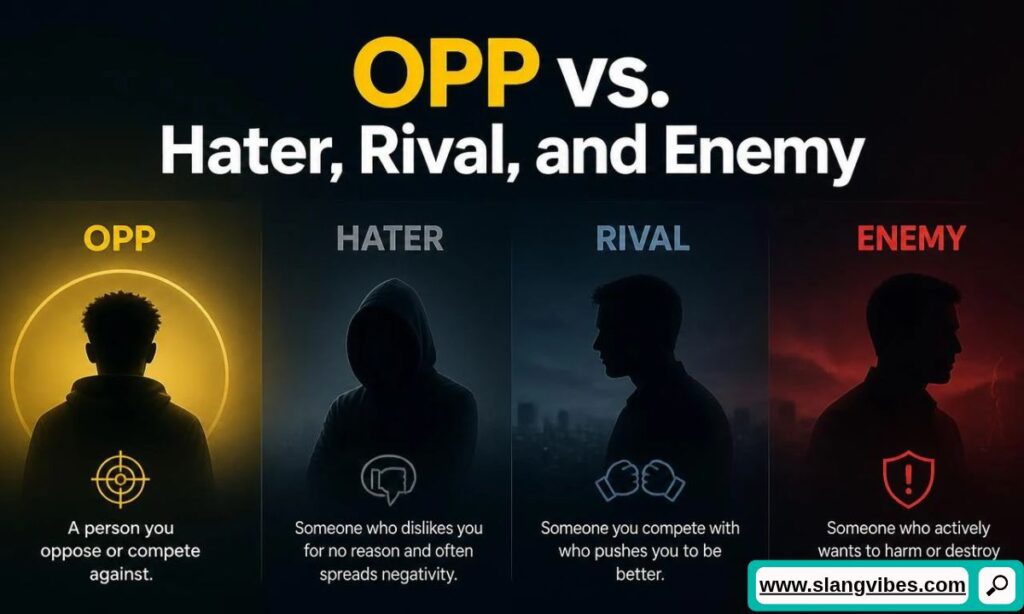
The OPP slang meaning sits somewhere between rival and enemy. It names a person or group on the other side of a conflict. Nearby words describe similar ideas, so the differences matter. Here’s a quick comparison.
| Word | How it feels |
|---|---|
| Hater | Criticizes you from the sidelines, often out of jealousy |
| Rival | Competes with you, usually in a fair contest |
| Opp | Stands against you, with a tone from playful to tense |
| Enemy | Serious and personal |
| Beef | The conflict itself, not the person |
A hater talks. An opp stands on the other side. This is why people sometimes call a hater an opp, but the reverse rarely fits.
Beef names the fight, while opp names the person in it. Someone with beef usually has opps. Rival works best for sports and school contests, where nobody expects real hostility.
Tone also separates the group. Rival and opp both allow humor. Enemy rarely does. Hater usually carries an eye roll.
Enemy is the heaviest word of the four. Use it only when you mean it. Opp gives you more room, since friends use it as a joke and rappers use it as a warning. Picking the right label keeps your message from sounding harsher than you intend. When in doubt, choose the softer word. Pick the word closest to your real feeling about the person.
Common Mistakes With the OPP Slang Meaning
Most mix-ups come from look-alike terms. OP is the biggest culprit. On forums and Reddit, OP means original poster. In gaming, OP also means overpowered. Neither one has anything to do with rivals.
OPP also stands for the Ontario Provincial Police in Canada. A news headline with OPP in it likely refers to police, not slang. Reading the OPP slang meaning correctly starts with checking the source. Police news uses the acronym often, so context usually settles the question.
Chris: Why did the OP call the other team the opps?
Alex: OP is the original poster, so he wrote the thread. Opps means rivals.
Chris: Got it. I mixed up the two.
Watch for these three slips too.
- Assuming every opp mention involves violence. Many uses are playful.
- Using the song meaning with younger friends who only know the slang.
- Saying opps out loud in formal settings, where it sounds forced.
Another slip involves spelling. Ops looks like a tiny typo, yet it carries the same rivals meaning in slang. Context fills the gap, since a sentence about enemies rarely refers to operations.
Each slip has the same fix. Pause, read the setting, and match the meaning to the audience. A two-second check prevents most awkward replies. If you still feel stuck, ask the sender a quick question before you answer.
Torta Meaning Slang: Why This TikTok Term Is Everywhere in 2026
When Not to Use OPP, and How to Respond
Knowing the OPP slang meaning also means knowing when to skip the word. Skip it in these spots. Check your audience first. A teenager hears a joke, while a parent hears a warning about conflict.
- Work emails and client messages
- School essays, presentations, and formal assignments
- Chats with people unfamiliar with rap or gaming slang
- Any moment where a joke about enemies sounds like a real threat
Picture a manager reading a message calling a client the opp. The joke lands badly, even if you meant light teasing. A formal setting rewrites the tone for you. Words harmless in a group chat read as hostile in a performance review or a client email.
Now flip it around. A friend calls you their opp as a joke. Answer in kind. Try a playful reply like “Guilty, and proud of it.” Matching the energy keeps the moment fun. Stay light, skip the escalation, and let the joke end on its own.
If the tone feels hostile, ask directly what the person means. Plain questions end most misunderstandings fast. Stay polite and keep it short. Try something simple, like “Do you mean a rival or the song?” The sender usually clears it up in one message. Real threats deserve a serious response. Save the message and tell a trusted person, a manager, or the platform.
Frequently Asked Questions
What does OPP mean in texting?
In texting, the OPP slang meaning usually points to opposition, so opps are rivals or enemies. The tone runs from playful to tense, depending on emoji.
What does “down with OPP” mean?
The phrase comes from the 1991 Naughty by Nature song. It describes someone open to pursuing another person’s partner.
Is OPP a bad word?
No, it isn’t profanity or a slur. The weight of the word depends on the speaker and the setting.
What is the difference between OP and OPP?
OP means original poster on forums, or overpowered in gaming. OPP means opposition in slang, plus the 1991 song and the Ontario Provincial Police.
Is it okay to use OPP at work or school?
Skip it in formal writing and professional chats. Casual use with friends who know the slang works fine.
Final Thoughts on OPP Slang
The OPP slang meaning comes down to context. Most of the time, opp means a rival, an enemy, or someone on the other side of a conflict. Sometimes it points back to the 1991 Naughty by Nature hit about other people’s property. Tone, emoji, and the people in the chat tell you which one applies.
Gen Z leans toward rivals, and many Millennials hear the song first. TikTok, Instagram, and X keep the rivals sense alive in captions and comments. Look-alike terms like OP and the Ontario Provincial Police add confusion, so check the setting.
Keep the word for friendly group chats, sports banter, and gaming lobbies. Skip it at work and in formal writing. When a message leaves you unsure, ask the sender what they mean. Slang keeps shifting, and a quick question beats a wrong guess every time. Next time someone texts you about their opps, you’ll know exactly how to reply.

Alex Carter is a language enthusiast and internet culture expert at SlangVibes. He explains the latest slang terms and text meanings in simple, clear English so everyone stays in the loop.