Last spring, my cousin posted a photo of her new sneakers right after her ex posted his. I commented, “okay, petty, I love it.” She replied with three skull emojis, and I froze. Had I praised her or roasted her? I typed and deleted four different follow-ups. Sound familiar? The petty meaning shifts with tone, timing, and the person typing, so the confusion is normal. Here’s the short version: petty describes a big reaction to something small. This guide walks through what the word says, where it started, how Gen Z and Millennials use it, and how to reply.
Read Also: EMP Meaning in Text: Platform-by-Platform Guide
Petty Meaning in Text: The Short Answer
Petty meaning in text is simple on paper. Someone acts petty when they put big energy into a small issue. The issue is usually minor, like who replied first or who got tagged in a photo. A late reply to a birthday text counts. So does a grudge over the window seat. The reaction earns the label.
You’ll see three forms of the word. Petty is the adjective, as in “she’s petty.” Pettiness is the noun, as in “the pettiness here is wild.” People also use it as a stand-alone reaction, like “petty, but fair.”
In texts, petty behavior tends to look quiet. Think of a slow reply sent on purpose, a message left on read, or a one-word answer with a period at the end. Nobody yells. The message arrives anyway.
Here’s a short coworker exchange to show the tone:
Dana: Did you see Marcus moved my mug off the shared shelf?
Priya: He did. Did you move his back?
Dana: Obviously. Then I turned the handle to face him.
Priya: Okay, you’re being petty. I respect it, though.
Priya uses the word as a gentle tease, not a hard insult. The same word in a stiff email from a manager would land differently. Her smile comes through in the wording, and the wording is what sets the mood.
Read New Articles: What Does WSP Mean in Text? Real Meaning in Chat & Social Media
How the Petty Meaning Changed Over Time
The petty meaning has traveled a long way from its start. The word entered English in the late 1300s, borrowed from Old French petit, which means small. At first it carried no insult. It simply described size or rank.
You still see this older sense today. Petty cash means a small pot of money for minor expenses. A petty officer holds a lower military rank. Neither phrase judges anyone’s character.
Fun Fact: The term petty officer dates to the 1570s, long before anyone used the word online.
By the 1520s, petty also described things of small importance. The “small-minded” sense shows up by the 1580s, according to the Online Etymology Dictionary. So people have used the word to mock overblown reactions for roughly four hundred years.
Internet culture added the next layer. Online, petty now points to attitude more than size. A tiny act, such as unfollowing someone after an argument, gets called petty because the feeling behind it is loud. Many people also use the word with pride, as in “petty and proud.”
Here’s the thing about word histories. A term starts neutral, picks up a judgment, and then people play with it. Petty followed this path from neutral to critical to playful. Each stage still lives inside the word today, which explains why one short label carries so many moods.
Read Also: TT Meaning in Text Messages and Social Media (2026)
What Petty Means on TikTok, Instagram, and Group Chats
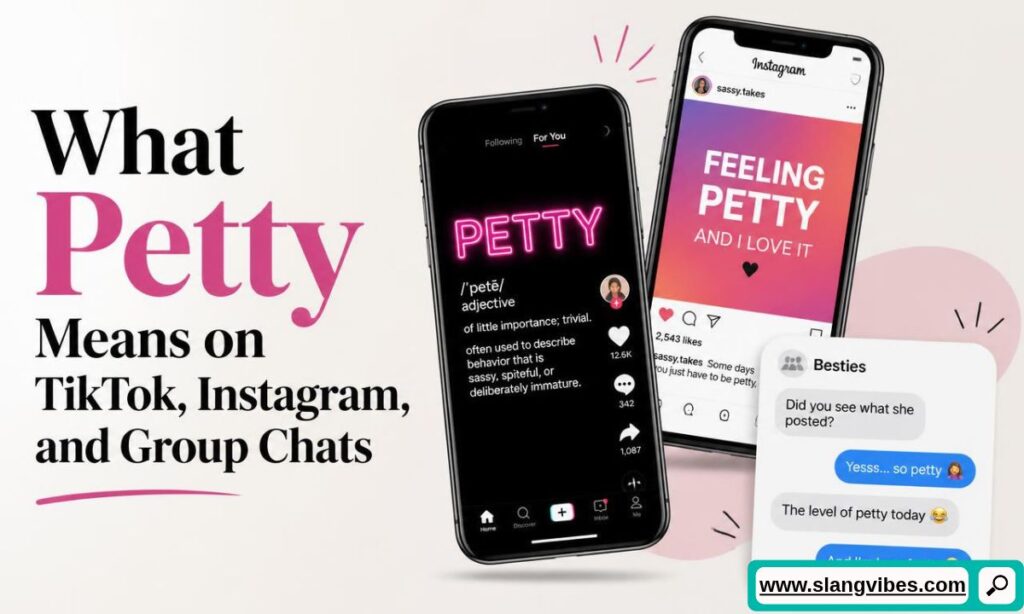
The petty meaning shifts a little from app to app. Each platform has its own habits, and the tone follows.
On TikTok, petty often shows up in comment sections and revenge stories. Creators film a small act of payback, and the audience cheers. On Instagram, it looks like a pointed caption posted right after a disagreement, or a quiet unfollow. In group chats, it feels more personal. Someone leaves a message unanswered, or replies to everyone except one person. Followers notice the pattern fast. A quiet reaction on a story stings as much as a long comment.
Group chats are where the word gets used most casually. Here’s a typical thread:
Jordan: Who ate my leftover pasta from the fridge?
Sam: Not me.
Riley: Okay, but you did label Sam’s yogurt “NOT YOURS” last week.
Jordan: Different situation.
Sam: Sounds petty to me, but I’m not stopping you.
Notice how Sam teases without anger. Group chats let friends use petty as a shared joke, since everyone knows the history.
Short posts often drop the context. A caption like “petty but worth it” reads as playful because the poster is laughing at themselves. A reply like “the pettiness is loud” reads as a tease, not an attack. Without a clear tone, people guess, and guesses go wrong. Reading the replies often clears things up.
Read More: HG Mean in Text: What It Really Means in Messages (2026)
Gen Z vs. Millennials: How Each Group Uses Petty
The petty meaning for Gen Z leans playful and proud. Many younger users wear the label like a badge. Posting “petty and proud” signals honesty and humor at once.
Millennials tend to use the word a bit more critically. Picture a Millennial manager saying, “Let’s not get petty about the schedule.” She means the issue is too small for the energy it’s getting. Here are two quick scenarios. A Gen Z roommate hides the good snacks after a chore dispute and tells the group chat, “petty era, no regrets.” A Millennial roommate notices the same snack drawer and sighs, “Let’s not be petty, please.” Both people know what happened. Their tone is the difference.
Now a first-person hypothetical. Say I send a friend a screenshot of my sharp reply to a rude comment. A younger friend might send back a laughing emoji and ask for details. An older friend might ask whether I’m okay.
Based on how the term is typically used online, these patterns are common, not strict rules. Plenty of Millennials say “petty, but fair,” and plenty of Gen Z users use it as a real criticism. Age shapes the tone. Context decides it.
Look at the setting first. A close friend group usually allows more play. A work chat or a family dinner usually allows less.
Read New Articles NTY Meaning in Text (2026): What It Means and How to Use It ⭐:
What Petty Means Next to Salty, Shady, Spiteful, and Extra
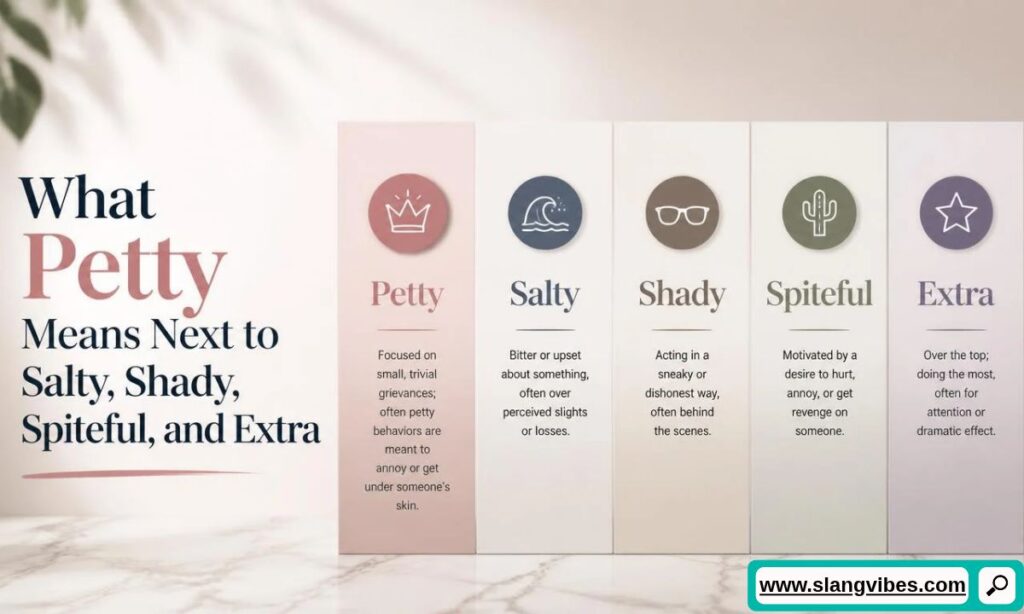
Mixing up the petty meaning with a close cousin is easy, since several slang words overlap. Each one points to a different feeling. This table shows how they compare.
| Term | Meaning | Tone/Vibe |
|---|---|---|
| Petty | Big reaction to a small issue | Playful or critical |
| Salty | Bitter or annoyed after a letdown | Sulky, a bit sour |
| Shady | Sneaky or untrustworthy | Suspicious |
| Spiteful | Wanting to hurt someone on purpose | Harsh, mean |
| Extra | Over the top in general | Dramatic, sometimes fun |
Petty and salty overlap the most. Salty describes a mood after losing or being slighted. Petty describes the move someone makes because of it. A salty person sulks. A petty person sends the passive-aggressive text.
Spiteful sits further out. Petty acts tend to feel small and almost silly. Spite aims to cause real harm. Shady works differently again. It describes a person who seems sneaky, while petty describes a visible reaction. Extra covers any over-the-top move, petty or not.
Usage differs a little between countries. Based on how the term is typically used online, US speakers often treat petty as a casual tease among friends. UK speakers often reach for phrases like “small-minded” or “being childish” for the same idea, though petty is common in UK slang too. Both groups understand the word, so mixed chats rarely cause confusion.
Is Being Petty Good or Bad? How Tone Changes the Meaning
The petty meaning swings between insult and compliment, and tone decides which one you get. Words alone don’t settle it.
As an insult, petty says someone is wasting energy on a trivial issue. “You’re being petty about the check” is a criticism. The speaker wants the behavior to stop.
As a compliment or joke, petty says someone has style in their payback. “Your reply was so petty, I love it” praises the wit. The speaker enjoys the drama from a safe distance.
Emoji help signal the mood. A nail-polish hand (💅) usually marks playful pride. A crying face or a skull (😭, 💀) usually marks amusement. An eye-roll (🙄) leans toward annoyance. A flat period with no emoji at all often reads cold. Timing matters too. A joke sent a minute after the event feels playful. The same joke sent days later feels like a grudge.
Here’s a dating-chat example to show how fast the tone shifts:
Alex: You left my message on read for six hours.
Taylor: I was busy. Also, you did it to me last week.
Alex: So this is revenge?
Taylor: Okay, a little petty. 😅
Alex: Fair. Let’s call it even.
Taylor admits the move with a smile, and Alex lets it go. The word works as a bridge here. If Taylor had used 🙄, the chat would have turned tense.
Common Mistakes When Using Petty at Work or in a Relationship
Misreading the petty meaning in a serious setting causes most of the trouble. A few patterns show up again and again.
Mistake one: calling a coworker petty in writing. Picture a team thread where someone replies, “This is a petty complaint.” The comment reads as a personal attack, even if the speaker meant it lightly. Written words lose tone. Colleagues remember them.
Mistake two: using petty when someone is genuinely hurt. Say a partner is upset about being left out of a plan. Telling them “you’re being petty” shrinks their feelings. It makes a small problem bigger.
Mistake three: labeling yourself petty to dodge accountability. A line like “I’m petty, deal with it” sounds like an excuse. It tells the other person you won’t change.
Mistake four: assuming everyone shares your sense of humor. A joke your best friend loves might fall flat with your in-laws. Many people notice older relatives treat the word as a real criticism.
Mistake five: bringing up old fights. Digging up an argument from months ago makes a small issue feel huge. Everyone slips sometimes, so own it quickly.
When should you skip the word? Skip it in formal emails, performance reviews, and any talk where emotions run high. Choose plain language instead, such as “this seems minor to me” or “I’d like to focus on the bigger issue.”
Read Also: ISTG Meaning in Text: How People Use It in Chats and Social Media
How to Reply When Someone Calls You Petty
Knowing the petty meaning helps you pick the right response. First, read the tone. A smiley face and a joke call for a light reply. A flat message with no emoji calls for a calmer, more direct one.
Here’s a sibling exchange showing a light reply:
Mia: You hid the TV remote again, didn’t you?
Leo: Guilty.
Mia: Petty.
Leo: Certified. You started it with the charger.
Mia: Fair. Truce?
Leo owns it with humor, and the moment stays warm.
For a serious tone, try a calm answer. Say, “You’re right, I reacted to a small thing. Let’s talk about the real issue.” This shows maturity without a fight.
Now a quick self-check. Before you reply to anyone, ask three questions. Is the issue small? Is my reaction bigger than the issue? Would I be okay if this message got screenshotted? If you answer yes, yes, and no, you might be acting petty. This doesn’t make you a bad person. Many people notice pettiness shows up most when they feel ignored or hurt. Naming the feeling often helps more than winning the point.
Funny, calm, and honest replies each have a place. A funny reply keeps friendships easy. A calm reply protects work relationships. An honest reply, such as “I was hurt and I handled it badly,” repairs trust.
Quick Answers: What Does Petty Mean?
What does petty mean in text?
It describes a strong reaction to a small issue, such as a slow reply or a pointed caption. Tone decides whether it sounds playful or critical.
Is petty an insult or a compliment?
Both. The petty meaning depends on tone, relationship, and emoji. Among friends it’s often a joke, while at work it usually reads as criticism.
What does it mean when someone says “I’m petty”?
They admit to reacting strongly over something small. Most people say it with humor and a bit of pride.
What is the difference between petty and salty?
Salty describes a bitter mood after a letdown. Petty describes the small action someone takes because of it.
What is the opposite of petty?
Words like gracious, forgiving, and big-picture describe the opposite. Letting a small issue go is the clearest example.
What to Remember About Petty
The petty meaning comes down to one idea: a big reaction to a small issue. Everything else depends on tone. Between friends, the word often signals humor and a little pride. In an email or a family argument, it usually signals criticism.
The word started in the late 1300s as a plain way to say small. Over the centuries it picked up a judgment, and the internet then added a wink. Today you hear it on TikTok, in group chats, and across the office.
Gen Z and Millennials use it a bit differently, so check who you’re talking to. Pair the word with a friendly emoji when you’re joking. Skip it entirely when someone is hurt.
Next time you feel the urge to send a pointed reply, pause for five seconds. Ask whether the issue deserves the energy. If it does, speak plainly. If it doesn’t, letting it go is often the most satisfying move of all.

Alex Carter is a language enthusiast and internet culture expert at SlangVibes. He explains the latest slang terms and text meanings in simple, clear English so everyone stays in the loop.