Last spring, my cousin sent me a video of a dog greeting its owner at an airport after eight months apart. Slow motion. Piano music. Tears everywhere. I watched it twice, then scrolled to the comments. One person had written “pure schmaltz,” and I had no clue what it meant. Was it praise? A joke? A snack? Here’s the thing: the schmaltz slang meaning is simple once you hear it. It describes sentiment piled on so thick it feels almost too much. Some people say it with a grin, and others say it with an eye roll. This guide covers where the word comes from, how to use it, and how to reply when someone aims it at you.
Read Also: Slang for Clothes: What People Really Call Their Outfits (2026)
Schmaltz Slang Meaning: The Quick Definition
The schmaltz slang meaning comes down to one idea: emotion laid on too thick. Schmaltz (say it SHMAHLTS or SHMAWLTS, both are common) is a noun for sappy, gushy, overdone sentiment. Think of a love song with a key change before the final chorus. Picture a commercial where a puppy and a grandpa become best friends in thirty seconds.
The word works as a noun and as an adjective. You might say a movie has “too much schmaltz,” or you might call the movie “schmaltzy.” Both land the same way.
Tone matters here. Some people use schmaltz as a mild insult, a way of saying a scene feels manipulative. Others say it with love, like admitting they adore a cheesy holiday film. The short answer is this: the word names the style, and your voice supplies the verdict.
Here are three quick scenarios. A critic calls a finale schmaltz because the orchestra swells the second the couple kisses. A friend says “okay, it’s schmaltz, but I’m crying” about a graduation video. A coworker teases your anniversary post as peak schmaltz.
The meaning stays steady in all three. Only the attitude changes, and the attitude is the part to watch. Read the tone and any emoji nearby, and you’ll know which way the speaker leans.
Read More:: 369 Meaning Slang: What It Really Means in Text, TikTok & Social Media (2026 Guide)
Schmaltz Meaning and Origin: From Chicken Fat to Sappy Feelings
The schmaltz meaning has a surprisingly greasy backstory. The word comes from Yiddish, where shmalts means melted fat, most often rendered chicken fat in Ashkenazi Jewish cooking. Yiddish borrowed it from older German roots tied to a verb meaning “to melt.” Modern German still uses Schmalz for fat, and it carries the same sentimental sense too.
So how did cooking fat become a word for gushy feelings? Think of it this way: schmaltz is thick, rich, and clings to everything it touches. A syrupy song does the same thing to your mood. Many people also link the smell of schmaltz with big family dinners, which adds a warm, nostalgic layer.
The feelings sense is newer than the food sense. Etymology sources place the earliest known figurative use in 1935, in a magazine piece about jazz. The writers used it as a put-down for bands who played music straight from the page, with no improvising. Over the following decades, the word spread into reviews of movies, ballads, and theater.
The food has made a comeback too. Chefs have brought real schmaltz back to menus, and the crispy bits left in the pan are called gribenes.
Did You Know: Schmaltz herring contains no chicken fat. The name points to the natural fat in the fish itself.
How Schmaltz Slang Meaning Shifts on TikTok, Reddit, and X
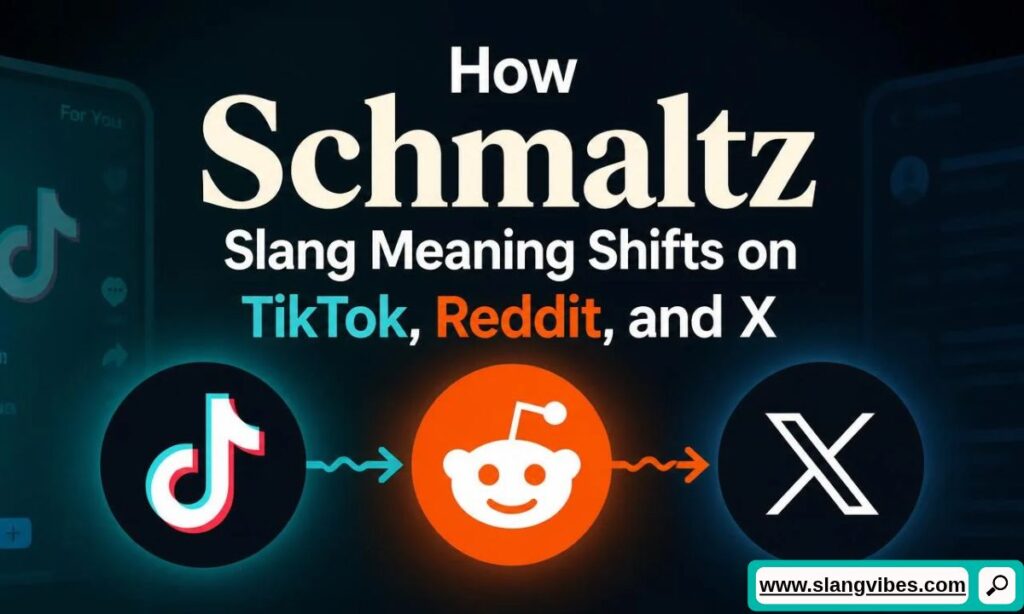
The schmaltz slang meaning stays fixed online, but the attitude shifts from app to app. Based on how the term is typically used, here’s the pattern.
On TikTok, schmaltz shows up in comments under reunion clips, proposals, and pet videos. The tone leans affectionate, often paired with a crying emoji. Something like “schmaltz but I’m sobbing 😭” tells everyone you know the video is manipulative and you love it anyway.
Reddit threads about film and TV treat the word as criticism. Posters use it to say a director piles on emotion in the third act. The tone turns analytical, and the emoji disappear. Longer comments there often name the exact scene behind the label.
On X, schmaltz works as a fast hot take. People post it after a series finale or during awards season, when acceptance speeches turn teary. A 🙄 signals a critique. A 😂 signals teasing.
Here’s how it sounds in a group chat.
Maya: Did you watch the reunion video I sent?
Chris: Yes. Total schmaltz. I cried twice.
Maya: Ha, so you loved it.
Chris: Obviously 😭 Send more schmaltz.
Notice what Chris does. He names the style and admits the feeling in one breath. This pairing is a friendly way to use the word, and it keeps the mood light.
FJB Meaning in Text (2K26 Guide): Full Form, Origin & Social Media Use
Schmaltz in Slang Across Generations and Countries
The schmaltz slang meaning sits in an odd spot, because the word is older than most internet slang. Younger people borrow it online, though, so it feels fresh in comment sections.
Gen Z readers often meet the word through film reviews, parents, and viral videos. Millennials tend to know it from sitcoms, holiday movies, and music criticism. Older speakers use it more for ballads, crooners, and classic melodramas. The meaning stays the same across all three groups.
Regional use adds a small twist. Americans use the word often, since it entered English through Yiddish speakers. UK readers understand it too, yet they often reach for cheesy, twee, or mawkish when they want a similar jab. It’s common to hear schmaltzy in British film and music reviews as well.
Picture a short hypothetical. You tell your grandfather his favorite crooner is pure schmaltz. He might grin and agree, because he grew up hearing the word. Now text your Gen Z cousin the same line about her favorite pop ballad. She might send back a question mark, since she knows the vibe but not the word.
Neither reaction is wrong. The gap shows how a word travels from one generation to the next, picking up new fans and new meanings of tone along the way.
Read Also: WYLL Meaning in Text: What It Stands for on Snapchat & TikTok
Schmaltz vs. Sappy, Cheesy, and Corny
The schmaltz slang meaning overlaps with several neighbors, yet each word has its own flavor. This table shows how they compare.
| Term | Meaning | Tone/Vibe |
|---|---|---|
| Schmaltz | Sentiment piled on thick | Gooey, rich, sometimes loved |
| Sappy | Sweet and soft-hearted | Gentle, a little teasing |
| Cheesy | Predictable or tacky | Playful, not always emotional |
| Corny | Old-fashioned, silly lines | Light, groan-worthy |
| Mawkish | Weakly, sickly sentimental | Formal, harsh |
Choose schmaltz when emotion is the target. A tearjerker with swelling strings earns it. Choose cheesy when the issue is a predictable plot or a groan-worthy line, even if nobody cries. Sappy works for sweet, soft-hearted moments, like a gushy birthday card. Corny fits dad jokes and old-fashioned lines. Mawkish sounds formal and harsh, so save it for pointed reviews.
Kitschy sits nearby too, but it describes tacky design more than feeling. A heart-shaped snow globe is kitsch. A slow ballad about losing a loved one is schmaltz.
Overlap is normal. A holiday movie might be schmaltzy, cheesy, and corny all at once. Picking the sharpest word shows you understand what bothered or delighted you.
Ask yourself one question. Is the problem too much feeling, or too little originality? Too much feeling points to schmaltz. Too little originality points to cheesy.
Common Mistakes With Schmaltz Slang Meaning
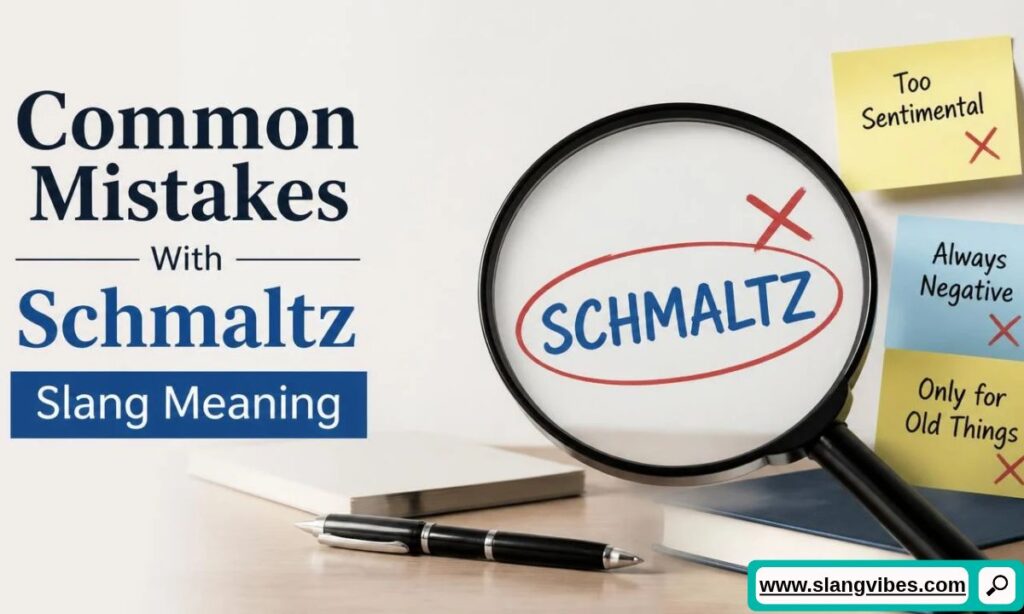
Most errors with the schmaltz slang meaning come from a few easy mix-ups. Here are the big ones.
First, treating it as only a food. On a deli menu, schmaltz means rendered fat. In a movie review, it means gushy sentiment. Context tells you which one applies. A menu listing schmaltz fries means fries cooked in fat, not sentimental fries.
Second, confusing it with its Yiddish cousins. Schmutz means dirt, and schmooze means to chat. Both also come from Yiddish, which explains the similar sound.
Third, spelling worries. You will see schmaltz, shmaltz, and schmalz. Schmaltz is the most common form in American English, and the others still get the point across.
Fourth, aiming it at people instead of things. It’s more natural to call a post, a song, or a scene schmaltzy than to label a person.
Fifth, using it on real feelings. Calling someone’s sincere note schmaltz stings, even in jest. A good test is simple: would you say it to the person’s face? If not, keep it to yourself. Here’s how the fifth mistake plays out at work.
Priya: Did you read Dan’s farewell email?
Leo: Yes. Three paragraphs of schmaltz.
Priya: Careful. He wrote it for real.
Leo: Fair. Sweet, but heavy on the violins.
Read More Articles: White Heart Emoji Meaning: Love, Friendship & Hidden Symbolism
When Not to Use Schmaltz Slang (Formal vs. Informal)
Schmaltz slang lives at the casual end of the spectrum. It fits blogs, reviews, group chats, and comment sections. It sounds out of place in academic papers, client emails, or reports. For those settings, swap in “excessively sentimental” and keep your tone neutral.
Know your audience, too. Plenty of people outside the US have never heard the word. If you’re writing for a mixed group, add a quick clue, like “schmaltzy, meaning overly sentimental.” The same goes for a first date or a new coworker, since you don’t know their sense of humor yet.
Think about the stakes, too. A group chat forgives a lot. A performance review, a cover letter, or a class essay does not. In those spots, a plain phrase like “overly emotional” keeps the focus on your point instead of your slang.
Skip the word when someone shares real emotion. Picture a friend reading a heartfelt toast at her sister’s wedding. Calling the toast schmaltz, even as a joke, lands like a slap. The same goes for eulogies, apologies, and proposals. Sincere moments deserve sincere responses.
Hold back when you’re teasing someone who feels fragile. A person having a rough week might hear “schmaltzy” as “your feelings are silly.” When in doubt, ask yourself whether the person wants a joke or a hug. Then choose your words to match.
How to Respond When Someone Says It’s Schmaltz
Once you know the schmaltz slang meaning, replying is easy. Someone calls your anniversary post schmaltz. Now what? You have three solid options.
Own it. Embrace the label with a grin, since many people say it teasingly. Defend it. Explain why the moment matters to you. Agree. Admit it’s over the top and move on.
Here’s a dating example.
Alex: Your birthday card was pure schmaltz 😂
Rin: I know. I picked the glittery one on purpose.
Alex: And the poem inside?
Rin: Schmaltz, yes, but you kept it.
And here’s a sibling example.
Noah: Mom’s wedding slideshow is schmaltz overload.
Ella: Leave her alone. She cried making it.
Noah: Okay, okay. Sweet schmaltz, then.
Ella: Better. Pass the tissues.
Pick your reply based on the sender. A friend who sends 😂 wants banter, so own it. A relative who typed a long, serious message might feel hurt, so defend your intent gently. A stranger online? Agree and keep scrolling.
Notice the pattern. Playful replies keep things light, while defensive ones protect something personal. Match your answer to the person’s tone. If they send a 😂, tease back. If they send a flat period, ask what they meant before you respond.
Read New Articles: Hood Slang Meaning (2K26 Guide): Popular Street Terms & Their Real Meanings
Schmaltz FAQs
What does schmaltz mean in simple terms?
The schmaltz slang meaning is overly sentimental, sappy, or gushy emotion in movies, songs, posts, or speeches.
Is schmaltz an insult or a compliment?
It’s neither by default. Critics use it as a mild put-down, while fans say it fondly about content they love anyway.
Is schmaltz Yiddish, and is it still a food?
Yes, it comes from Yiddish shmalts, meaning melted fat. It’s still a real cooking ingredient, usually rendered chicken fat.
How do you pronounce schmaltz?
Most Americans say SHMAHLTS, and SHMAWLTS is also common. The adjective schmaltzy ends with a “see” sound.
Is schmaltz okay for kids and formal writing?
The word is safe for kids, with no rude origin or hidden meaning. It’s casual, so swap in “excessively sentimental” for formal writing.
Final Thoughts on Schmaltz in Slang
Schmaltz started life in a frying pan and ended up in movie reviews, comment sections, and group chats. The word names emotion served extra thick, whether in a slow-motion reunion, a swelling ballad, or an anniversary post with too many hearts. Its Yiddish and German roots give it real history, and a 1935 magazine piece about jazz gave it the sentimental twist we know today.
Remember the tone rules. Say it fondly when you enjoy the gooey stuff. Say it with a raised eyebrow when a scene feels manipulative. Skip it when someone shares real feelings. The mistakes are easy to dodge, too: don’t confuse it with schmutz or schmooze, and keep it out of formal writing.

Alex Carter is a language enthusiast and internet culture expert at SlangVibes. He explains the latest slang terms and text meanings in simple, clear English so everyone stays in the loop.