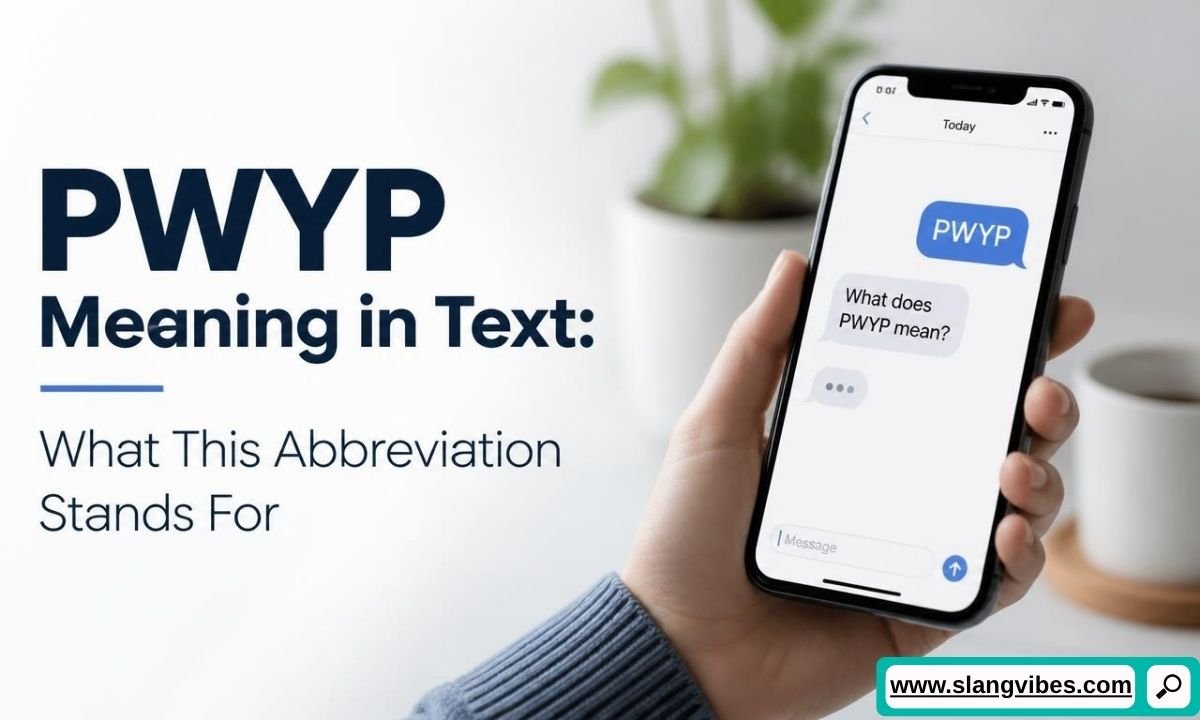
Last spring, my friend Dana opened a small print shop on Instagram. Her bio ended with “all prints PWYP.” I assumed it was a typo and scrolled on. A week later, a buyer asked her what it meant, and I realized I had no idea either. So I looked it up. The PWYP meaning in text depends on context. Most often, it stands for “Pay What You Please,” a pricing style where the buyer picks the amount. It also stands for two other phrases, and mixing them up leads to awkward replies. Here’s how to tell them apart, so you never have to guess in front of a friend.
Read Now: Snowball Kiss Meaning: The Truth You Didn’t Expect 😳
What Is the PWYP Meaning in Text?
The PWYP meaning in text usually points to flexible pricing. A seller offers a product, a ticket, or a service, and the buyer decides what to pay. The full phrase is “Pay What You Please.” Some people write “Pay What You Want,” and the idea stays the same. Wikipedia describes pay what you want as a pricing strategy. Buyers choose their own amount, and it sometimes includes zero.
Three readings show up online:
- Pay What You Please or Pay What You Want, a flexible pricing style
- Publish What You Pay, a transparency campaign
- Practice What You Preach, a saying about acting on your words
The first one wins in most chats. If money, tickets, downloads, or prices sit nearby, expect the pricing meaning. Short abbreviations like this spread because they save typing. A bio has limited space, and so does a caption.
Here’s a quick example from a group chat.
Maya: Anyone want my zine? It’s PWYP.
Eli: PWYP? Is it a typo?
Maya: Pay What You Please. Pick your own price.
Eli: Oh nice, I’ll send five bucks.
Priya: Same here, grab me one too.
Eli’s reaction is normal. The abbreviation looks odd until someone spells it out. Notice how Maya explains the rule right away. Clear explanations like hers prevent most of the confusion.
Where You’ll See PWYP Meaning in Text Online
You’ll spot PWYP meaning in text most often on creator pages. Artists, writers, and musicians use it to keep pricing flexible. The abbreviation saves space in a bio, a caption, or a link description.
Common places include:
- Instagram and TikTok bios beside a shop link
- Captions announcing a new digital download
- Event posts where entry has no fixed fee
- Direct messages when someone asks about price
Short examples show how the tone shifts with the setting.
| Example | Meaning | Tone |
|---|---|---|
| “Zine is PWYP, link in bio” | Pay What You Please | Casual |
| “Workshop tickets: PWYP” | Pay What You Want | Friendly |
| “Report on PWYP rules” | Publish What You Pay | Formal |
Look at the third row. Formal writing about company payments uses a different meaning entirely. Context decides everything here. A caption about a download points to pricing. A news article about mining firms points to transparency.
Many creators add a short note after the abbreviation, such as “support if you’re able.” This small addition removes guesswork for readers. Others pair PWYP with a suggested price. A suggested price gives buyers a reference point without forcing the amount. Short, scannable posts like these keep the focus on the offer, not the explanation.
Read More: Soft Launch Meaning: Why Everyone Is Doing It on Social Media
The PWYP Abbreviation Has Two More Meanings
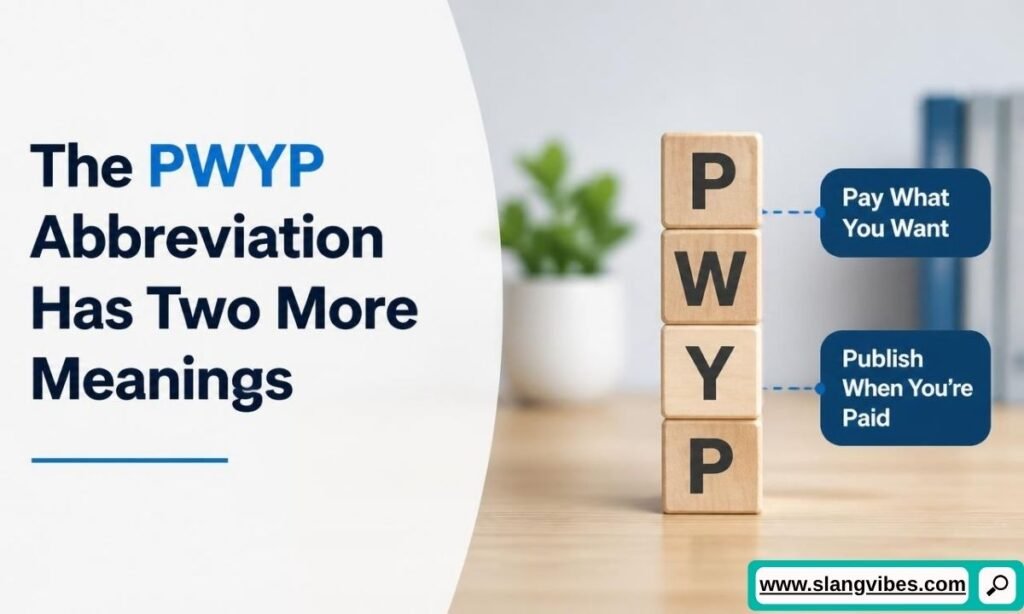
Pricing isn’t the only story. The PWYP abbreviation also stands for Publish What You Pay. This is a coalition urging oil, gas, and mining companies to disclose payments made to governments. You’ll see it in news coverage, policy discussions, and work chats about transparency.
Practice What You Preach is the third reading. The Free Dictionary lists it as a PWYP expansion. It describes someone who acts on the advice they give. People often use it as a gentle call-out when a friend’s actions contradict their words. The tone tends to be playful or pointed, depending on the relationship.
Both extra meanings are established phrases, not internet inventions. Dictionaries list them, while most texting guides focus on pricing alone. Knowing all three keeps you from confidently explaining the wrong one.
Here’s how a mix-up looks at work.
Jordan: Did you read the PWYP report?
Sam: The one about ticket pricing?
Jordan: No, the mining one. Publish What You Pay.
Sam: Ah, wrong PWYP. I’ll open it now.
Sam’s confusion is understandable. Both meanings use identical letters. The subject of the conversation is the only reliable clue. When in doubt, ask for the full phrase before replying. A quick question costs five seconds. A wrong guess costs more, especially at work.
How to Read PWYP in a Text Message
Three quick checks usually settle the question. First, look for money words nearby. Price, download, ticket, tip, and support all point toward Pay What You Please. Second, consider the sender. A creator, artist, or small shop owner almost always means the pricing version. A coworker sharing a policy document likely means Publish What You Pay. A friend teasing you about your habits likely means Practice What You Preach.
Third, check the platform. A shop link in a bio suggests flexible pricing. A news thread suggests transparency. A comment under a news video leans toward transparency, while a comment under a handmade shop leans toward pricing.
Picture this. You get a message saying, “Class is PWYP this Friday.” You know the sender teaches yoga. The meaning is clear: pay what you please. Now picture a different one. A friend texts, “Come on, PWYP,” after you skip a promised gym session. This is the Practice What You Preach reading.
Reading the PWYP meaning in text correctly takes about ten seconds once you know the clues. Keeping a mental checklist of money words, sender, and platform makes it almost automatic. When the clues point in two directions, ask. Something like “Do you mean pay what you want?” works well. Nobody minds a clarifying question, and it avoids an awkward payment mistake.
Read Here: Sans Meaning in Text: Slang Definition & Examples
PWYP vs PWYW, PWYC, and Suggested Price
PWYW is the standard abbreviation for Pay What You Want, according to Wikipedia. PWYP in the pricing sense looks like a less common spelling of the same idea. Based on how the term is typically used online, both appear in bios and captions, and readers treat them as twins. Either way, the PWYP meaning in text stays the same for the reader: choose a fair amount.
PWYC stands for Pay What You Can. It leans toward charity and ability to pay. Wikipedia notes it is sometimes used as a synonym, but it focuses on what a person is able to afford. PWYW focuses on the value a buyer sees in the product.
Two other terms sit nearby:
- Suggested price: the seller names an amount, and buyers choose differently if they wish
- Donation-based: payment is voluntary and framed as support
A short exchange shows the difference.
Noor: Is the class PWYP or PWYC?
Hamza: Same thing, mostly. PWYC leans on what you’re able to afford.
Noor: So pay by ability, not by value?
Hamza: Right. Either way, the organizer picks the label.
Hamza’s answer holds up in daily use. Most sellers care less about the exact letters and more about the invitation. They want you to pay something fair, or nothing if money is tight.
Where Pay-What-You-Want Pricing Came From
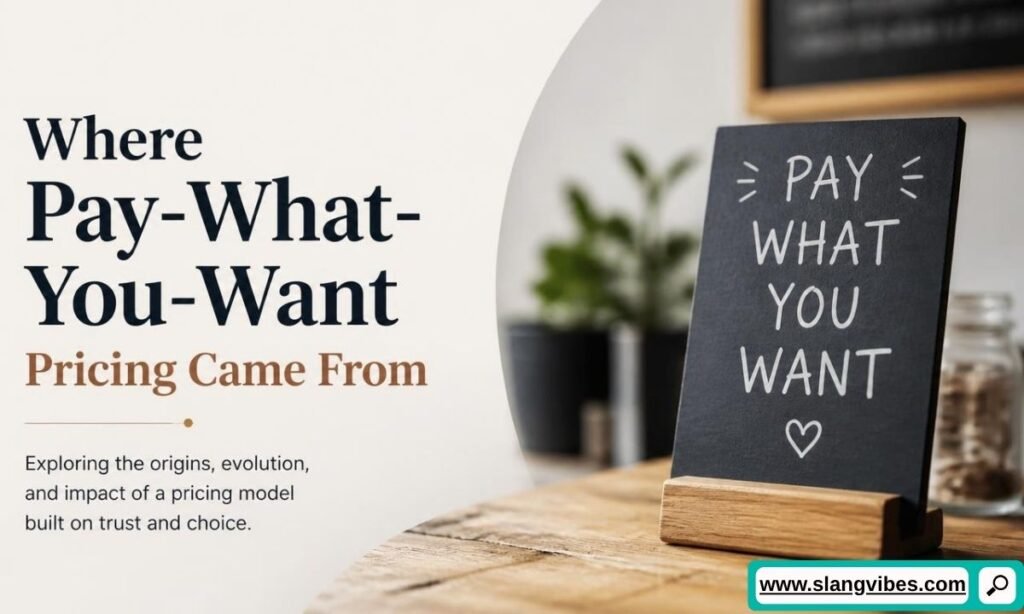
The pricing idea is older than the abbreviation. Wikipedia credits musician Jane Siberry with pioneering a self-determined pricing policy on her website. Buyers chose a standard price, paid now at their own price, paid later at their own price, or took a track as a gift.
The same entry lists Terra Bite Lounge, a coffeehouse in Kirkland, Washington, among the earliest known examples. It started in 1984 and used a pay what you want approach for its first year. Later, it switched to fixed pricing. Terra Bite’s switch shows sellers sometimes adjust when the model stops fitting.
The abbreviation itself has no documented origin. I found no source naming who first used PWYP. Someone shortened a familiar phrase, and the short form spread through bios and captions. Guessing a date or a platform would mislead you.
What matters for readers is simpler. Voluntary pricing has a long history in music, food, and community events. Community events often rely on goodwill, so the model fits them naturally. Each example treats the buyer as a partner, not a target. Digital downloads suit the model because extra copies cost sellers almost nothing. Seeing the PWYP meaning in text today connects to a model people have tried for decades. Knowing this helps you treat the abbreviation as an invitation, not a puzzle.
Read New Articles: DRS Meaning in Chat: What It Really Means in Text, Snapchat & Social Media (2026)
How to Reply When Someone Sends PWYP
A good reply matches the sender’s tone. Casual options include “Got it, I’ll send something over” or “Nice, checking it out now.” Funny options include “So I’m paying in good vibes?” Polite options include “Thanks for offering it this way, I’ll contribute.”
Picking an amount is the tricky part. Think about three things: what the product is worth to you, what the creator’s time deserves, and what fits your budget. Zero is sometimes allowed, so an honest “I’m short on cash this month” is fine. Sending something small still feels kind. A short thank-you note with the payment goes a long way.
Here’s a chat between a buyer and a creator.
Chloe: Hey, your template pack says PWYP. How does it work?
Marcus: You choose the price. Even zero is okay.
Chloe: Great, I’ll send ten dollars.
Marcus: Thank you! Sending the link now.
Marcus never pressures Chloe. Healthy PWYP moments feel relaxed on both sides. The buyer decides, the seller says thanks, and nobody feels judged.
If you aren’t sure what a fair amount looks like, check for a suggested price in the post. Many creators list one. You’re also free to ask politely. Sellers who use PWYP usually enjoy answering this question. Once you know the PWYP meaning in text, replying gets easier.
Common Mistakes With PWYP Meaning in Text
Misreading the PWYP meaning in text causes small but real problems. The first mistake is assuming it means free. Many sellers allow a zero payment, but they still hope for support. The second is assuming the transparency meaning in a pricing chat, or the pricing meaning in a news thread. The third is using PWYP in formal settings. A contract, invoice, or client quote needs a clear number, so flexible pricing shorthand looks vague there.
Common Mistake: Replying “thanks, free!” to a PWYP post. The seller chose a flexible price, not a zero price. Send what feels fair, or ask what the seller expects.
The fourth mistake is leaving the abbreviation unexplained. Picture yourself running a small shop. You write “PWYP” in your bio and receive five confused messages. One extra line fixes it: “PWYP means pay what you please.” Formal writing deserves the full phrase every time. Informal writing allows the short form once readers know the context.
A fifth mistake involves tone. Pushing buyers to pay more defeats the purpose of the model. If you sell this way, thank people warmly and skip the guilt trips. If you buy this way, pay in good faith and say thanks. Both sides benefit when the exchange stays friendly and clear.
Read Also: GL Meaning in Text: What Does GL Mean in 2026?
FAQ
What does PWYP stand for in text?
The PWYP meaning in text is usually “Pay What You Please,” a flexible pricing style. It also stands for Publish What You Pay and Practice What You Preach.
Is PWYP the same as PWYW?
Mostly yes. PWYW means Pay What You Want and is the standard abbreviation for the pricing model, while PWYP is a less common spelling of the same idea.
Does PWYP mean free?
Not by default. Buyers choose the amount, and zero is sometimes allowed, but sellers usually hope for fair support.
What does PWYP mean on social media?
On creator accounts, it usually points to flexible pricing for downloads, tickets, or services.
Does PWYP ever mean Publish What You Pay or Practice What You Preach?
Yes. Publish What You Pay is a transparency campaign for the extractive industries, and Practice What You Preach is a saying about matching actions to words. Context settles which one applies.
Reading PWYP With Confidence
PWYP looks like a typo until someone spells it out. In most chats about prices, downloads, or tickets, it stands for Pay What You Please, a pricing style where you choose the amount. Some writers prefer PWYW, which says the same thing with different letters. Outside of pricing, PWYP stands for Publish What You Pay, a transparency campaign, or Practice What You Preach, a saying about honesty in action.
Context settles it. Look at the money words, the sender, and the platform. When the clues clash, ask for the full phrase. Nobody minds the question, and you avoid a wrong reply.

Alex Carter is a language enthusiast and internet culture expert at SlangVibes. He explains the latest slang terms and text meanings in simple, clear English so everyone stays in the loop.