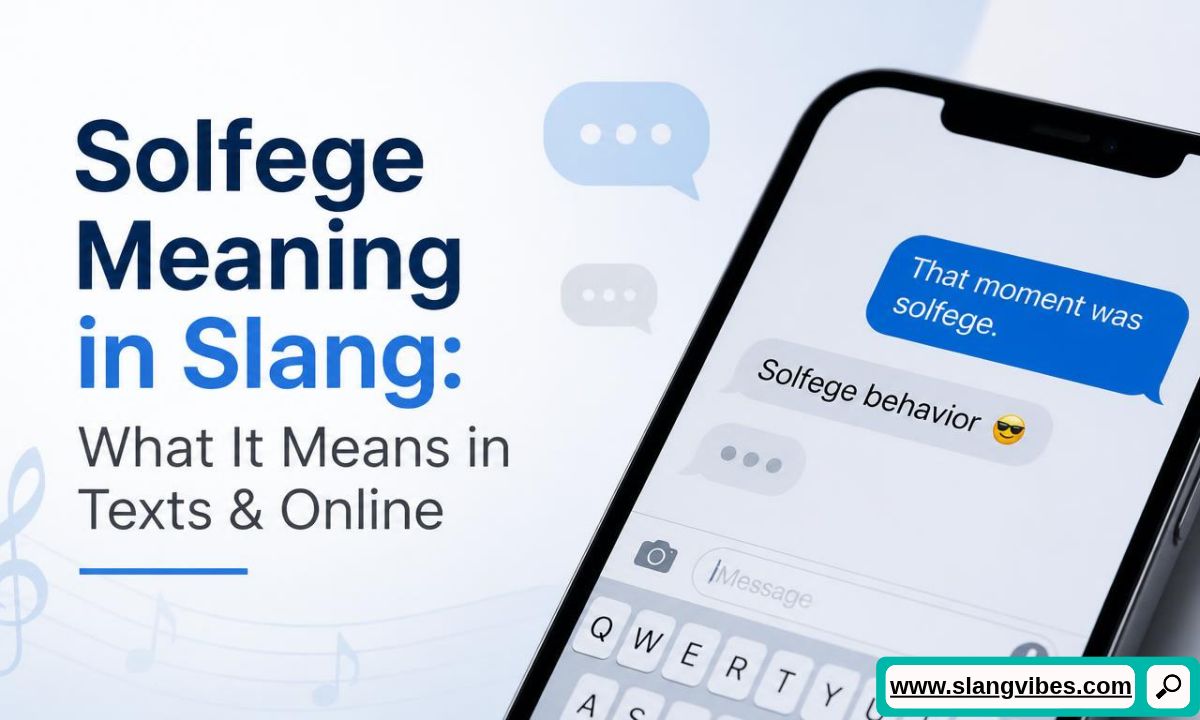
Last month, I spotted a comment under a choir video: “solfege era, no notes.” I assumed it was fresh internet slang. So I texted my friend Maya, who sang in choir for years. She replied with a full music lesson and three laughing emojis. Turns out I’d been guessing wrong. The solfege meaning is simpler than I expected, and it’s more fun than most textbook definitions. Here’s the thing: the word lives in two worlds at once. Music classrooms own it, and social feeds borrow it. This guide sorts out both sides, so you’ll know what someone means when they drop it in a caption or a chat.
Solfege Meaning: The Short Answer
The solfege meaning comes down to one idea: every note in a scale gets a singable name. Those names are do, re, mi, fa, sol, la, and ti. Then the pattern loops back to do. Singers use the syllables instead of letters like C, D, and E. It’s a shortcut for hearing how notes relate to each other.
Think of it this way. Saying “do, re, mi” feels like reading a melody out loud. Your voice learns the distance between pitches before your brain names them. Teachers lean on this method for sight-singing and ear training. Many kids meet it in school music class.
You’ll see the fifth syllable written as “sol” or “so.” Both name the same note. Pop, jazz, and folk singers use the system too, since the syllables label pitch, not style.
Here’s how it sounds in a real text thread.
Priya: Why are people commenting “do re mi” on my choir clip?
Dev: You sang the whole warmup in solfege.
Priya: So is it a compliment?
Dev: Mostly. It means they noticed you used the syllables.
How to Pronounce Solfege
Say it like SOL-fezh, with the stress on the first syllable. The ending sounds like the middle of “measure.” You’ll also see it spelled solfège with an accent mark. Both spellings work, and most people drop the accent in texts. Say it aloud twice and the sound sticks.
Read More: Pookie Meaning in Slang: The Cute Word Everyone Is Using in 2026
Is Solfege Slang or a Music Term?
The short answer is simple. Solfege is a music term, and it sits closer to a school subject than to internet slang. Still, plenty of people type solfege meaning in slang into Google. They spot the word in a caption or comment and assume it’s new.
Picture this. You’re scrolling through Reels and see a vocal coach post with “solfege check” in the caption. Nothing in the video sounds like slang. The coach sings do, re, mi over a piano and asks followers to sing along. The word is doing its normal job.
Now picture a different scene. A friend texts “my solfege skills peaked in fifth grade” under a meme about school choir. Here the word carries a joke, but the definition stays the same. The humor comes from the shared memory of class.
Here’s the pattern you’ll see online. Solfege stays a music term, and people wrap jokes, nostalgia, and bragging around it. Many people notice the word rarely changes meaning from platform to platform. The tone shifts instead. A tutorial sounds helpful, a meme sounds silly, and a caption sounds proud.
So if someone asks whether solfege counts as slang, call it a borrowed term. Social media picked it up because everyone recognizes do, re, mi. Many adults who never touched an instrument still get the reference.
Read New Article: WFH Meaning: What It Stands for in Texts, Chats, and at Work (2026 Guide)
Where the Solfege Meaning Comes From
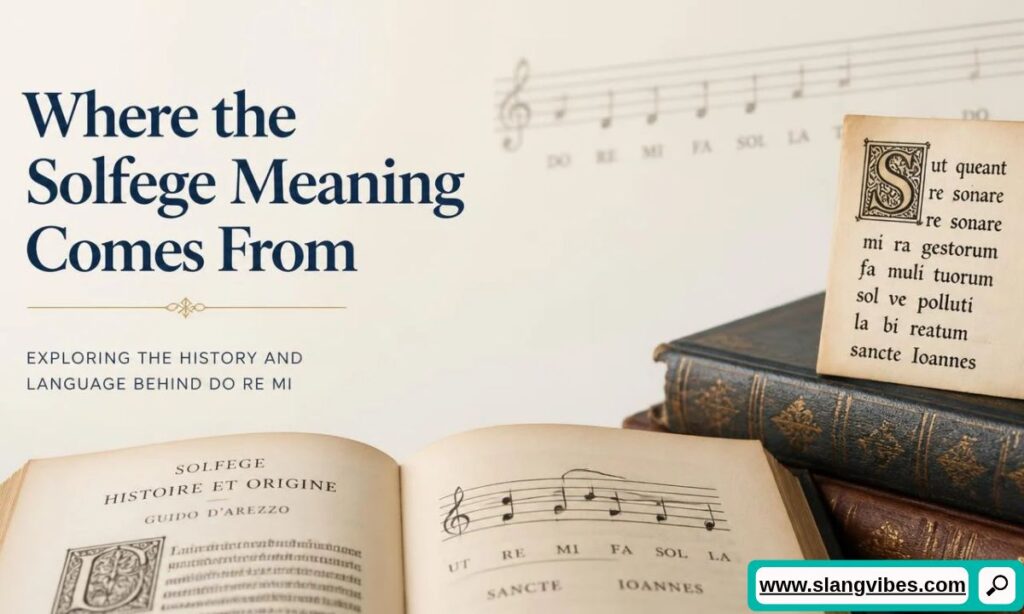
The solfege meaning traces back almost a thousand years. An Italian monk named Guido of Arezzo worked in the 11th century. He wanted choir singers to learn new chants faster.
His trick used a Latin hymn to Saint John the Baptist. Each line of the hymn started on a higher note. Guido took the first syllable of each line and gave it to the matching note. The result was ut, re, mi, fa, sol, la.
Over time, “ut” became “do,” which is easier to sing. The seventh syllable, “ti,” arrived later to complete the scale. Teachers also added hand signs for each syllable. Educator John Curwen popularized a version in the 1800s, and many choir classes still use hand signs today.
Fun Fact: The word solfege itself blends sol and fa, two of the syllables.
Pop culture gave the system a second life. The song “Do-Re-Mi” from The Sound of Music debuted on Broadway in 1959. The 1965 film carried it to movie screens worldwide. Many people first heard the syllables there. Many people still hum it decades later.
Picture two coworkers on a lunch break.
Nate: Wait, monks invented do re mi?
Alicia: One monk, yes. Guido of Arezzo, around the 1000s.
Nate: Why did he bother?
Alicia: Choirs needed a faster way to learn new songs.
Nate: Fair. Best teaching hack ever.
Solfege in Texts and on Social Media
Online, the solfege meaning stays steady while the tone shifts by platform. You’ll meet the word in captions, comments, and music forums. Short video apps lean playful. Forums lean detailed. Text chats lean casual and nostalgic, based on how the term is typically used.
This table shows common phrasing and what each one signals.
| Example | Meaning | Tone/Vibe |
|---|---|---|
| “solfege check” | Sing along using the syllables | Playful |
| “do re mi this melody” | Break a tune into syllables | Educational |
| “my solfege trauma” | Bad memories of choir drills | Sarcastic |
| “solfege queen” | Someone skilled at ear training | Admiring |
| “movable do changed my life” | Praise for a learning method | Enthusiastic |
Emoji choices add extra clues. A musical note or microphone usually signals pride or a tutorial. A crying face or skull points to school choir memories. Sparkles suggest a warm, encouraging post.
Subreddits like r/musictheory and r/singing host longer solfege debates. Users compare fixed and movable do and swap lesson tips. Teachers post lesson plans, and learners post progress updates. Discord music servers work the same way, with quick ear-training questions.
In private texts, solfege shows up when friends talk about music or joke about school. Nobody treats it like a code word. If a friend says “I’m doing solfege before bed,” picture a vocal warmup. A quick “nice” or a music emoji works as a reply.
Read More: IYKYK Slang Meaning: The Internet Phrase You Need to Know
How Different Generations Use Solfege
The solfege meaning stays the same across age groups, but the memories attached to it differ. It’s common to see each generation bring its own angle.
Many millennials tie solfege to school choir and elementary music class. Group chats often fill with hand sign jokes and warmup memories. Gen Z tends to meet the word through tutorials, singing videos, and ear-training content. Older readers often link it to The Sound of Music, where “Do-Re-Mi” taught the syllables in one bouncy song.
Readers in the UK often know the older name sol-fa too. Tonic sol-fa, a movable-do method tied to John Curwen, spread through British choirs in the 1800s. US readers usually hear plain “solfege” or “do re mi” instead. Either way, the syllables match.
Parents and teens sometimes trade notes on it. Here’s a sample exchange.
Mom: Why are you humming do re mi in the kitchen?
Leo: Solfege practice for choir tryouts.
Mom: We sang this in school too.
Leo: Same syllables, new playlist.
Mom: Show me the hand signs.
Leo: Only if you sing with me.
Solfege links generations because the syllables still sound familiar. Only the way people share them changed. Older learners leaned on classrooms and sing-alongs. Younger learners lean on short videos and group chats. A shared warmup memory needs no lecture or long explanation.
Solfege vs. Note Names, Sargam, and Related Terms
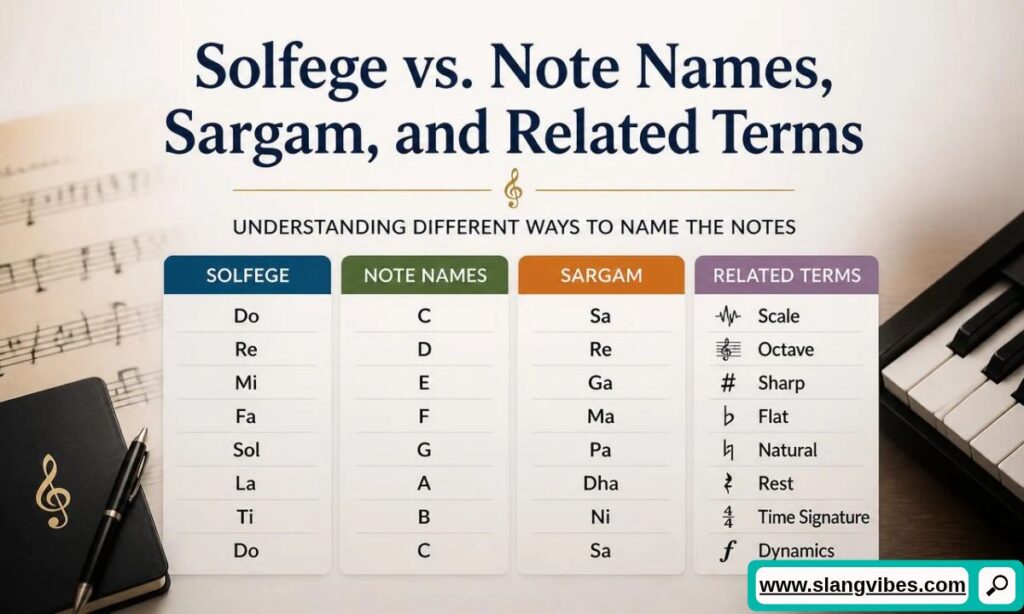
The solfege meaning gets clearer next to its neighbors. Each related term covers a different job. Here’s a quick comparison.
- Note names: Letters like C, D, and E label exact pitches on an instrument. Solfege labels a note’s role inside a scale.
- Sargam: The syllable system in Indian classical music, sung as sa, re, ga, ma, pa, dha, ni. It serves a similar teaching purpose.
- Sight-singing: Singing music straight from the page. Singers often pair it with solfege syllables.
- Ear training: Learning to identify pitches and intervals by ear. Solfege is one popular tool for it.
- Fixed do: The syllable do always means C. This version is common in countries such as France and Italy.
- Movable do: The syllable do matches the key’s home note. This version is common in many US classrooms.
Think of it this way. Letter names tell you where a note lives. Solfege tells you what job the note does in the song.
In France, “solfège” also names the broader music theory course students take. A French friend saying “I did solfège for years” means years of theory and ear training, not only singing syllables.
Fixed and movable do also explain why two singers might use different syllables for the same note. Neither system is wrong. They serve different goals. Choose the one your teacher uses and stay consistent.
Read New Article: BBG Meaning: Slang Definition, Text Uses & Examples (2026)
Common Solfege Mistakes to Avoid
Even music lovers trip over the solfege meaning at first. Most mistakes come from mixing up nearby ideas. Here are six.
First, many people treat “do re mi” as the whole system. It only names the first three syllables. Solfege covers seven, plus the pattern back to do.
Second, people mix up fixed and movable do. Two singers might sing different syllables for one note and assume someone made an error. Both follow a valid system.
Third, some treat solfege as a music genre or a fancy word for singing. It labels notes. It doesn’t describe a style or a voice type.
Fourth, people drop the term into unrelated chats. Calling a random topic “so solfege” confuses everyone.
Fifth, people sometimes read a solfege comment as criticism. A “solfege check” or “solfege queen” usually reads as playful praise.
Sixth, learners expect instant results. Solfege takes regular practice, like any new language. Short daily sessions feel easier to keep up than rare long ones. Spelling matters less. Solfege and solfège both look fine.
Here’s a group chat mix-up.
Jess: Anyone have a good solfege playlist?
Omar: Is solfege a genre?
Jess: It’s the do re mi system. I want songs to practice with.
Omar: Oh, ear-training songs. Got it.
Spot these six, and you’ll sound fluent fast. Group chats forgive small slips.
When to Use Solfege, and How to Respond
Knowing the solfege meaning helps you decide when to use the word. The rule is simple: match the setting. Here’s a quick guide.
Use solfege when:
- You’re explaining the solfege meaning to a curious friend
- You’re posting singing tips or tutorials
- You’re joking about school music class with people who share the memory
Skip it when:
- The chat has nothing to do with music
- You would need to explain it to sound clever
- You want to sound casual around people outside music circles
How to Respond to a Solfege Post
Replies depend on the tone. If someone posts “solfege check,” sing along or drop a music note emoji. If a friend jokes about choir trauma, share your own story, If a coworker asks what it means, keep the answer short. Say it’s the do re mi system for naming notes.
Picture a few quick scenes. A teammate mentions solfege while planning a jingle for a client video. Ask which notes they hear. A cousin posts a solfege reel from her voice lesson. Leave a clapping emoji. A stranger comments “solfege trauma” under a school concert clip. Reply with a laughing face and your own warmup memory.
Tone matters more than vocabulary here. Match the energy of the post, and your reply will land well. Curious follow-up questions tend to start good conversations. Keep replies warm and short.
Read Here: Poignant Slang Meaning: What It Really Means in Text and Chat
Solfege FAQ
What does solfege mean in simple terms?
The solfege meaning is a system of syllables (do, re, mi, fa, sol, la, ti) used to name and sing musical notes.
Is solfege slang?
No. Solfege is a music term, and people borrow it online for jokes, captions, and tutorials.
Is solfege the same as do re mi?
Do re mi are the first three syllables. Solfege includes all seven, plus the return to do.
What’s the difference between fixed do and movable do?
Fixed do always sets do as C. Movable do shifts do to match the key’s home note.
How do you pronounce solfege?
Say SOL-fezh, with the stress on the first syllable.
Final Thoughts on Solfege
So here’s the full picture. Solfege is a centuries-old system for giving musical notes singable names. The solfege meaning stays steady from choir rooms to comment sections, and only the tone changes. It works in a lesson, a joke, or a brag.
Monks built it to teach chants faster. Movies helped make it famous. Short videos keep it alive for a new crowd. This history explains why a teaching method from the 11th century still feels familiar in a group chat.
You now know what the word means, where it came from, and how people use it. You also know its cousins, from sargam to fixed do, and the mistakes worth skipping.
Bottom line: when you see solfege in a caption or text, think music first and slang second. Reply with warmth, match the tone, and keep it short. Next time a friend mentions do, re, mi, hum along. You’ll fit right in.

Alex Carter is a language enthusiast and internet culture expert at SlangVibes. He explains the latest slang terms and text meanings in simple, clear English so everyone stays in the loop.