I still remember the first time I saw “STSU” pop up in a group chat. A friend sent it after I told a joke that wasn’t even that funny, and I just stared at my phone for a solid minute. Was she mad? Was it a compliment? I had no idea, so I did what every confused person does now: I googled it. If you’re here for the same reason, you’re in the right place. This guide breaks down the STSU meaning in text so you never have to send that awkward “wait what does that mean” reply again.
Texting slang moves fast, and STSU is one of those terms that slipped into everyday chat without much warning. It shows up in comments, DMs, and group threads, and depending on who sends it, it can feel playful or sharp. So before you reply with a confused emoji, let’s get into what this texting acronym actually means and how to read the tone behind it.
STSU Meaning in Text: The Real Definition
The STSU meaning in text usually comes down to “Shut The Stuff Up,” with “stuff” standing in for a stronger word people would rather not type out. In plain terms, someone is telling you to stop talking, stop joking, or just pump the brakes for a second.
That said, the words on the screen rarely tell the whole story. This piece of chat abbreviation depends heavily on who sent it and why. Here’s how it usually breaks down:
- A teasing nudge between close friends
- A surprised reaction to something unexpected
- A sharper, more serious request to stop
So while the letters stay the same, the feeling behind them shifts based on context. That’s actually true of a lot of internet slang, not just this one term.
| Example / Context | What It Means / How It Feels |
|---|---|
| “STSU 😭 you did NOT just say that” | Shocked, amused, fully playful |
| “STSU. I mean it.” | Serious, possibly annoyed |
| “lmaooo stsu rn” | Light teasing, no real anger |
Once you start noticing the pattern, the STSU meaning in text becomes a lot easier to read at a glance.
STSU Meaning in Text: Where It Came From
Every piece of texting language has a starting point, and STSU likely grew out of gaming chats and Discord servers before it spread to bigger platforms. Players needed quick, short ways to react mid-match, and full sentences slow things down. From there, it spilled into TikTok comment sections, where reaction-based abbreviations spread fast.
Unlike older internet abbreviations that took years to catch on, STSU rode the wave of short-form video culture. A viral clip gets thousands of comments in minutes, and people reach for the shortest reaction possible. STSU fit that need perfectly because it’s quick to type and carries real emotion behind it.
It also softened a harsher phrase that already existed in online chat slang. Instead of typing something blunt, people swapped in “stuff” as a workaround, which made it feel less aggressive while still getting the point across. That’s a common move in digital slang: take something sharp, round off the edges, and let tone fill in the rest.
By 2026, STSU sits comfortably inside the wider world of Gen Z slang, even though plenty of Millennials use it too. It’s not as old as “LOL,” but it’s carved out a steady spot in casual texting.
Read More: HN Social Media Meaning: What It Really Means on TikTok, Instagram & Snapchat (2026)
STSU Meaning in Text on Facebook, TikTok, and Instagram
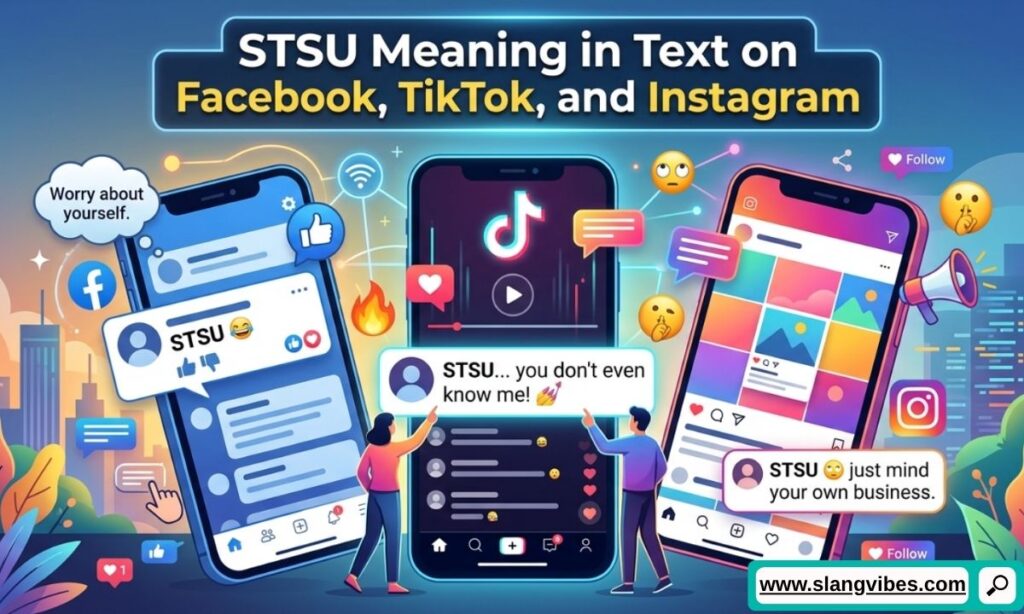
Here’s where things get interesting: the STSU meaning in text can shift slightly depending on which app you’re using. Each platform has its own rhythm, and STSU adapts to fit.
On TikTok, it usually shows up in comments under surprising or chaotic videos.
Conversation example 1: Friend: “wait the dog actually did that 😭” You: “STSU that’s wild”
On Instagram, it leans more playful, often tucked into replies on Stories or posts.
Conversation example 2: Friend: “I got engaged!!” You: “STSUUU congrats omg 😭❤️”
On Facebook, where the audience skews a bit older, STSU shows up less often, and when it does, it tends to read more literally.
Conversation example 3: Cousin: “Mom said she’s selling the house” You: “STSU wait seriously??”
On regular text messaging or WhatsApp, tone depends entirely on the relationship.
Conversation example 4: Roommate: “I ate your leftovers lol” You: “STSU you did NOT”
Across every platform, capital letters, repeated vowels, and emojis push the meaning toward shock or excitement rather than anger. Without those cues, the same three letters can read a lot colder.
STSU Meaning in Text: Playful or Rude?
Reading tone through text is tricky, and this is exactly where most people get tripped up. A short message like STSU carries almost no built-in emotion, so you have to lean on the small details around it.
Before jumping to conclusions, check these signals first:
- Punctuation: periods feel firmer, exclamation points feel lighter
- Emojis: laughing or crying-laughing emojis soften it instantly
- Capitalization: “STSUUU” usually reads as excited, not angry
- Timing: a quick reply during a joke feels playful; a delayed one during tension feels serious
| Signal | Likely Meaning |
|---|---|
| “stsu 😂😂” | Playful, amused |
| “STSU.” | Annoyed or serious |
| “stsuuuu no way” | Shocked, excited |
| “stsu, I’m not playing” | Firm, possibly upset |
When in doubt, the safest move is to read the rest of the conversation rather than judging the abbreviation by itself. Context almost always wins.
STSU vs Similar Texting Slang (STFU, SH, NS, TS)
People often lump STSU in with harsher chat abbreviations, but there are real differences worth knowing. Mixing these up can change how a message lands, so it helps to see them side by side.
- STFU is the more aggressive, explicit cousin of STSU
- SH (shush) feels softer and more lighthearted
- NS (no shot) expresses disbelief without telling anyone to stop talking
- TS (that’s tough or that stuff) shifts the focus entirely to sympathy or sarcasm
| Term | Meaning | Tone Level |
|---|---|---|
| STSU | Stop talking / shut it | Medium |
| STFU | Stop talking (explicit) | High/harsh |
| SH | Be quiet | Low/playful |
| NS | No way, that’s surprising | Neutral |
| TS | That’s tough / that stuff | Varies |
Knowing these differences matters more than people think. Sending STFU instead of STSU to the wrong person can come across far harsher than intended, even if you meant it as a joke.
Gen Z vs Millennial Use of STSU (US & UK Differences)
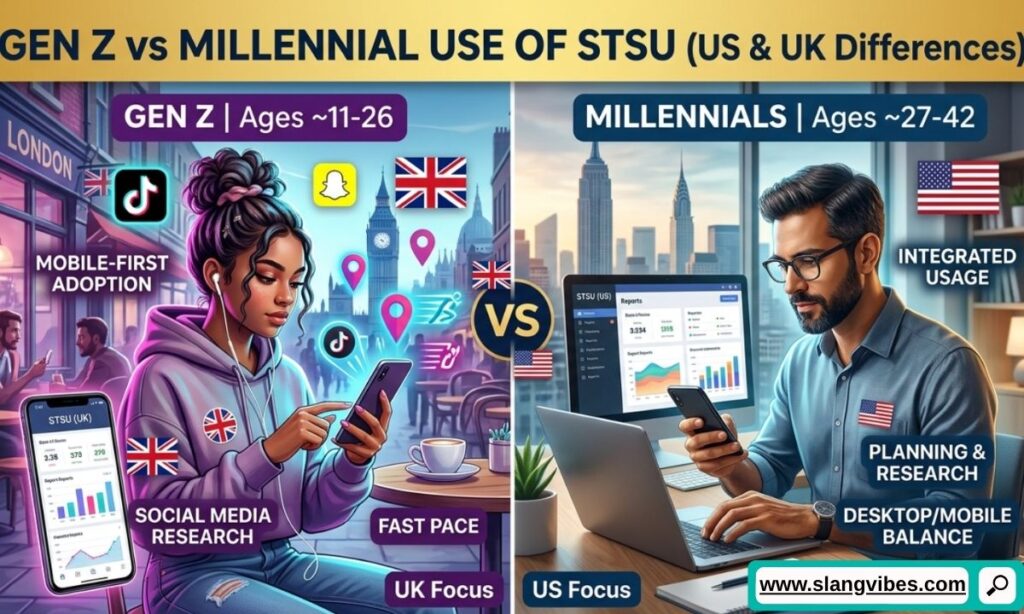
Texting habits shift across generations, and STSU is a solid example of that gap. Gen Z tends to use it constantly, often stripped of any real heat, almost like punctuation for a joke. Millennials, on the other hand, use it a bit less and are more likely to read it literally rather than playfully.
Regional differences matter too. In the US, STSU shows up across casual texting and social media comments without much hesitation. In the UK, similar sentiments often get expressed through phrases like “shut it” or “give over,” which carry a similar tone but feel a touch more traditional.
Conversation example 5: US friend: “STSU that’s actually wild” UK friend: “Shut it, no way 😂”
Both phrases land the same emotional punch, just through different slang dictionaries shaped by culture. So if you’re texting across the pond, don’t be surprised if STSU gets a confused reaction from someone who’s never seen it before. It’s still catching on outside the US.
Read Also: LMS Meaning in Text: What It Really Means on Snapchat, TikTok & Instagram (2026)
When You Should Never Use STSU (Texting Etiquette)
As fun as this term is, there are places it simply doesn’t belong. Sending it in the wrong setting can come across as disrespectful, even if that’s not the intent behind it.
Avoid using STSU in these situations:
- Work emails, Slack messages, or professional chats
- Conversations with someone you’ve just met
- Family group chats with older relatives unfamiliar with online chat slang
- Customer service exchanges
- Any message where tone could easily be misread
Professional settings call for clear, polite language, not abbreviations that rely on tone to soften their meaning. A coworker who doesn’t know the term might take it as a genuine insult rather than a joke. When in doubt, save STSU for friends who already understand your texting style.
How to Respond to STSU (Real Reply Examples)
Knowing how to reply matters just as much as knowing what it means. The right response depends entirely on how the message felt when you read it.
If it feels playful, lean into it:
- “lol make me”
- “you know it’s true though”
,now If it feels rude or sharp, it’s fine to address it directly:
- “no need to be harsh”
- “what’s going on, you good?”
, If you’re genuinely unsure, asking is always the safer route:
- “wait are you joking or serious lol”
Reacting calmly gives the other person room to clarify, rather than escalating something that might’ve just been a joke gone slightly flat over text.
Does STSU Mean Anything Outside Texting? (Quick Answer Box)
Quick Answer: Outside of texting and social media slang, STSU doesn’t have a widely recognized meaning in fields like medicine, physics, or aviation. It occasionally appears as a school or organization abbreviation (some universities use similar letter combinations), but that’s unrelated to the texting version. If you spot it somewhere unexpected, the context around it will usually make the real meaning clear.
Read New Article: TY Meaning in Text: How People Use It on WhatsApp, TikTok & More
Frequently Asked Questions
It can be, but it’s not always meant that way. Among friends, it usually reads as playful teasing rather than a genuine insult, though tone and context decide that.
In the UK, phrases like “shut it” or “give over” carry a similar meaning. STSU itself is still more common in American texting culture.
No, it’s best to avoid it entirely in professional settings. It reads as too casual and risks coming across as disrespectful.
Gen Z uses it more frequently and casually, often without any real emotion behind it. Millennials use it less and tend to take it more literally.
A simple, direct question works best, something like “wait are you serious or joking lol.” It clears up the confusion without assuming the worst.
Final Thoughts
At the end of the day, the STSU meaning in text really comes down to tone, timing, and who’s sending it. It can be a lighthearted joke between friends or a sharper request to stop, and the only real way to know is by reading the full conversation around it. So the next time it lands in your inbox, take a breath, check the context, and respond accordingly. Once you get the hang of it, this little piece of online chat slang stops feeling confusing and starts feeling like second nature.

Alex Carter is a language enthusiast and internet culture expert at SlangVibes. He explains the latest slang terms and text meanings in simple, clear English so everyone stays in the loop.