My friend sent me a voice note laughing so hard she barely spoke. All because I replied “huh?” when someone dropped SYBAU meaning in text into our group chat. Everyone else carried on like nothing happened. I sat there refreshing my brain, wondering if I’d missed some major cultural moment. Sound familiar? You’re not alone. SYBAU is one of those acronyms that Gen Z and Millennials throw around constantly, and if you don’t know it, the conversation moves on without you. So here’s the full breakdown of what SYBAU means in text, where it came from, and how to use it without looking confused.
What Does SYBAU Mean in Text?
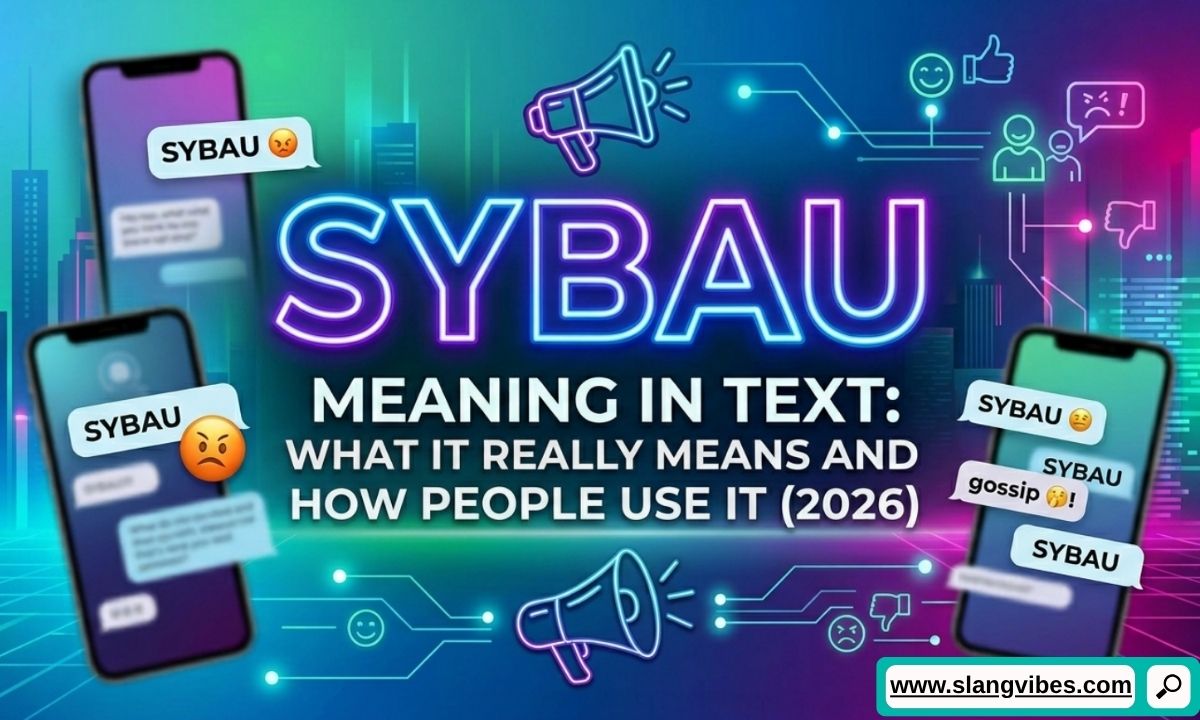
The SYBAU meaning in text is “Shut Your B*h A Up.” It’s a blunt, aggressive-sounding acronym used in texting and online chats to tell someone to stop talking, stop complaining, or stop being annoying. On the surface, it sounds harsh. In practice, though, context changes everything.
Quick Answer: SYBAU stands for “Shut Your B*h A Up.” It’s used in casual texting, mostly between close friends, as either a sharp clap-back or a jokey way to hype someone down.
The SYBAU acronym meaning sits in the same family as STFU (Shut The F*** Up), but it carries a slightly different energy. STFU is more widely understood and often used semi-seriously. SYBAU, on the other hand, leans more into internet slang culture and tends to show up where the tone is already playful or heated. The SYBAU text meaning shifts depending entirely on who’s saying it and why.
When you see this in your messages, the first thing to do is read the tone of the conversation. Is the person laughing? Are they genuinely annoyed? Those two situations call for completely different responses.
Where Did SYBAU Meaning in Text Come From?
To understand the SYBAU slang meaning fully, it helps to know where it came from. The acronym grew out of early-2000s internet culture, where abbreviations were king and nobody had time to type full sentences. SMS character limits pushed people to shorten everything, and dismissive phrases like “shut up” became natural candidates for acronym treatment.
The term gained real momentum through Black Twitter and Black internet culture, where sharp, rapid-fire clapbacks are practically an art form. Platforms like Tumblr and early Twitter helped spread dismissive slang to wider audiences. By the time TikTok took over as the dominant platform for Gen Z communication, phrases like SYBAU were already embedded in online vocabulary.
What’s interesting is that the phrasing “b*h a” as an intensifier has roots in African American Vernacular English (AAVE), where it functions more as an adjective than a true insult. That context matters. When someone who grew up using AAVE drops SYBAU in a group chat, it often reads quite differently than the written words suggest. It’s a cultural product first, and a rude comment second, if at all.
The shift from niche internet slang to mainstream texting happened fast. By 2022 and 2023, SYBAU was appearing regularly in comment sections, reaction memes, and Snapchat conversations across the US and UK.
How People Use SYBAU Meaning in Text and Online Chats
Now let’s get into the part where the SYBAU meaning in text comes alive: how people use it in conversation. The tone ranges from warmly teasing to genuinely fed up, and the examples below show exactly what that looks like.
Here are five real-style text conversations showing SYBAU in action:
Read Also: DND Meaning in Text: What It Really Means on Snapchat, TikTok & Instagram (2026)
Example 1: Playful Banter Between Friends
Jordan: I’ve been to the gym three days in a row now Sam: SYBAU lmaooo nobody asked Jordan: 😭 rude
2: Clapping Back at Oversharing
Priya: Wait he texted again?? What did he say? Mel: Okay so first he said he was busy but THEN he kept texting Priya: SYBAU and tell me what happened next
3: Reacting to Bragging
Tyler: I finished the whole series in one night, it wasn’t even that good Dani: SYBAU you stayed up till 4am for something “not that good” 💀
4: Genuine Frustration
Group Chat Member: Everyone agreed on this plan, stop complaining Alex: SYBAU nobody agreed, you decided [everyone goes quiet]
Now Example 5: Self-Directed Humor
Nia: Me: “I won’t spend money this week.” Also me: adds 6 things to cart SYBAU Nia 😭
As you see, the SYBAU meaning in chat ranges from a lighthearted laugh to a sharp shutdown, and sometimes it’s even aimed inward as self-deprecating humor.
SYBAU on Social Media: TikTok, Instagram, Snapchat, and Twitter/X
The SYBAU meaning on TikTok is where things get especially interesting. On TikTok, SYBAU appears mostly in comment sections, often as a reaction to someone saying something obvious, overconfident, or unnecessarily dramatic. When a creator posts a hot take and the comment section floods with “SYBAU” replies, it’s usually a collective eye-roll rather than genuine anger.
The SYBAU meaning on Instagram works similarly, popping up in comment replies and DMs when someone’s being extra or oversharing in their stories. Since Instagram skews slightly older than TikTok, you’ll see it more among Millennials who’ve picked it up from younger siblings or the algorithm.
The SYBAU meaning on Snapchat feels more intimate. Because Snapchat is primarily one-on-one or small group communication, SYBAU there tends to be more personal. It shows up in streaks, quick reactions, and inside jokes between people who know each other well.
On Twitter/X, the term functions almost like punctuation in discourse. Somebody makes a wild claim, and a reply with “SYBAU” cuts the conversation short. It’s economical and pointed.
What separates SYBAU meaning in texting from its social media use is scale. In a private message, it’s a personal exchange. In a public comment section, it becomes a performance for whoever’s watching.
When SYBAU Is Funny vs. When It Crosses a Line
Here’s the thing: SYBAU meaning in text isn’t inherently rude or inherently harmless. The same four letters land completely differently depending on relationship, tone, and context. That’s the part most people miss.
The table below breaks down the key differences:
| Playful Use | Aggressive Use |
|---|---|
| Between close friends who regularly roast each other | Directed at someone during a heated argument |
| Followed by a laughing emoji or “lmaooo” | Sent with no emoji, often in all caps |
| Response to harmless bragging or oversharing | Response to a genuine complaint or sensitive topic |
| Part of ongoing banter in a group chat | Aimed at silencing someone who’s expressing feelings |
| Used in memes or self-directed humor | Used to dismiss or belittle someone |
When SYBAU shows up in the first column, it’s a sign of comfort and familiarity. When it slides into the second column, it becomes something worth addressing. People who don’t share that level of closeness with you sending SYBAU will feel dismissive or aggressive, even if they didn’t intend it that way.
So before you send it, think about your relationship with the recipient and the current mood of the conversation.
Read More Article: NGL Meaning in Text: What It Really Means + Examples (2026)
SYBAU vs. Other Dismissive Slang Terms
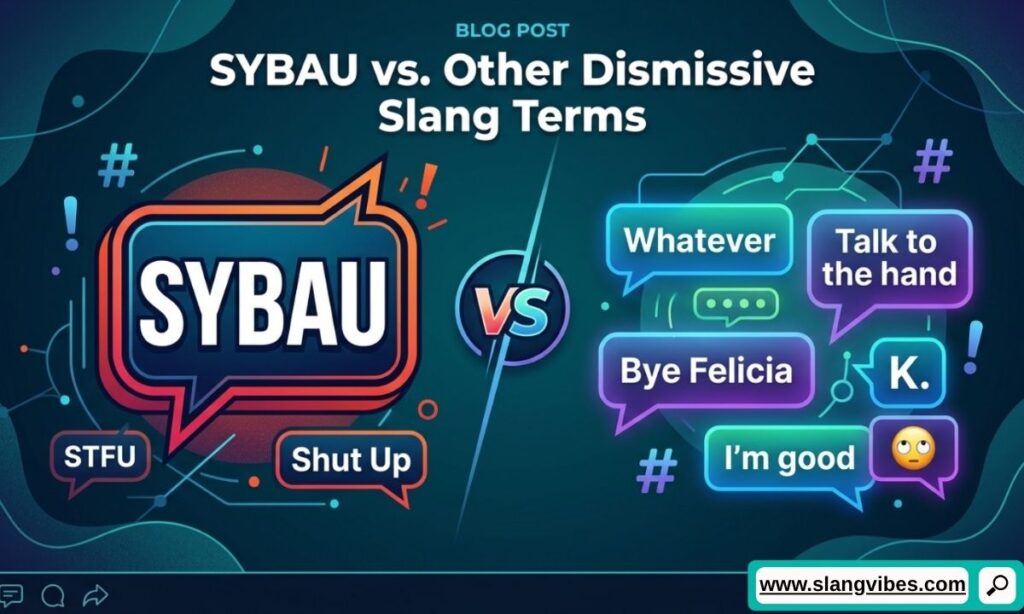
Understanding the SYBAU slang meaning gets easier when you see how it stacks up against other similar terms. Each one carries its own weight and fits different moments.
| Term | What It Means / How It Feels |
|---|---|
| SYBAU | “Shut Your B*h A Up”: sharp, more intense, often playful between friends |
| STFU | “Shut The F*** Up”: widely understood, more universal, slightly less aggressive in practice |
| SYB | “Shut Your B***h”: shorter, slightly more casual, less common |
| BYE | Dismissal through exit, lower energy, often used as a reaction to something absurd |
| IDGAF | “I Don’t Give A F***”: expresses indifference rather than telling someone to stop |
| OK and? | Dismissal of a point, Gen Z staple, dripping with unbothered energy |
The SYBAU acronym meaning sits at the sharper end of this spectrum. It’s more specific than STFU and more intense than a simple “BYE.” When someone reaches for SYBAU over the others, they’re usually going for maximum effect, whether comedic or otherwise.
How to Respond When Someone Sends You SYBAU
Getting SYBAU in a text will throw you off if you’re not expecting it. The right response depends on the situation, and there are three common ones.
Scenario 1: They’re clearly joking. This is the most common scenario. If the conversation has been light, there are emojis involved, and you two regularly trade jokes, they’re not genuinely trying to shut you down. Respond in kind. Match the energy with something like “make me” or a string of laugh-crying emojis.
Scenario 2: They’re genuinely annoyed. If the tone of the conversation had been tense before the SYBAU arrived, it’s worth pausing. You don’t need to escalate. A short “ok noted 😐” or simply leaving them on read for a bit is a perfectly valid response.
Scenario 3: You’re not sure. When context isn’t clear, a simple “lol what did I do” works well. It’s light enough to stay casual if they were joking, but direct enough to get clarification if they weren’t.
The worst response in any scenario is getting deeply offended without checking the tone first. Given how often SYBAU shows up in purely comedic contexts, jumping to anger is usually the wrong move.
Should You Use SYBAU? Who Actually Says This and When
Knowing the SYBAU meaning in text is one thing. Knowing whether you should use it is something else entirely. The honest answer depends on your age, your relationship with the recipient, and the platform you’re on.
Gen Z users, generally those born between the late 1990s and early 2010s, use SYBAU freely and often. For them, it’s a standard part of digital vocabulary. It carries no more weight than “oh shut up” does in person.
Millennials, on the other hand, tend to use it more selectively. Some have adopted it fully, especially those who spend a lot of time on TikTok or in spaces where Gen Z language dominates. Others find it too aggressive-sounding and stick to STFU or simple “bye.”
If you’re texting someone you don’t know well, or someone who might read it at face value, hold off on SYBAU. The same goes for workplace messaging apps. Even informal Slack channels at work aren’t the place for it. And if the person you’re texting has been genuinely upset or vulnerable in the conversation, SYBAU is the wrong tool for the moment.
The sweet spot for SYBAU is a close friend who shares your communication style, in a casual platform like iMessage, Snapchat, or a group chat where the vibe is already playful.
Read New Article: MLM Meaning in Text: What It Really Means on Snapchat, TikTok & Instagram (2026)
Frequently Asked Questions
It means the same thing regardless of who sends it: “Shut Your B*h A Up.” If a girl sends it in a jokey tone, it’s playful. If it comes without context or warmth, take a moment to check the overall vibe of the conversation.
It depends entirely on context and relationship. Between close friends in a roast session, it’s usually harmless humor. Directed at a stranger or sent during a sensitive moment, it reads as genuinely dismissive or aggressive.
On TikTok, SYBAU typically appears in comment sections as a reaction to someone saying something over-the-top, obvious, or unnecessarily dramatic. It functions more like a collective eye-roll than a genuine attack.
SYB stands for “Shut Your B*h” while SYBAU adds “A Up” for extra emphasis. SYBAU is the more complete and commonly used form, and it hits harder in tone than the shorter version.
Use it when you want to playfully shut someone down in a friendly roast, react to obvious bragging, or clap back at something absurd. Always make sure the other person knows you’re joking, unless you genuinely want to end the exchange.

Alex Carter is a language enthusiast and internet culture expert at SlangVibes. He explains the latest slang terms and text meanings in simple, clear English so everyone stays in the loop.