My friend Kayla sent a voice note in our group chat last summer. It started as a quick update about her weekend. Two minutes in, she was describing her stomach bug in full detail. Before I could even put my coffee down, three of us had already typed the same thing: “TMI.” If you’ve ever wondered about the TMI meaning in text, that moment explains it perfectly. Three letters. Zero confusion. Instant shared understanding.
If you’ve ever seen TMI meaning in text and wondered what it signals, why people use it, and how Gen Z has made it into something even sharper, you’re in the right place. This guide covers all of it, from the original meaning to the way it shows up in TikTok comments in 2025.
What Does TMI Mean in Text? (The Short Answer)
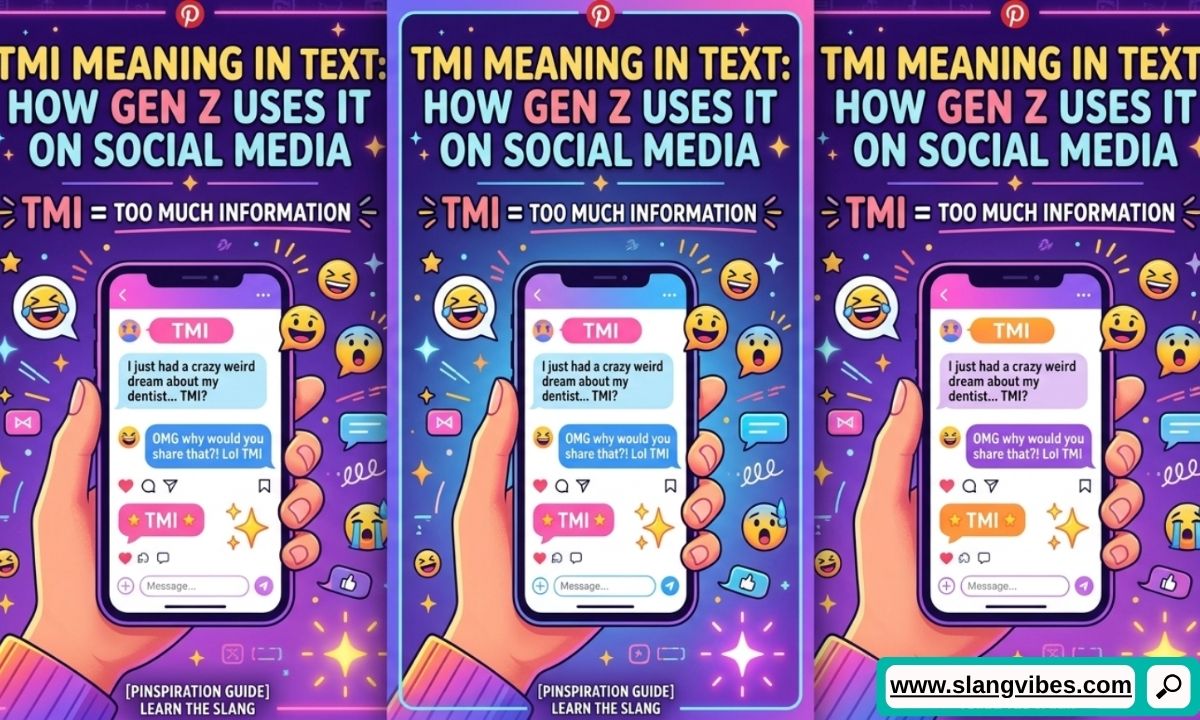
The TMI meaning is simple: it stands for “Too Much Information.” As a result, it’s used when someone shares more personal detail than their audience needed, wanted, or expected. The phrase existed in spoken English long before smartphones, but texting gave it new life as a three-letter shorthand that fit perfectly in a chat bubble.
Here’s the thing about TMI text meaning: it’s not always negative. The tone shifts depending on your relationship with the person, the platform you’re on, and how it’s typed.
Quick Answer: TMI = Too Much Information. It signals that someone has shared more detail than the conversation called for, and it works as both a reaction and a gentle boundary.
Here’s a quick look at what the TMI acronym communicates in different situations:
| Context | What TMI Signals |
|---|---|
| Friend sharing health details | Playful, no hard feelings |
| Stranger oversharing in DMs | Mild discomfort or awkwardness |
| Group chat confession | Surprise, humor, shared reaction |
| Dating app conversation | A polite pump-the-brakes moment |
Since TMI lands differently based on tone, knowing how to read those signals matters as much as knowing the definition itself.
Where Did TMI Come From? (The Origin of the Slang)
The TMI meaning in text didn’t start with texting. People were already saying “that’s too much information” in everyday conversation well before the internet existed. It was a natural way to stop someone mid-story when the details got uncomfortably specific.
What changed everything was instant messaging. When AIM and MSN Messenger took over in the late 1990s and early 2000s, people needed faster ways to react. Full sentences took too long. So TMI, along with LOL, BRB, and OMG, became part of the first wave of internet slang. These abbreviations weren’t born from Gen Z, they were inherited.
By the time social media arrived, TMI had already crossed into pop culture. TV shows like Friends and Seinfeld used the phrase constantly. Characters would say it to cut off a rambling story, and audiences immediately understood. That familiarity made the TMI abbreviation even easier to absorb when it moved into texting.
What Gen Z did was pick it up and add layers to it. While Millennials used TMI mostly as a genuine reaction, Gen Z started using it ironically, sarcastically, and even affectionately. The meaning stayed the same, but the energy behind it became more flexible.
Read Also : GM Meaning in Text: What It Really Means on Snapchat, TikTok & Instagram (2026)
How Gen Z Uses TMI Meaning on Social Media Differently
This is where it gets interesting, because the TMI meaning on social media in 2024 and 2025 looks a lot different from how it looked in 2005.
Millennials used TMI as a stop sign. You said too much, here’s your signal to course correct. Gen Z, on the other hand, uses it as a whole emotional register. Sometimes it means “I loved that but it was a lot.” Sometimes it’s self-aware: someone will post something personal and caption it “okay TMI but I needed to say this.” That’s a move Millennials never made. You wouldn’t voluntarily label your own content as oversharing.
On TikTok, TMI shows up in comment sections constantly. When a creator shares something deeply personal, like a breakup story or a medical update, the comments fill with “this is TMI and I’m here for it.” That’s not sarcasm. That’s Gen Z expressing investment. The overshare has become a form of intimacy online.
There’s also the TMI challenge trend, where creators deliberately spill personal details as a form of entertainment. The audience votes on whether something counts as TMI or not. In that context, TMI in texting has shifted from a warning to a game.
Here’s a real example of how this plays out on TikTok:
Creator posts: “Okay I wasn’t going to share this but my ex texted me at 2am last night and I need to tell you everything” Top comment: “TMI incoming and we’re buckled in”
That comment isn’t shutting the creator down. It’s encouragement. That’s the shift.
TMI Meaning in Chat: Group Texts vs. One-on-One DMs
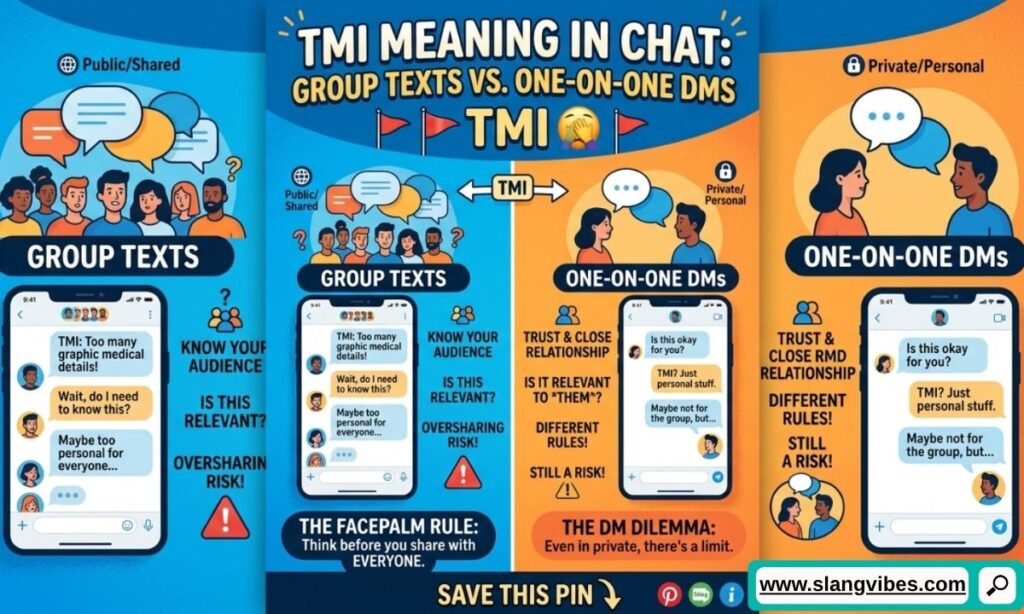
The same three letters hit differently depending on where you send them. TMI meaning in chat changes based on audience size, and that’s something most people learn the hard way.
In a one-on-one DM, TMI is almost always gentle. You and the other person have a shared understanding. When your best friend texts you TMI after you describe your doctor’s appointment, it’s probably followed by a laughing emoji. No harm done.
Group chats are a different situation. When someone sends TMI in a group, there’s a collective reaction happening. Multiple people are reading the same overshare at the same time. That shared experience makes the TMI response feel more pointed, even if the sender meant it as a joke. The original poster is now aware that everyone saw both the overshare and the reaction.
Did You Know: Research on group messaging behavior shows that people overshare more in group chats than in one-on-one texts. The audience feels more anonymous, which lowers people’s filters.
Here are two examples showing the contrast:
One-on-one DM:
Maya: “So the rash turned out to be from the new laundry detergent and the doctor had to look at it for like ten minutes” Jordan: “TMI babe lmaooo but glad you’re okay”
Group chat:
Alex: “Can I just say I had the worst morning and it involved a noodle incident in the bathroom” Sam: “…TMI” Chris: “TMI x100” Alex: “okay fair”
See how the group response lands with more weight? Even though both situations are lighthearted, the group version creates a louder moment.
The Tone Behind TMI Text Meaning: Playful, Awkward, or a Real Boundary?
Here’s the thing that most guides miss completely: TMI doesn’t always mean the same thing, even when the definition stays constant. The tone behind it tells you whether someone is laughing or genuinely uncomfortable.
Learning to read that tone is a skill. Fortunately, there are clues in how TMI is typed.
Read More Articles: DW Meaning in Text: What It Really Means on Snapchat, TikTok & Instagram (2026)
| How It’s Typed | What It Signals |
|---|---|
| “TMI lol” or “TMI haha” | Lighthearted, no issue |
| “TMI!!” | Surprised but amused |
| “TMI.” (just a period) | Might be a real boundary |
| “Okay… TMI” | Mild discomfort, proceed carefully |
| “TMI but I love you” | Playful, affectionate |
The relationship between the two people matters too. Between close friends, TMI is almost always a joke. Between acquaintances or people who’ve just started texting, it sends a clearer signal to back off a little.
Here’s a conversation that shows the difference in tone:
Close friends:
Dev: “I just ate an entire rotisserie chicken by myself” Priya: “TMI!! Icon behavior though”
Newer connection:
Marcus: “My last relationship ended because of some personal stuff I was going through health-wise” Tyler: “Oh wow. TMI but thanks for sharing I guess”
The second one has a little friction. Tyler isn’t sure what to do with that information. The “I guess” at the end tells you everything.
How to Respond When Someone Sends You TMI in a Text
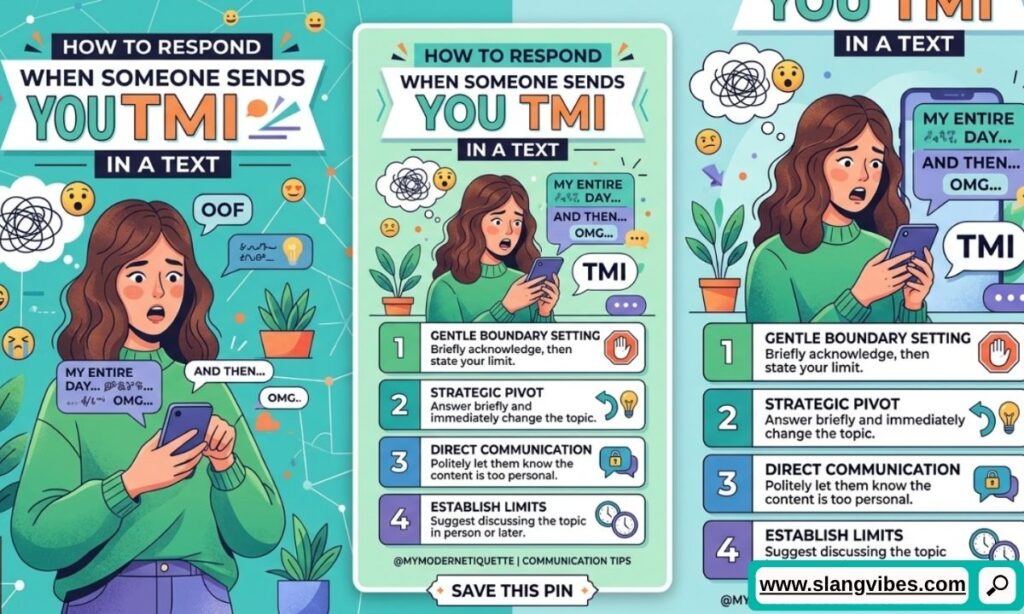
So someone just hit you with TMI. What do you do? The good news is that in most cases, it’s not a crisis. Since TMI is usually more playful than harsh, your response doesn’t need to be a full apology.
Here are a few ways to respond well:
For casual situations with friends, keep it light. Match the energy.
“okay okay I’ll keep the details to myself next time lol” “noted. deleting that memory from both our brains”
For situations where you sense genuine discomfort, acknowledge it simply:
“Sorry, didn’t mean to go there. Moving on!” “Fair. I’ll spare you the rest.”
What you want to avoid is over-explaining or defending your original message. That turns a small moment into an awkward conversation. The person who sent TMI already moved past it. You should too.
Here’s one more real exchange showing a smooth recovery:
Sam: “Oh and the whole thing took like forty minutes and there was a lot of blood involved” Jess: “OKAY TMI oh my god” Sam: “LOL okay I’ll skip to the end, she’s fine” Jess: “Perfect, yes, skip to the end”
Clean recovery. No awkwardness. Done.
When You Should NOT Use TMI (And Why It Matters)
Knowing the TMI meaning in text is one thing. Knowing when to hold back is another, and this part doesn’t get discussed enough.
There are situations where sending TMI does real damage to a conversation. If someone is sharing something genuinely painful, like a loss, a health scare, or something they’ve been building up the courage to say, responding with TMI shuts them down. Even if your intention is lighthearted, the timing makes it land like dismissal.
Cultural context matters too. In the UK, TMI tends to carry a slightly more formal tone than it does in the US. American texting culture is generally more comfortable with casual oversharing, so TMI gets used more loosely. British texters sometimes reserve it for situations where someone has genuinely crossed a line.
Here are clear situations where you should skip TMI:
- Someone is venting about a hard situation they didn’t choose
- A person is opening up about mental health for the first time
- You’re in a professional or semi-professional setting
- The conversation is already emotionally sensitive
- You don’t know the person well enough to gauge how they’ll take it
The bottom line is that TMI is a tool for managing casual oversharing, not a response to vulnerability. Keep that distinction clear and you’ll never misuse it
TMI vs. Similar Slang: NSFW, Overshare, NTY and More
Since TMI in texting is one of several ways to signal “that was too much,” it’s worth knowing how it compares to the alternatives. Each one fits a slightly different situation.
Here’s how they break down:
| Term | What It Signals | Best Used When |
|---|---|---|
| TMI | Friendly overshare warning | Casual texting between people who know each other |
| NSFW | Content not appropriate for work | Sharing links, images, or explicit material |
| Overshare | More formal way to say the same thing | Writing, semi-formal conversations |
| NTY (No Thank You) | Polite refusal of information | Declining details you didn’t ask for |
| “Too much, babe” | Affectionate, informal | Close relationships only |
The biggest difference between TMI and NSFW is intent. TMI is reactive, you use it after the overshare happens. NSFW is a warning label, you use it before someone opens something. They’re solving different problems.
TMI meaning also differs from “overshare” in tone. “Overshare” is the clinical, neutral term you’d see in an article or a think piece. TMI is what you actually type at 11pm in a group chat.
TMI in Pop Culture, Memes, and Social Media Trends
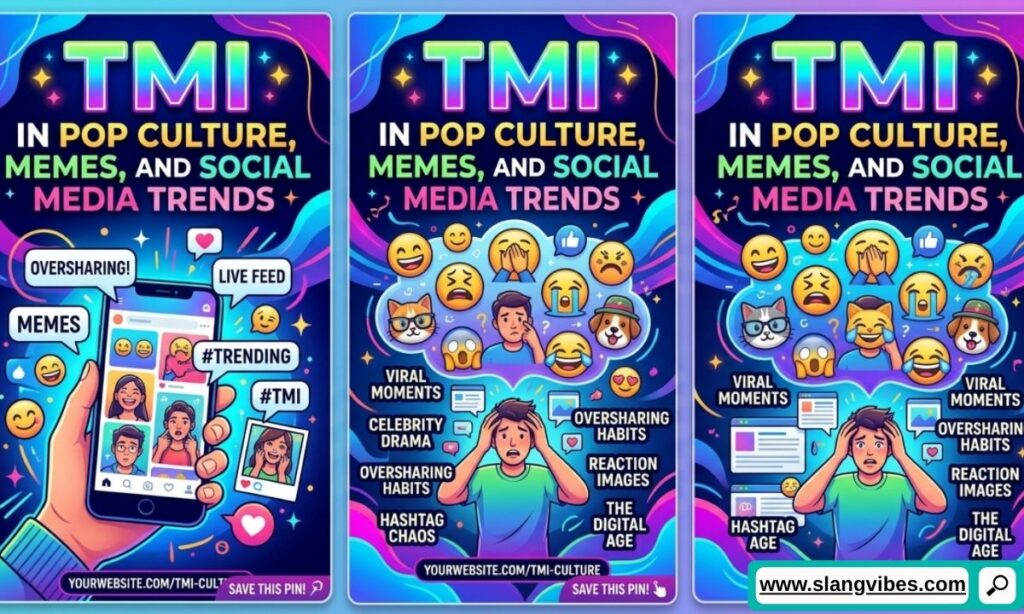
The TMI meaning on social media has grown well beyond texting. At this point, it’s a pop culture fixture.
“TMI Tuesday” became a long-running social media trend where people answer extremely personal questions publicly. What started on Tumblr spread to Twitter, TikTok, and Instagram. The whole point is that the answers are supposed to be too much information. The overshare is the entertainment.
On Reddit, TMI has its own subcultures. The subreddit r/tifu (Today I F***ed Up) is essentially a TMI engine. People post detailed, personal disaster stories and the community rewards the ones that are most gloriously overshared.
Brands have tried to borrow the TMI energy in marketing, usually with mixed results. When a corporation types TMI in a tweet, it tends to land as try-hard rather than relatable. The slang works because it’s personal. It doesn’t translate easily into marketing voice.
Meme culture has kept TMI alive too. The format “nobody asked but here’s my TMI” followed by an extremely specific personal fact has been a recurring format since at least 2019. Gen Z uses it as a way to share things they want to say while preemptively acknowledging that no one requested the information.
Read New Article: OP Meaning in Text: What It Really Means on Snapchat, TikTok & Instagram (2026)
Frequently Asked Questions
What does TMI mean in a text message?
TMI stands for “Too Much Information.” It’s used to tell someone they’ve shared more personal detail than the conversation needed, usually in a lighthearted way.
Is it rude to say TMI to someone?
Not usually. TMI is most often playful rather than harsh. The tone depends on your relationship and how you type it. “TMI lol” lands very differently from a flat “TMI.” with no emoji.
How do you use TMI in a sentence?
You’d type it as a standalone reaction: “Okay, TMI, but thanks for the update.” Or someone might say, “I won’t share the full story, it’s TMI.”
What does it mean when a girl or guy says TMI to you?
It means you shared more detail than they were expecting or comfortable with. In most cases, it’s not a big deal. Respond lightly, move on, and keep the conversation going without dwelling on it.
Is TMI still used in 2025 and 2026?
Yes, absolutely. TMI is one of the few internet abbreviations that has stayed relevant across generations. Gen Z uses it both sincerely and ironically, which has kept it fresh. It shows up in TikTok comments, group chats, DMs, and memes regularly.
Wrapping It Up
Remember Kayla and her voice note? The reason those three letters worked so well in that group chat is because everyone already knew exactly what they meant. No explanation, no offense taken, just instant shared understanding. That’s the power of TMI meaning in text.
Whether you’re using it to stop a friend mid-story, dropping it ironically in a TikTok comment, or finally understanding why someone sent it to you, TMI is one of those abbreviations that earns its place in the conversation. It’s flexible, it’s fast, and when you use it right, it keeps things light without shutting anyone down.
Now you know not just what TMI means, but how to read it, how to respond to it, and when to hold it back entirely. That’s the full picture.

Alex Carter is a language enthusiast and internet culture expert at SlangVibes. He explains the latest slang terms and text meanings in simple, clear English so everyone stays in the loop.