My cousin Dani texted me last week while I stood in line for coffee. “Gotta run, TTU!” I stared at my phone. Texas Tech? Was she heading to a college visit? I typed back three confused question marks. She replied with a laughing emoji and spelled it out. Dani meant “talk to you.”Here’s the thing. The TTU meaning in text trips up plenty of people, because the same three letters point to a school too. This guide breaks down what TTU stands for, how people use it, and when to skip it. By the end, you’ll read it like a pro.
Read Here: FOB Meaning Explained: Definition, Origin, Examples & Cultural Significance
What Is the TTU Meaning in Text?
The TTU meaning in text is simple. It stands for “talk to you.” People type it when they’re about to leave a chat. They plan to reply later, or they want to start talking soon.
Quick Answer: TTU means “talk to you.” Most people use it as a casual sign-off, like “TTU soon” or “TTU after work.”
Think of it as a cousin of TTYL, which stands for “talk to you later.” The only difference is length. TTU drops the “later” and keeps things short. Based on how people typically use the term online, it shows up most in friendly messages. The senders usually know each other well.
Here’s a sample exchange between two friends.
Jordan: Heading into a meeting now, TTU after
Sam: No worries, good luck!
Jordan: Thanks, TTU at lunch
Sam: Sounds good, enjoy lunch
Notice how TTU works as a polite exit. Nobody feels ignored, since the message promises a follow-up. This promise is the heart of the term. It tells the other person you’re busy and still friendly.
Tone-wise, TTU feels warm and relaxed. It carries no drama. You won’t find hidden sarcasm in it, though context always matters. A short “TTU” after a heated argument reads differently than a “TTU” after a fun chat about weekend plans.
You might be wondering how old the term is. Nobody has pinned down a clear origin.
TTU Meaning in Text vs. TTU the University
The TTU meaning in text isn’t the only one you’ll meet. Three-letter abbreviations get reused constantly, and schools claim this one often.
Texas Tech University goes by TTU. So does Tennessee Tech University in Cookeville. Students and alumni type it in posts about classes, games, and campus life. Some abbreviation lists also show “talk to us” as a meaning. It seems far less common in everyday chats.
Context settles the question fast. Picture these three situations.
A friend texts “TTU later” on the way out the door. Here the letters mean “talk to you.” A classmate posts “Go TTU!” under a stadium photo. Here the letters name the university. A company replies “TTU anytime” to a customer. Here the letters likely mean “talk to us.”
Same letters, three different meanings. You’ll sort them out with a few simple clues.
- Sender: Friends and family lean toward “talk to you.”
- Placement: A sign-off at the end of a message points to “talk to you.”
- Surrounding words: Terms like game, campus, or class point to a school.
Here’s the thing. Nobody expects you to memorize every acronym. You only need to read the situation. Think of it this way. A goodbye rarely names a college. If two readings both fit, ask. A quick “TTU as in talk to you?” clears things up in seconds and saves a lot of guessing.
Read Also: DLS Meaning in Text: Definition, Examples, and How to Use It in Chats (2026 Guide)
How People Use TTU in Messages and Chats

The TTU meaning in text stays the same, but people use it in a few different ways. Most fall into three patterns.
The first is the quick goodbye. Someone has to leave and signs off with TTU. The second is the future promise. People write “TTU tomorrow” to set up a later chat. The third is the nudge. A short “TTU?” asks the other person to reply or call.
Generational habits show up here too. Based on how people typically use the term online, Gen Z tends to type it in lowercase. The vibe stays casual, like “ttu later.” Millennials often keep the capital letters and pair it with an exclamation point. Neither style is wrong. Both read as friendly.
Here’s a text between two siblings.
Alex: Mom’s calling me, ttu in a bit
Riley: Tell her I said hi
Alex: Will do, ttu soon
Riley: Okay, I’m heading to dinner anyway
You’ll notice the lowercase style feels relaxed and quick. Capital letters add a little more energy. Either way, the meaning holds steady.
Time matters in a busy chat. A three-letter sign-off takes two seconds to type, while a full sentence takes longer. Short forms like TTU also save effort. Think of them as a digital wave goodbye. They keep the mood light and the exchange moving, especially when both people are on the go.
TTU Meaning in Text Across Apps and Platforms
The TTU meaning in text holds steady on every app you open. The tone shifts a little from platform to platform, though. Here’s how it typically plays out.
- iMessage or SMS: Family and close friends send TTU as a quick sign-off, often after “on my way” or “heading out.”
- WhatsApp: People chatting across time zones type “TTU tomorrow” before bed, and the reply arrives hours later.
- Snapchat: Chats move fast, so messages stay short. A lowercase “ttu later” fits the rhythm.
- Instagram DMs: TTU often follows a meme swap or a story reply, as a friendly way to pause the chat.
- Discord: A gamer might type “ttu after the match” when a session ends.
Notice the pattern. Casual apps invite casual sign-offs, and TTU fits right in.
Punctuation and emoji shift the mood a little. A plain “TTU” feels neutral. Add an exclamation point and it feels cheerful. Add a smiley and it feels warm.
Group chats add one more twist. In a group, TTU often signals you’re leaving the thread for now, not ending it for everyone. Others keep talking while you step away.
A quick tip on timing: send TTU when you truly plan to follow up. People notice when a promise to talk never turns into a message. Silence after TTU feels like a skipped appointment. Keep your word, and the sign-off stays friendly.
Read Also: Crank Slang Meaning (2K26 Guide): What “Crank” Really Means in Modern Conversations
TTU vs. TTYL, TTYS, and Other Similar Slang
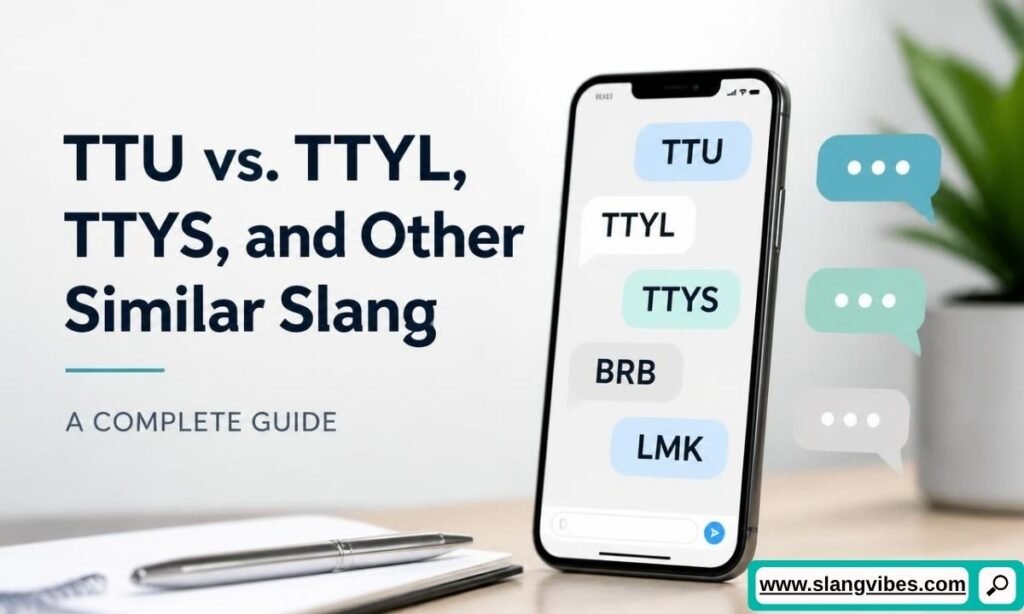
The TTU meaning in text gets clearer when you compare it with its closest relatives. Several abbreviations look alike, and mixing them up leads to awkward replies. This table sorts them out.
| Term | Meaning | Tone/Vibe |
|---|---|---|
| TTU | Talk to you | Casual, open-ended |
| TTYL | Talk to you later | Friendly, expects a delay |
| TTYS | Talk to you soon | Warm, promises a quick return |
| TTY | Talk to you | Short, rushed |
| TU | Thank you | Polite and brief |
| TY | Thank you | Polite, standard |
The key difference is timing. TTYL points to a later chat, and TTYS points to a sooner one. TTU leaves the timing open. The sender might reply in five minutes or tomorrow, and the word gives you no clue.
TU causes the most confusion. Online, it usually means “thank you.” Some people also type it as a shortcut for “talk to you.” Read the rest of the sentence before you decide.
Picture a friend writing “TU for dinner, TTYL.” The first abbreviation says thanks. The second promises a later chat. Two similar-looking terms, two different jobs.
Pick the abbreviation by what you want to say. Want to set a timeframe? Use TTYL or TTYS. Want to keep things open? TTU does the job. Want to thank someone? Reach for TY. Bottom line: each term has its own lane, and using the right one keeps your message clear.
When Not to Use TTU in a Message
The TTU meaning in text is casual, so it belongs in casual spaces. Some situations call for full words instead.
Skip TTU in these situations.
- Job applications and recruiter emails
- Messages to a manager, client, or professor
- Customer service replies
- Serious conversations, like apologies or bad news
Why the caution? Formal messages signal respect. Abbreviations make a note feel rushed, and some readers won’t recognize them. Remember, TTU also names a school, so an older reader or a stranger might misread it.
Here’s how a mix-up plays out at work.
Priya: Would you send the report by noon?
Marcus: On it, TTU after I finish the call
Priya: Sorry, does TTU mean the university?
Marcus: Ha, no! I meant talk to you. I’ll message after the call.
Notice how a tiny abbreviation slowed the whole exchange. Marcus saved two seconds and cost Priya a minute of confusion.
A simple rule works well. Match the message to the reader. When you’re unsure, write out “talk to you later.” It costs three extra words and removes all doubt.
Think of it this way. A suit works at a wedding, and a hoodie works at brunch. TTU belongs in the hoodie category. Friends forgive shortcuts easily. Hiring managers rarely do. Even inside a casual workplace, new coworkers appreciate clear wording until you know their style.
Read More Articles: FTW Meaning in Text: What Does It Really Stand For?
Common Mistakes People Make With TTU
Misreading the TTU meaning in text causes more small awkward moments than you’d expect. Most mistakes fall into a handful of habits. Watch for these four.
- Assuming it means “thank you.” TU and TTU look close, but they say different things.
- Assuming it names a school. Without sports or campus words nearby, “talk to you” is the safer read.
- Treating it as a cold goodbye. TTU sounds warm in most chats, so don’t read it as a brush-off.
- Waiting by the phone. TTU doesn’t promise a specific time, so a quick reply isn’t guaranteed.
Picture this. You text a new friend, “TTU soon!” and she replies with a long message about her college days. You meant a goodbye. She read a school reference. Both of you walk away puzzled.
The fix is easy. When the setting is new or mixed, add one clarifying word. Write “TTU later” or “talk to you soon” and the mix-up disappears.
One more habit worth watching is using TTU in every message. Repeating it makes a chat feel like a series of exits. Save it for moments when you’re truly leaving.
Everyone misreads an abbreviation now and then. I’ve done it myself, and the embarrassment fades fast. Asking beats guessing every time. A friendly question like “wait, what does TTU mean?” shows curiosity, and most people are happy to explain.
How to Reply When Someone Texts You TTU

Once you know the TTU meaning in text, replying is easy. You only need to match the sender’s tone. Here are a few replies to keep handy.
- Casual: “Sounds good,” “Talk soon,” or “Catch you later.”
- Warm: “Looking forward to it!” or “Talk to you soon!”
- Supportive: “Good luck with the meeting!” or “Take care!”
- Playful: “Don’t ghost me!” or “Bring snacks next time.”
Emoji add flavor. A wave, a smiley, or a thumbs up all fit a friendly sign-off. A heart suits close friends and partners. Skip the angry faces unless you’re joking.
Here’s a dating example.
Maya: Dinner was fun tonight!
Chris: Same here, I’m getting on the train, TTU tomorrow?
Maya: Sounds great! Text me when you’re home
Chris: Will do, sleep well
And one from a group chat.
Taylor: Leaving the party early, ttu tomorrow everyone
Jess: Boo, but okay! Get home safe
Sam: Bye Taylor, see you at brunch
Taylor: Wouldn’t miss it
Notice how short the replies stay. Nobody writes an essay back to a sign-off. A light answer keeps the mood easy, and the goodbye lands smoothly.
Silence is also a fine response. A TTU doesn’t always demand an answer, especially when the sender is heading into a meeting or a class. Use your judgment and match the energy. Short and warm wins every time.
Read New Articles: Ohio Slang Meaning: Popular Ohio Slang Words, Origins & Examples (2026 Guide)
Frequently Asked Questions
What does TTU mean in text?
The TTU meaning in text is “talk to you.” People use it as a casual sign-off or a promise to chat soon.
Is TTU the same as TU?
No. TU usually means “thank you,” while TTU means “talk to you.” Read the rest of the sentence to be sure.
Does TTU mean Texas Tech University in a text?
Sometimes. The letters also stand for Texas Tech University and Tennessee Tech University. Sports or campus words point to a school.
Is TTU the same as TTYL?
Not quite. TTYL means “talk to you later,” while TTU leaves the timing open.
Is it okay to use TTU in a work message?
Skip it with managers, clients, and professors. Between close coworkers, it’s usually fine, but spelling it out is safer.
The Bottom Line on TTU
The TTU meaning in text comes down to three simple words: talk to you. Most people type it as a friendly sign-off when they’re leaving a chat and plan to return. It sits comfortably next to TTYL and TTYS, and it leaves the timing open.
Context does the heavy lifting. A message from a friend at the end of a conversation points to “talk to you.” A message near sports or campus words points to Texas Tech or Tennessee Tech. A tiny TU with no second T usually means “thank you.” When two readings compete, a quick question clears things up.
Use TTU where it belongs, in relaxed chats with friends, family, and teammates. Spell it out for bosses, clients, and professors. Reply with a short, warm line and let the conversation breathe.

Alex Carter is a language enthusiast and internet culture expert at SlangVibes. He explains the latest slang terms and text meanings in simple, clear English so everyone stays in the loop.