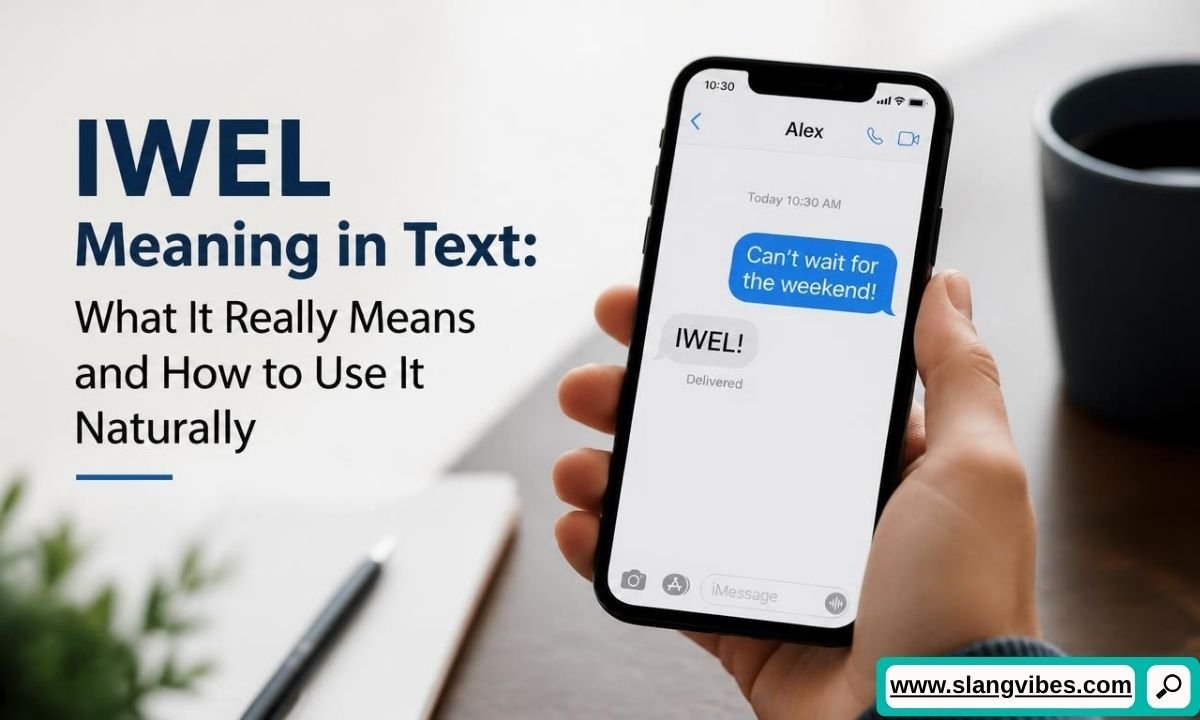
Last week, my friend Danny sent me this text.
Danny: iwel be there by 8
Me: Is it a typo or a secret code?
Danny: Typo, I meant I’ll be there
I laughed, but I’d stared at it for a full minute first, wondering if I’d missed a new trend. IWEL meaning in text is one of those puzzles you only notice when it lands in your own inbox. The short version: it isn’t established slang. People type it as a slip or shorthand for “I will” or “I’ll.” Below, you’ll see where it shows up, who uses it, and how to reply.
Read New Articles: IMAO Meaning in Slang: What It Stands For and How to Use It
IWEL Meaning in Text: The Short Answer
IWEL meaning in text comes down to one plain fact. There’s no official definition. It isn’t a recognized English word. Based on how the term is typically used online, it works as a typo or informal shorthand, not as established slang.
Most of the time, the sender means one of two things. The first is “I will” or “I’ll,” as in “iwel call you later.” The second is “well,” often used as a filler word at the start of a thought.
Quick Answer: IWEL is usually a typo or shorthand for “I will,” “I’ll,” or “well.” Read the rest of the sentence to know which one.
Here are three quick examples:
- “iwel call you later” means “I’ll call you later.”
- “iwel try my best” means “I will try my best.”
- “iwel idk what to say” means “well, I don’t know what to say.”
Context does the heavy lifting. If the word sits right before a verb, it almost always means “I will.” If it opens a sentence and leads into a thought, it usually means “well.” Think of it as a puzzle with only two real answers. Most readers figure it out within a second.
Some people type it on purpose, as a relaxed, lowercase style choice. It’s rare, though. Treat it as a slip first and a style choice second.
Why Do People Type IWEL in Texts?
Here’s the honest answer: nobody knows where IWEL started. No confirmed origin exists, and anyone who claims one is guessing. What we do know is how the typo tends to form. Understanding IWEL meaning in text starts with seeing it as a typing habit, not a coded term.
Based on how the term typically appears, the cause is typing speed. People text fast, often with one thumb, often while walking or half-watching a show. Letters get swapped, dropped, or squeezed together.
Take “I will.” Type it quickly with no space and you get “iwill.” Drop a letter or hit a neighboring key, and “iwel” appears. “I well” with a missing space creates the same result.
Autocorrect adds to the mess. Some keyboards leave unfamiliar strings alone, so the typo sticks. Others swap in a word you didn’t want. Either way, the sender hits send and moves on.
Here’s the thing: casual texting rewards speed over polish. Most friends read past errors without a second thought. After a few repeats, a typo starts to feel like a habit, and the habit starts to feel like a personal style.
You don’t need a special reason to understand it. If a message looks odd, say the word out loud. “Iwel” sounds a lot like “I will” when spoken fast, and the sound is often the best clue you have.
Read More: ASL Meaning in Chat: Popular Uses, Examples, and Hidden Meanings
What Does IWEL Mean on WhatsApp, Instagram, and TikTok?
Platform changes the feel, not the meaning. On every app, IWEL meaning in text stays the same: a typo or shorthand for “I will” or “well.” What changes is how much anyone cares.
WhatsApp and iMessage chats move fast. Plans shift, replies arrive in bursts, and typos slide by. Instagram DMs feel looser still, and TikTok comments go further, with lowercase and slang everywhere. Snapchat sits at the casual end too, since messages fade quickly and nobody rereads them.
Here’s a typical group chat on WhatsApp:
Maya: are you coming to dinner tonight?
Jordan: iwel try, work is impulsive
Maya: ok let me know by 6
Jordan: will do, sorry!
Jordan didn’t hide any meaning. “Iwel try” is “I’ll try” typed in a hurry. Maya read it fine and moved on.
Comments work the same way. Under a funny video, a reply like “iwel same 😂” reads as “well, same” or “I’ll say the same.” Nobody pauses on it. Emoji often follow it, which signals a laid-back mood instead of confusion. Voice notes skip the issue entirely, since nobody types anything.
One small difference shows up in public spaces. A typo in a public comment sometimes draws a reply asking what you meant. In a private chat, friends fill in the blank themselves.
Bottom line: the app doesn’t change the definition. Your relationship with the sender does.
IWEL Meaning in Text Across Gen Z and Millennials
Different age groups treat typos differently. The meaning doesn’t shift, but the reaction does.
Many Gen Z texters write in lowercase, skip punctuation, and treat small errors as part of the vibe. A Gen Z reader might see “iwel” and understand it instantly, or ignore it without a thought. Some even type it on purpose to sound relaxed.
Millennials tend to lean toward fuller sentences. Many notice the slip, smile, and read it as “I’ll.” A few fix it in their own reply, though most don’t. Texting style shifts with every group chat, so treat these patterns as tendencies, not rules.
Here are three quick scenarios.
A college student texts a roommate, “iwel grab food on the way back.” The roommate replies with a thumbs up.
A thirty-something coworker sends “iwel send the notes after lunch” in a work chat. The reply is “Sounds good,” with no comment on the typo.
A teenager in London types “iwel see you at the station” to a mate. Nobody blinks.
US and UK texters both shorten words and skip apostrophes. Neither group treats this typo as a big deal, and the meaning stays identical across both.
Age matters less than context. A close friend, a casual group chat, and a quick reply all lower the stakes. A boss, a client, or a first message to someone new raise them.
Read Also: SYFM Meaning in Slang: What Does It Stand For?
When Not to Use IWEL in Text Messages
Knowing the IWEL meaning in text doesn’t mean every chat welcomes it. Casual typos are fine with friends. They’re a bad idea in a few spots, so here’s where to type the full words instead.
Picture this: you’re a new hire, and you text your manager, “iwel send the file by noon.” You meant “I’ll send the file by noon.” Your manager reads it twice, then wonders whether you rushed. Nothing terrible happens, but your first impression takes a small hit.
Work chats, job applications, and client messages call for clean language. Anything tied to a deadline, a payment, or a promise should stay clear too. If someone must guess whether “iwel” means “I will” or “well,” the message has already failed.
Here are a few places to skip it:
- Emails and professional messaging apps
- Messages to teachers, landlords, or customer support
- Early texts with someone new
- Anything you plan to screenshot or share
Most people read one typo as a sign of rushing, so a single slip rarely causes harm. A repeated pattern stands out, though.
Here’s a quick fix. Reread before sending anything important. Two seconds of checking saves a confused reply. Spell check also helps, since it usually flags unfamiliar strings like “iwel” with a red underline.
If the message is a promise or a deadline, spell it out. “I will” costs you two seconds.
Common Mistakes When Reading IWEL Meaning in Text
Most confusion around IWEL meaning in text comes from four easy mistakes.
Mistake one is treating it as established slang. It isn’t. Unlike “bet” or “fr,” no strong community owns it. Slang usually spreads through videos, songs, or group chats, and people use it on purpose. Based on how it typically appears, IWEL lacks this pattern.
Mistake two is assuming one fixed meaning. The sentence decides. “Iwel call” points to “I will.” “Iwel ok” points to “well, okay.”
Mistake three is trusting random websites. Search for it and you’ll see pages claiming spiritual, cultural, or language-specific meanings, and those pages often disagree with each other. Treat any page with no source and no real examples with caution. A good definition always shows real texts. For text messages, only the conversation counts.
Mistake four is overthinking it. Sometimes a typo is only a typo. Reading deep meaning into it creates drama nobody asked for.
Here’s how overthinking looks:
Priya: he sent me “iwel see” what does it even mean
Sam: it’s “I will see.” He types fast
Priya: so no hidden message?
Sam: nope, he hits send and moves on
Priya’s worry is common. A short, odd word feels loaded when you already feel unsure about the person. Most of the time, it’s only a rushed text. A quick reread of the full sentence solves most cases.
Read Here: YKD Meaning in Text: What It Means in Chats and How to Reply
IWEL vs I’ll, IWL, Imma, and Well
Seeing how IWEL stacks up against clean alternatives makes the typo easier to spot. This table shows the differences, and each term earns a different reaction from readers.
| Term | Meaning | Tone/Vibe |
|---|---|---|
| IWEL | Typo or shorthand for “I will” or “well” | Rushed, casual |
| I’ll | Contraction of “I will” | Neutral, clear |
| IWL | Possible shorthand for “I will,” depends on context | Casual, less clear |
| Imma | Slang for “I’m going to” | Playful, widely understood |
| Well | Filler or transition word | Neutral, universal |
Imma is the only one in the group with a real slang identity. People use it on purpose, as in “imma head out.” IWEL and IWL work differently. They tend to appear by accident, so they lack a shared meaning.
Tone matters too. “I’ll” and “well” sound clear in any chat. “Imma” signals a playful voice, usually among friends. IWEL and IWL send a rushed signal, which is fine for a quick reply but weak for anything important.
Another tell is the apostrophe. Without it, “I’ll” becomes “ill,” and readers sort out the meaning from context. IWEL works the same way, but with no real word to fall back on.
Try this quick rule. Swap in “I’ll” and see if the sentence makes sense. If it doesn’t, try “well.” If neither fits, you’re likely looking at a plain typo, and a short follow-up question solves it.
How to Reply When Someone Texts You IWEL
Knowing IWEL meaning in text makes replies feel natural, not awkward. Replying is easy. Skip the typo hunt and answer the message. Most of the time, the meaning is clear enough to respond without asking.
Casual replies work best with friends: “Sounds good,” “Okay, let me know,” or “Cool, see you then.”
Playful replies fit close friends: “iwel understood 😂” or “Translation received, thanks!”
Professional replies stay simple: “Thanks, I’ll watch for it,” or “Got it, thank you.”
Match the sender’s energy. If they sound rushed, keep your answer short, If they sound anxious, add a friendly line such as “No stress, see you then.”
If the meaning isn’t clear, ask politely. Try, “Quick check, do you mean you’ll try, or you’re unsure?” Keep the tone light and never mocking.
Here’s how a dating chat might go:
Chris: iwel be at the cafe around 7
Alex: Perfect, see you at 7
Chris: omg typo, I’ll be there! 😅
Alex: haha no worries
Skipping the typo is the easy path, and it keeps the vibe warm. Group chats follow the same rule: answer the plan, not the spelling.
Avoid correcting the typo unless the message covers something serious. Correcting a friend’s typing often feels stiff.
One last tip: if you type it by mistake yourself, send a follow-up only when the meaning might confuse. Otherwise, move on.
Read More Articles: Nevertheless Meaning: The Hidden Power of This Word in Everyday English
FAQs
Is IWEL a real word?
No. It isn’t a recognized English word. It works as a typo or informal shorthand.
What does IWEL stand for in texting?
It doesn’t stand for anything official. The IWEL meaning in text is usually “I will” or “well,” depending on the sentence.
Why do different websites list different meanings for IWEL?
Many pages guess, since no authoritative source exists. Trust the conversation instead of a random definition.
Is it okay to use IWEL in a work message?
No. Type “I will” or “I’ll” in anything professional.
How do I stop typing IWEL by accident?
Slow down on the first word, turn on spell check, and reread before sending. A text replacement shortcut for “I’ll” also helps.
The Bottom Line on IWEL
IWEL meaning in text isn’t a mystery once you know the pattern. It’s a typo or quick shorthand, most often for “I will,” “I’ll,” or “well.” No official definition exists, and no confirmed origin explains it, so the sentence around the word tells you everything.
Keep the main points in mind. Friends read past it. Gen Z and Millennials treat it as a small slip. Work chats and promises deserve full words. When a message looks odd, the fastest fix is a simple swap: try “I’ll” first, then “well.”
Don’t spend time hunting for a hidden code. Most senders type fast, hit send, and move on. Your best move is to answer the message and keep the chat going.

Alex Carter is a language enthusiast and internet culture expert at SlangVibes. He explains the latest slang terms and text meanings in simple, clear English so everyone stays in the loop.