A friend once texted me, “I burned the cake, XD.” I stared at the screen for a full minute. Was she sad, Was she laughing at herself? Was I supposed to laugh too? The XD meaning isn’t obvious when nobody has shown you the face hiding in those letters. I felt silly asking. Let me spare you the confusion. Here’s the thing: the answer is simple, but the small details matter. This guide covers what the letters represent, where they came from, and how to read the tone. You’ll also learn when to skip them and how to reply when someone sends them your way.
Read Also: FAFO Meaning Explained: What Does “FAFO” Mean in 2026?
XD Meaning in Text: The Short Answer
The XD meaning comes down to one idea: laughing hard. Tilt your head to the left and the two letters turn into a face. The X is a pair of squeezed-shut eyes. The D is a wide, open mouth in mid-laugh. Together they show someone cracking up so hard their eyes squeeze shut.
People type XD at the end of a message to show amusement. Some use it to soften a joke. Others use it to laugh at their own mistakes. Many people read the face as someone dying of laughter. That’s why it feels stronger than a plain “haha.” You’ll see it in texts, comment sections, and chats, usually after something silly, awkward, or unexpectedly funny.
XD works as a picture built from keyboard characters, so people call it an emoticon. No phrase hides behind the letters, unlike LOL or BRB. The face adds energy to a message.
Here’s a quick exchange between two friends:
Jordan: I sent my boss a meme meant for my group chat
Sam: Wait, which meme? XD
Jordan: The one about Monday meetings
Sam: Please tell me he laughed
Jordan: He replied with a thumbs up. I’m terrified
Sam: XD you’ll be fine
Sam’s XD tells Jordan the situation is funny, not a disaster. Those two letters add warmth a plain “you’ll be fine” would miss.
Where XD Came From, and What Nobody Has Proven
Tracing the XD meaning back to its first use is harder than it sounds. Nobody has pinned down who typed it first. Many accounts point to chat rooms and message boards from the late 1990s and early 2000s. People built faces out of letters and symbols back then, since phones had no emoji keyboards.
The earliest dated trace I found is a March 2003 Urban Dictionary entry, which defined XD as a laughing face. The entry collected more than 9,600 upvotes over the next dozen years. It proves people used the face by then. It doesn’t prove who invented it.
You’ll also see claims tied to specific apps, countries, or fan communities. Nobody has produced firm evidence for any of them, so treat those claims as stories, not facts. A safer way to say it: XD grew out of early internet chat culture, and its exact birthplace stays unknown.
Picture a teenager in 2003 typing XD into a chat window after a friend’s joke. No emoji button, no GIF library, only two characters doing the work of a whole laugh.
Fun Fact: In December 2003, an Urban Dictionary user added “ecks dee” as a phonetic spelling of the face. Someone, at least, was spelling out how it sounds.
The face was built for speed. Two keystrokes, an instant laugh.
Read More: BBG Meaning: Slang Definition, Text Uses & Examples (2026)
XD Meaning on TikTok, Instagram, and Gaming Chats
Platform shapes how people type XD. On TikTok and Instagram, it shows up in comment sections as a quick reaction. A commenter watches a clip of a cat sliding off a couch, types “the landing XD,” and moves on. The face works like a laugh track attached to a sentence. Public comments move fast, so short signals win. Short comments hide tone, so the face stands in for a smile.
Direct messages feel different. In a DM, the XD meaning leans personal, a reaction aimed at one person instead of a crowd. In a group chat, it often keeps the mood light after someone shares an embarrassing moment.
Gaming chats lean on XD too. A player types it after a teammate walks off a cliff by mistake. Another types it after a lucky win. Typing fast during a match leaves no room for full sentences, so two letters carry the whole laugh.
Here’s a group chat in action:
Maya: Who posted the blurry floor photo in the album?
Dre: Not me XD
Kai: Me. My phone fell
Maya: XD the floor looks great though
Dre: Best shot of the whole trip
Notice how nobody feels attacked. The XD softens Maya’s question and keeps the mood friendly. Public or private, the face sets a playful tone before anyone has to ask for one.
What XD Means to Gen Z, Millennials, and Older Texters
The XD meaning stays steady across age groups, but the feeling around it shifts. Many people who grew up on early chat apps read XD as warm and nostalgic. Plenty of younger texters see it as a retro throwback. Some prefer emoji or other slang to show a laugh.
XD has always had critics, too. Know Your Meme records a Facebook page launched in 2010 for people who hate the xD emoticon. Some forums and imageboard communities also looked down on it. So the face carries a mix of affection and eye rolls, depending on who’s reading.
Try this on for size. Picture sending XD to your 19-year-old cousin. She might smile at the throwback, or she might never type it herself. Now picture texting your aunt XD. She might wonder if you hit the wrong keys. Picture a coworker in her forties who still ends jokes with xD. Her team likely reads it as a harmless quirk. Quirks like this build a personal style.
Tone depends on the relationship more than the birth year. Friends who share jokes read XD as warmth. Strangers might read it as childish, especially in serious threads. If you’re unsure, think about how the other person writes. Do they use emoji? Do they type “haha” or “lol”? Match their style and you’ll rarely miss.
Read Here: NGL Meaning in Text: What It Really Means + Examples (2026)
XD Meaning Across Spellings: XD, xD, XDD, and xd
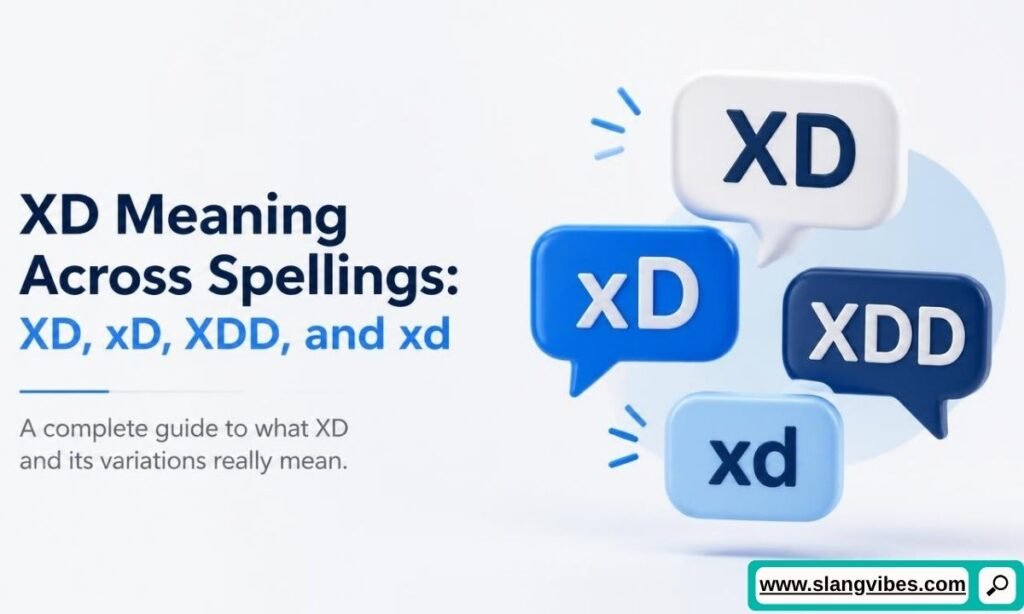
The XD meaning holds steady across spellings, but small changes add flavor. People mix capitals, lowercase letters, and extra Ds without much thought. Here’s how those forms are typically read:
| Form | Typical Feel | Example |
|---|---|---|
| XD | Classic, full laugh | Wow, the plot twist XD |
| xD | Softer, a bit playful | Okay, you got me xD |
| XDD | Extra laughter, bigger reaction | He walked into the glass door XDD |
| xd | Quiet, low-key amusement | ok fair, you win xd |
| XD XD | Strong teasing | XD XD you forgot again |
These readings come from habit, not rules. No official guide exists, so each friend group sets its own habits. Many people treat the lowercase version as a touch more casual. A longer string of Ds signals a bigger laugh. Look at the words around the face too. A short, dry sentence plus xd often reads as quiet amusement.
Here’s how it plays out between siblings:
Ava: You left your socks in the living room again
Ben: xD I’m collecting them as a sport
Ava: Mom found one in the fridge
Ben: XDD no way
Ava: Way. She’s furious
Ben: ok ok I’m coming
Ben starts with a soft xD, then jumps to XDD once the fridge detail lands. The extra D tells Ava his laugh grew. Small shifts like this give typed laughter a volume dial, even without sound.
XD Slang vs LOL, LMAO, and Laughing Emojis
XD slang sits in a crowded group of laugh signals, and each one carries a different weight. LOL spells out the action in words. Many people type it without laughing at all, so it often works as a polite filler. LMAO signals a bigger laugh and a bolder tone. The crying-laughing emoji works nearly everywhere, from family chats to office threads.
XD draws the reaction instead of describing it. You see the face, not a label. Many people read it as more personal than LOL and more casual than an emoji. Plenty of texters notice LOL turning into a polite reflex, while a face still feels like a live reaction.
Here are a few one-line scenarios to show the difference. Your friend sends a clip of a dog on a skateboard. LOL says you smiled. LMAO says you laughed hard. XD says you’re still grinning minutes later.
Your manager shares a funny photo in a work thread. The crying-laughing emoji fits fine. XD might feel a little too loose.
Your sibling teases you about a haircut. XD softens your reply and keeps the mood playful, while LOL might sound flat.
No single option wins every time. Pick the option matching your relationship, the platform, and the energy in the chat. Context decides the winner, and it changes from chat to chat.
Read Also: RLS Meaning in Text: What It Really Means on Social Media (2026)
When Not to Use XD, and Mistakes to Avoid
Knowing the XD meaning helps, but knowing when to hold back matters more. Skip it in apologies, bad news, and emotional conversations. A laughing face next to someone’s bad day lands as mockery, even when you mean well. Skip it in client emails and formal messages too. A plain “Haha” or a short sentence works better. A quick pause saves awkward replies.
Casual teams sometimes use XD in chat threads. If you’re new, watch how coworkers write before copying them.
Here are the mistakes people make most often:
- Overusing it in every message, which waters down the laugh
- Adding it after a harsh remark, which makes the comment read as sarcasm
- Assuming everyone likes it, when some people find it childish
- Mixing it up with Adobe XD, a design program with no link to laughter
The last one trips up many people. If a designer says, “Send me the XD file,” nobody is laughing. They mean a software file.
Tone matters in dating chats too. Here’s an example of XD helping rather than hurting:
Leah: You said you’d call me at seven
Nico: I fell asleep on the couch XD I’m sorry
Leah: Napping through our call XD
Nico: Guilty. Dinner on me Saturday?
Leah: Deal
Nico’s XD softens the apology. Leah answers in kind, so the mood stays warm.
Read new Articles: What Does SB Mean in Text? Definition, Slang, Usage & Examples (2026)
How to Reply When Someone Sends XD
Replying gets easier once you read the XD meaning in context. Ask yourself one thing: is this a laugh with you, or a tease at you? The sentence before the XD usually answers it.
Here are a few easy replies, matched to the mood:
- “Haha, right?” works for a simple shared laugh
- “I know, I’m still laughing” works for a funny story
- “Okay, you got me” works for playful teasing
- “Ha, fair” works in serious or professional chats
Say a friend texts you about spilled coffee: “You soaked your own laptop XD.” Reply with “Don’t remind me.” The mood stays light. A coworker types, “Slides went out with the wrong date XD.” Answer with “Haha, fixing it now.” Then move on. With someone you barely know, a short “Ha, thanks” after a stiff message keeps things friendly without matching the energy.
You don’t need to type XD back. Copying it feels natural among close friends, but plenty of people skip it. Matching the mood matters more than copying the letters. Sometimes a simple “Ha” is enough. Group chats work differently. A reaction emoji often answers an XD faster than a typed reply, and nobody minds. If the tone feels off, ask a quick question like “Funny or frustrating?” Many people answer right away. The confusion fades fast. Pick whichever feels natural.
Quick Answers About XD in Texts
What does XD mean in a text message?
The XD meaning in a text is hard laughter, drawn as a face with squeezed-shut eyes and an open mouth.
Is XD outdated in 2026?
It’s less common than emoji, but still easy to find in comments and chats.
Is XD sarcastic or rude?
Usually neither. It reads as sarcasm only after a harsh comment, so context decides.
What’s the difference between XD and xD?
No official difference exists. Many people read the lowercase x as slightly softer.
Do people say “ecks dee” out loud?
Some do, usually as a joke. Most people type the face instead.
The Bottom Line on XD
The XD meaning is simple: hard laughter drawn with two letters. Behind the face sits a mix of warmth, teasing, and nostalgia. Its exact origin stays unknown, though Urban Dictionary entries from 2003 show people were using it early. Since then, it has picked up fans, critics, and spelling variations.
Platform, age, and the relationship between two people all shape how it lands. A comment on a viral clip reads differently from a note to your boss. Capital or lowercase, one D or two, the core idea holds. You’ll also dodge the Adobe XD mix-up, since you know a design program shares the letters.
Most confusion fades once you read the whole message, not only the last two characters. Next time a friend sends XD, you’ll know they’re laughing and likely want you to laugh along. Match the energy, skip it in serious moments, and when in doubt, type “haha” instead.

Alex Carter is a language enthusiast and internet culture expert at SlangVibes. He explains the latest slang terms and text meanings in simple, clear English so everyone stays in the loop.