Last month my cousin texted me a screenshot: “mfw the pizza guy says it’s a 90 minute wait.” I stared at it for a full minute. Was it a typo? A code? I felt like the only person on earth missing the joke. My cousin finally explained it, and I laughed out loud. Turns out MFW meaning is simple once you see it in action. It stands for “my face when,” and it introduces a reaction. This guide covers where it came from, how to read its mood, and how to reply without sounding lost. Stick with me and you’ll never freeze over this term again.
Read Also: TMI Meaning in Text: How Gen Z Uses It on Social Media
MFW Meaning in Text: What “My Face When” Says
Every MFW message follows one pattern. You type MFW, then describe the moment behind your reaction. The face never appears in words. Your reader fills it in.
Quick Answer: MFW stands for “my face when.” Writers use it to share a reaction to a situation, usually with humor.
Here’s how the grammar works. A situation follows MFW, usually as a short clause: “mfw I open my bank app.” The situation carries the joke. Some writers add an emoji, a GIF, or a selfie to show the face for real.
Writers use it as a shortcut. Typing “my face when I see the bill” takes longer than typing “mfw I see the bill.” Speed explains much of its appeal, since reactions in chat happen fast.
Capitalization matters less than you’d expect. People type “mfw” in lowercase when the mood feels relaxed. They type “MFW” in caps when the moment feels louder.
It also works as a signal. The moment readers spot MFW, they expect a joke, a groan, or a confession. Watch it work in a real chat.
Priya: Did you study for tomorrow’s quiz?
Jess: mfw I open the textbook for the first time 😭
Priya: Same. Want to cram together?
Jess: Yes. Bring snacks.
This short exchange shows the full MFW meaning in text. Jess never describes the face, yet Priya feels the panic instantly.
MFW Origin: How a Reaction Image Caption Became Slang
The story starts with pictures, not words. Based on how the term is typically used online, MFW grew out of early meme and image board culture. Someone posted a photo of a face, often a screenshot or a cartoon frame. The caption read “my face when” plus a situation.
Photos carried the emotion. Captions set up the joke. Together, they made a tiny story in two parts.
Face is the key word. Many reaction images relied on clear expressions like shock, disgust, joy, and smugness. Writers picked a face to match the feeling.
Many people associate the format with forums like Reddit and Tumblr. No single confirmed first post exists, so treat any exact creator or date with caution.
Over time, typing habits shortened the phrase. “My face when” became MFW, which saved keystrokes and signaled insider humor. Next came text-only posts with no photo at all. Social platforms later carried it to bigger audiences, and each platform added its own flavor. The face turned imaginary, but the joke structure stayed.
Picture an old forum post. A wide-eyed cartoon character stares at the screen, captioned “MFW the final boss has a second form.” Today’s captions follow the same blueprint.
The MFW meaning never changed through all of this. The wording shrank, but the purpose stayed: show a feeling through a situation.
Read Also: GPI Meaning in Text: Everything You Need to Know in 2026
The Hidden Emotion Behind MFW Meaning: Humor, Panic, Shame, and Joy
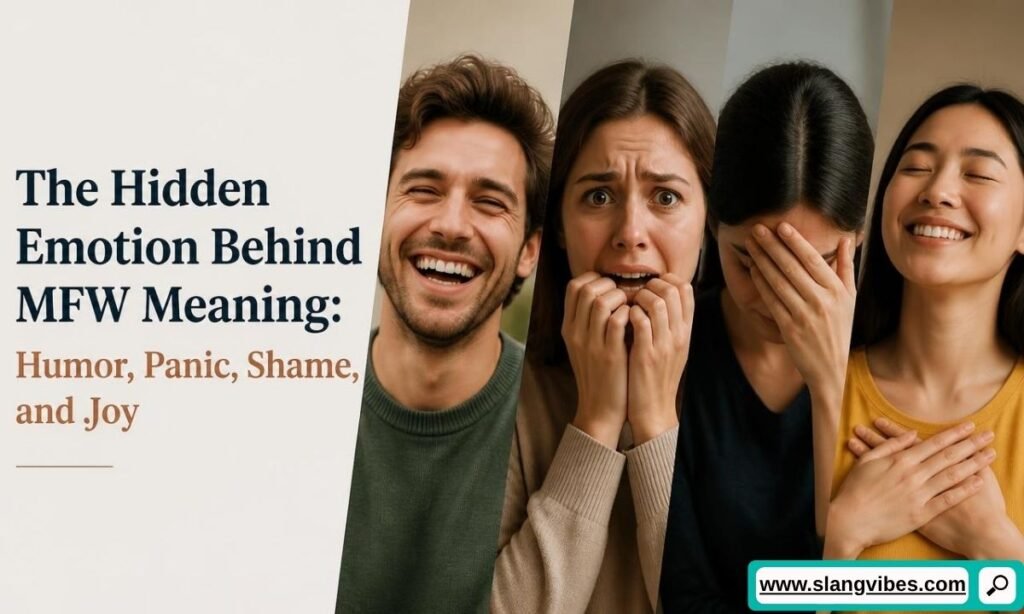
MFW never carries one fixed feeling. The emotion hides in the situation and the cues around it. Here’s how to read four common moods.
- Humor: a light situation plus a laughing emoji. Example: “mfw my cat sits on my keyboard 😂”
- Panic: caps, extra letters, or a skull emoji. Example: “MFW the teacher says pop quiz 💀”
- Shame: a tiny cringe moment, often with a grimace emoji. Example: “mfw I wave back at someone waving at the person behind me 😬”
- Joy: good news and exclamation points. Example: “MFW the concert tickets load!!!”
Punctuation and emoji set the mood more than the words do. A single period feels flat or dry. Three exclamation points feel excited.
Sarcasm adds a fifth shade. Someone who types “mfw my flight gets delayed again 🙃” is not delighted. The upside-down smile signals irritation wrapped in a joke. Context matters too. A friend who always jokes sends a different MFW than a friend who rarely does.
Watch how one line flips meaning.
Marco: I got the job offer!
Dev: MFW you tell me this!!! 🎉
Marco: They moved my flight to 5 a.m.
Dev: MFW you tell me this 💀
Same words, opposite moods. Emoji and punctuation did all the work. Reading this emotional layer gives you the full MFW meaning. Without it, you only get half the joke.
How MFW Works on TikTok, Snapchat, Instagram, and WhatsApp
TikTok creators put MFW in captions over a clip showing the reaction. Picture someone filming a burnt dinner with the caption “mfw I said I’d cook tonight.” Viewers copy the pattern in comments, so the thread becomes a pile of relatable moments. Short lines work best here. Captions flash by in seconds, so a punchy situation beats a long setup.
Snapchat users send a selfie with MFW across the top. The picture becomes the face. A friend who receives wide eyes and “mfw my streak hits 400” understands the joke at once. Friends usually answer with their own selfie. Bitmoji versions are popular too. A cartoon avatar with a stunned expression replaces the selfie.
Instagram leans on meme pages and reaction photos. Captions like “MFW I check my bank balance after shopping” show up often. Comment replies keep the same short, sarcastic tone. Stories add a twist. People pair MFW with a screenshot, a text overlay, or a photo of a pet.
WhatsApp feels quieter. Friends drop MFW into chats between plans and jokes, often with a sticker in place of a photo. The vibe stays warm and teasing, never formal. Older relatives in family groups tend to skip it.
Across all four apps, the MFW meaning holds steady. Situation comes first, feeling second.
Read More Articles: DW Meaning in Text: What It Really Means on Snapchat, TikTok & Instagram (2026)
MFW vs MRW vs TFW vs “Me When”: Which One Fits?
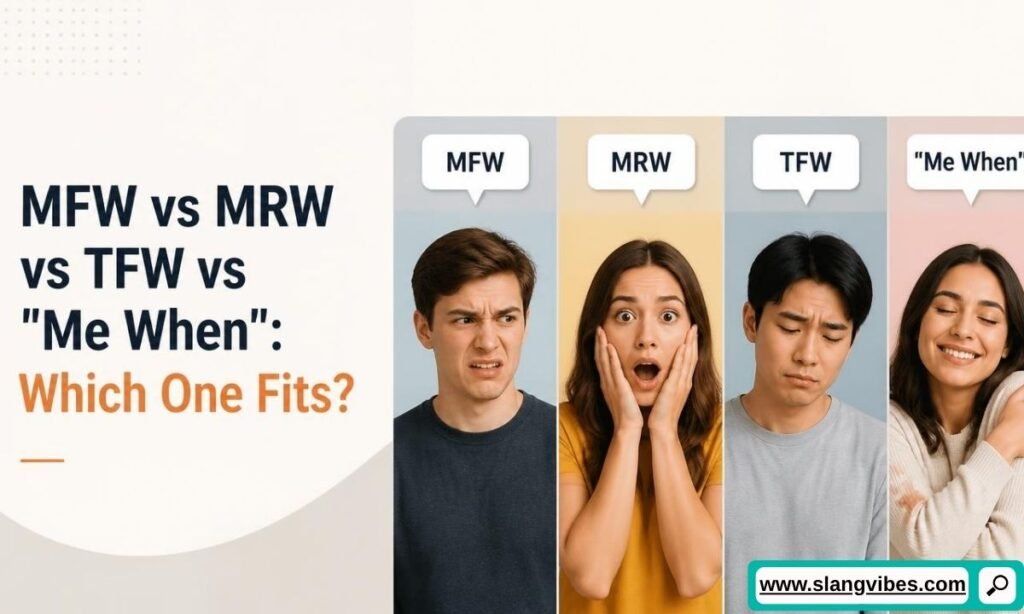
The MFW meaning overlaps with a few close cousins. People swap them constantly, and the differences are small. This quick table shows how each one works.
| Term | Meaning | Vibe |
|---|---|---|
| MFW | My face when | Funny, dramatic, relatable |
| MRW | My reaction when | Broader, often GIF-friendly |
| TFW | Shares a feeling instead of a face | Emotional, relatable |
| Me when | Describes yourself in a moment | Self-aware, playful |
| POV | Sets a scene from one viewpoint | Video-driven, story-like |
MFW and MRW trade places most often. The first points to a facial expression, while the second points to a wider reaction, often a GIF. Based on how people use them, MFW feels natural in texts, while MRW feels at home beside a GIF.
TFW leans toward feelings, such as relief or longing. “Me when” skips the acronym and describes yourself in a moment. POV sets a scene, usually in video. Each one still follows the situation-first pattern.
Here’s a mix-up many people recognize.
Lena: Why did you write MRW instead of MFW?
Omar: Is there a difference?
Lena: MFW points to a face. MRW points to a reaction.
Omar: So I should add a selfie?
Lena: Or pick one and move on. Nobody’s grading you.
Bottom line: any of them works in casual chat. Pick the one closest to the feeling you want to share.
Read Here: Trade Gay Slang Meaning: What “Trade” Really Means in LGBTQ+ Culture
MFW Meaning by Generation and Region: Gen Z, Millennials, US, and UK
Gen Z and Millennials both use MFW, but each group wears it differently. Many Millennials remember the reaction image era, so they often add a photo or GIF. Gen Z users tend to type it as a quick caption with no picture at all.
Say you’re 34 and you type “My face when the printer works.” You use capitals, a period, and the full phrase. Your 19-year-old coworker types “mfw the printer works” in lowercase with no period. Both messages land, and both mean the same thing.
Both generations share the same MFW meaning, yet the style signals who wrote it. Lowercase and no punctuation feel casual and current. Capitals and full stops feel a little more careful. Pick the style closest to your own voice.
Region adds another layer. US and UK writers spell it the same way, and both use it on every major platform. Many people notice a difference in flavor, though. UK writers lean on dry, understated humor, as in “mfw the train is only 20 minutes late.” US writers often go louder, with caps and extra emoji.
Canada and Australia show similar habits. Online culture crosses borders quickly, so you’ll see MFW in most English-speaking chats. Age tends to matter more than geography. Two teenagers in different countries often type it identically.
When to Skip MFW and Common Mistakes
Knowing the MFW meaning also means knowing when to hold it back. This term belongs in casual spaces. Formal ones call for plain language instead.
Imagine you text your manager, “mfw the report is due Friday.” She might read it as sarcasm, stress, or disrespect. Even a friendly boss might wonder about your attitude.
Skip it in these places.
- Essays and academic writing
- Formal emails and client messages
- Job applications and cover letters
- Serious conversations about loss or illness
Even in casual spaces, check your audience. A group chat with your cousins welcomes it. A group chat with your grandparents might need a translation. In those cases, spell out the reaction.
A few mistakes also show up often.
- Posting MFW alone with no situation
- Dropping it mid-sentence
- Pairing a joking MFW with heavy news
- Sending it to someone who doesn’t know the term
Place MFW at the start. “mfw I see the bill” works. “I felt mfw tired” does not. The term needs a clear opening spot so readers know a reaction is coming.
Tone mismatch causes the most damage. A friend shares hard news about a job loss, and you answer with a joking MFW. The word choice sounds careless, even when you mean to relate. Match the mood first, then pick the format.
Read New Articles: WB Meaning in Text: What It Really Means on Social Media (2026)
How to Reply When Someone Sends an MFW Text
Once you know the MFW meaning, replying feels easy. Match the mood of the message and keep your answer short. Here’s how to handle four common tones.
- Funny: “Mood.” or “Accurate 😂”
- Supportive: “Ugh, I’m sorry. Want to talk?”
- Flirty: “Now I’m curious what the face looked like 😉”
- Neutral: “Fair.” or “Makes sense.”
Emoji pairings sharpen the tone. Use 😂 for light humor and 💀 for dramatic panic. Pick 😭 for overload, 😬 for cringe, and 🥺 for soft or flirty moments.
Here’s a real-world reply in action.
Noah: mfw I find out the meeting moved to 7 a.m. 💀
Ava: Mood. I’d cry into my coffee.
Noah: Already planning to.
Ava: Bring me one too.
Notice how Ava matched the humor and added a tiny joke of her own. Replies work best when they stay light, short, and warm. You don’t need a perfect comeback. A matching emoji or a one-word reply keeps the chat moving.
Serious MFW posts need extra care. Someone who writes “mfw my landlord raises rent again” might be venting in earnest. Lead with empathy before any joke. Read the first line twice if the mood seems unclear. A quick “you okay?” beats a wrong guess.
Reply with your own MFW when the moment fits. Trading reactions builds a small running joke between friends.
Quick Answers to Common MFW Questions
What Does MFW Mean in Text?
It stands for “my face when.” The MFW meaning stays the same across every app, from texts to TikTok captions.
Is MFW the Same as MRW?
Close, but not identical. MFW points to a facial expression, while MRW points to a wider reaction.
Is MFW Rude or Offensive?
No. It’s clean, harmless slang. The tone depends on the situation you describe.
How Do You Write a Good MFW Caption?
Name a specific, relatable moment right after MFW. Add one emoji to set the mood, and keep it short.
Is MFW Okay at Work or School?
Skip it in essays, formal emails, and client chats. It fits casual messages with friends or close coworkers.
Final Thoughts on Using MFW
MFW meaning comes down to one simple idea. You name a situation, and your reader imagines the face you’d make. This tiny shortcut turned a forum caption into everyday internet language. Its mood depends on small cues, so emoji, capitals, and punctuation deserve a close look. Humor, panic, shame, and joy all travel through the same three letters.
You now know where MFW came from and how each platform shapes it. The differences from MRW, TFW, and “me when” should feel clear too. Formal spaces, heavy news, and unfamiliar audiences call for plain words. Whether you read it in a group chat or write it under a video, you’re now fluent. It’s one of the internet’s most familiar reaction formats.
Language like this keeps shifting, yet the structure behind MFW has stayed steady for years. Next time you spot it in a chat, check the emoji first, then match the mood. Reply short, stay warm, and add your own reaction if the moment fits.

Alex Carter is a language enthusiast and internet culture expert at SlangVibes. He explains the latest slang terms and text meanings in simple, clear English so everyone stays in the loop.