You’re scrolling through the comments on a friend’s post. Someone did something reckless, ignored every warning sign, and now it’s blowing up in their face. And right there, top comment: “FAFO.” No explanation. No context clue. Just four letters staring back at you while you try to figure out if it’s an insult, a joke, or something you’re supposed to already know. Here’s the thing: you’re not behind. This term moved fast, and a lot of people are Googling the FAFO meaning for the exact same reason you are right now.
The short answer is FAFO stands for a blunt warning about consequences. But the full story, where it came from, how it jumped from comment sections to actual news headlines, and how to use it without sounding out of touch, takes a bit more unpacking.
What Does FAFO Actually Stand For?
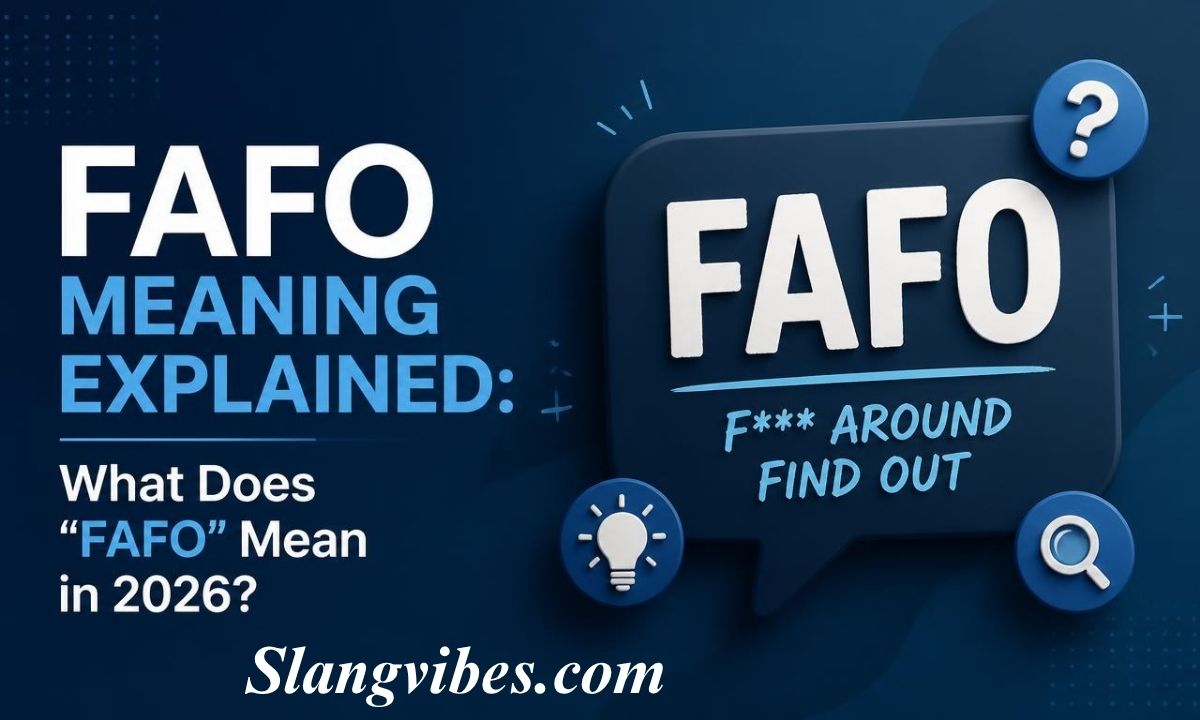
FAFO is short for “eff around and find out.” The clean version people use in captions and comments swaps out the curse word, but everyone knows what letter it’s standing in for. At its core, the phrase is a warning: keep pushing your luck, and you’re going to get an answer you didn’t want.
You’ll usually see it written as FAFO or fafo, and capitalization doesn’t change the meaning at all. It’s mostly a style choice. Some people shout it in all caps for emphasis, others lowercase it to keep the tone casual.
What makes this term flexible is how many ways it functions in a sentence. Merriam-Webster has actually tracked it being used as:
- A noun (“that was a total FAFO”)
- A verb (“he FAFO’d hard”)
- An adjective (“a FAFO moment”)
- An interjection, standing alone as a reaction
- A hashtag, which is where most people first ran into it
Quick Answer: FAFO means “eff around and find out.” It’s a warning that reckless behavior leads to real consequences, and it can be said as a joke, a threat, or a flat statement of fact depending on tone.
That range is exactly why context matters so much with this one. The letters never change, but the intent behind them shifts every single time.
Where Did FAFO Come From?
Here’s what most articles skip: FAFO isn’t a new phrase. The full saying, “eff around and find out,” has roots in African American Vernacular English, with recorded use going back to at least 2007. It also shows up in older biker slang, where it worked the same way it does now, as a warning that messing around with the wrong person or situation comes with a price.
What’s new is the acronym. Compressing the whole phrase into four letters is an internet-era move, built for captions, comments, and hashtags where space is tight and tone needs to land fast.
The term picked up serious momentum in 2022, after Elon Musk used it publicly during a dispute connected to Kanye West, which sent a wave of people searching to figure out what it meant. Around the same time, a TikTok creator named Roger Skaer posted a now-famous “FAFO chart,” visually mapping out how much someone has to “eff around” before they “find out.” That video is a big reason the phrase became a shared reference point instead of a niche saying.
So when you’re looking at the FAFO meaning, you’re really looking at decades-old street wisdom that got repackaged for a scroll-fast, caption-heavy internet.
Why FAFO Is Suddenly Everywhere Again
If FAFO feels more present than ever, that’s not in your head. The phrase has quietly moved from meme culture into actual institutional language over the past year or so.
In September 2025, U.S. Defense Secretary Pete Hegseth used the term while addressing military commanders, warning adversaries that consequences for hostile action weren’t just talk. Coverage of the moment was split. Some outlets treated it as blunt, plain-spoken messaging. Others called it an odd choice of words for a formal setting. Either way, it made headlines.
Then, in January 2026, the White House posted an image referencing FAFO tied to the capture of Venezuelan leader Nicolás Maduro. A phrase that started in comment sections was now attached to a major international news story.
I personally think that’s the real shift here. FAFO didn’t get a new meaning. It got a bigger stage. The warning behind it, that actions have consequences, translates just as easily to geopolitics as it does to a friend ignoring bad advice. That jump from internet slang to political shorthand is exactly why searches for the term have spiked again.
Read Also: What Does Surreal Mean In Slang? Definition & Examples
FAFO in Real Texts, DMs, and Comments

Reading FAFO on a screen without any tone of voice attached can be confusing. Context does almost all the work here, so let’s look at how it actually shows up in everyday conversations.
Text message, sarcastic:
“Told him not to text his ex at 2am. He did it anyway. FAFO 💀”
Instagram comment, playful roast:
“Bro tried to skip leg day for six months and now he’s got noodle legs. Classic FAFO.”
Group chat, genuine warning:
“If you keep ignoring the landlord’s emails, you’re gonna FAFO real quick when that late fee shows up.”
Sincere, self-directed:
“Didn’t study for the exam, told myself I’d be fine. Failed it. FAFO, honestly, that one’s on me.”
Tweet, political commentary:
“Every leader who’s ignored the warning signs eventually has their own FAFO moment.”
Notice how none of these needed extra explanation once the tone came through. That’s the pattern with this phrase. What this really means is that FAFO rarely stands alone as a definition; it works because of the situation wrapped around it.
Is FAFO a Threat, a Joke, or a Warning?
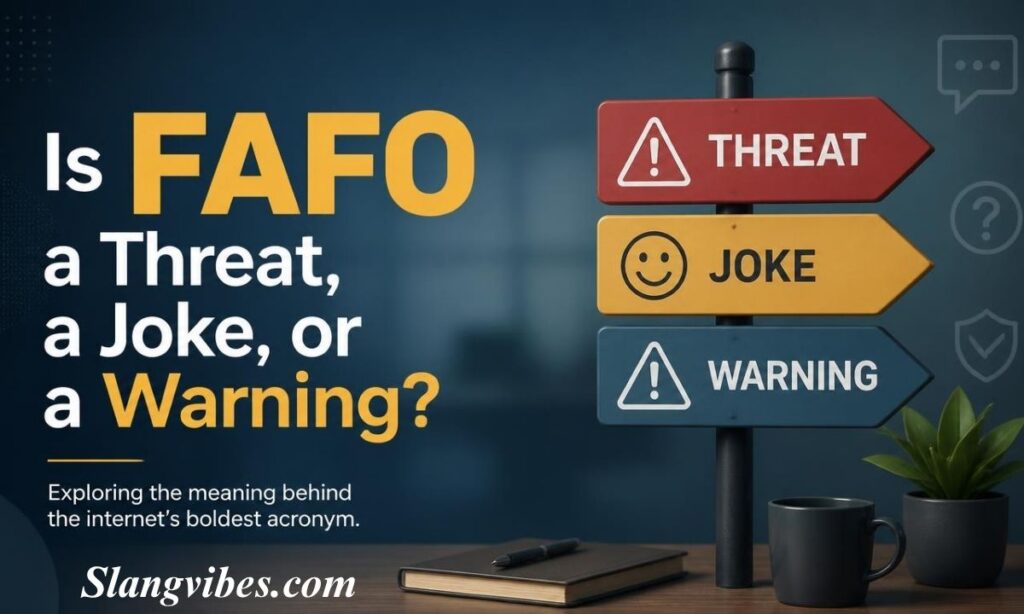
This is where most people get tripped up, and it’s a fair question. FAFO can be all three, and the tone depends entirely on who’s saying it, and why.
Used playfully, it’s basically a lighthearted “well, you kind of asked for that.” A friend who ignored your advice and got a predictable result usually gets the joking version. Nobody’s actually mad, they’re just enjoying being right.
Used as a genuine warning, it’s a heads-up before something bad happens. Think of it like a verbal yellow flag, someone telling another person to change course before things go wrong.
Used as a threat, it’s sharper. This version shows up in confrontations, arguments, or, as seen in real reporting, actual workplace disputes where people used the phrase alongside intimidation. That’s the version that can cross a line fast, and it’s worth taking seriously when it shows up in that context.
The short answer is you can usually tell which version you’re dealing with by looking at what came right before it. A laughing emoji or a sarcastic setup means it’s a joke. A flat statement with no humor attached, especially in a tense exchange, means it’s not.
FAFO vs Similar Slang: A Quick Comparison
FAFO gets lumped in with a handful of other internet acronyms, but they don’t all mean the same thing. Here’s how it stacks up against the terms people mix it up with most.
| Term | What It Actually Means | Typical Tone |
|---|---|---|
| FAFO | Reckless action leads to real consequences | Warning, joke, or threat |
| YOLO | You only live once, so take the risk anyway | Encouraging, carefree |
| IDGAF | I don’t care about the outcome or opinion | Dismissive, indifferent |
| TIL | Today I learned, sharing new information | Neutral, informative |
The key difference is direction. YOLO pushes someone toward taking a risk. FAFO shows up after the risk already backfired, or as a warning that it’s about to. They’re almost opposites in terms of timing, even though people sometimes use them in the same breath.
Also Read: What Does POV Mean in Slang? The Real Meaning, Explained
Where It’s Fine to Use FAFO, and Where It’ll Backfire
Context isn’t just about tone, it’s also about setting. FAFO works fine in some spaces and lands badly in others.
On social media, in group chats, and among friends, it’s low-risk. Everyone reads it the way it’s meant, and the casual, slightly crude edge is part of the appeal. It’s built for that kind of space.
At work, in customer service, or in any formal writing, it’s a different story. The phrase carries an implied curse word, and even the “cleaned up” version still reads as unprofessional in an email or a client-facing message. Using it in a performance review or a serious HR conversation is a fast way to undercut your own credibility, no matter how well the point lands.
It’s also worth avoiding in genuinely sensitive situations, like grief, illness, or someone going through a hard time they didn’t choose. FAFO implies the outcome was earned. That framing doesn’t belong anywhere near situations involving bad luck or things outside someone’s control.
Bottom line: read the room before the letters. If you’d hesitate to say the full uncensored phrase out loud in that setting, skip the acronym too.
Common Mistakes People Make With FAFO
A few misunderstandings keep popping up around this term, and clearing them up makes the whole thing easier to use correctly.
- Confusing it with FOMO. They look nothing alike once you know them, but people genuinely mix up the letters, especially typing fast. FOMO is about missing out, FAFO is about facing consequences.
- Mixing it up with FAFSA. Yes, this happens. Students searching financial aid forms occasionally land on FAFO instead. Different world entirely.
- Assuming it’s always aggressive. Plenty of FAFO usage is self-deprecating or funny, not hostile.
- Missing the humor in it. Reading every instance as a threat misses how often it’s just friends ribbing each other.
- Overusing it. Like most slang, it loses its punch fast if it’s attached to every single minor inconvenience.
Getting the tone wrong in either direction, reading a joke as a threat, or a real warning as a joke, is the most common way people misjudge this term online.
Gen Z vs Millennial Usage
The two biggest groups using FAFO online apply it a little differently, and it’s worth knowing the difference.
Gen Z tends to use it ironically and often turns it on themselves. A bad decision, a small embarrassing moment, a self-inflicted inconvenience, all fair game for a self-directed FAFO caption. It’s lighter, quicker, and often paired with humor or memes.
Millennials lean closer to the original, more literal warning. You’ll see it show up in workplace memes, parenting posts, and comments about real-world accountability, closer to the “actions have consequences” root of the phrase. It shows up less as a joke about yourself and more as commentary on someone else’s situation.
Neither usage is wrong. They’re just two branches of the same warning, shaped by how each group tends to talk online.
How to Respond When Someone Uses FAFO
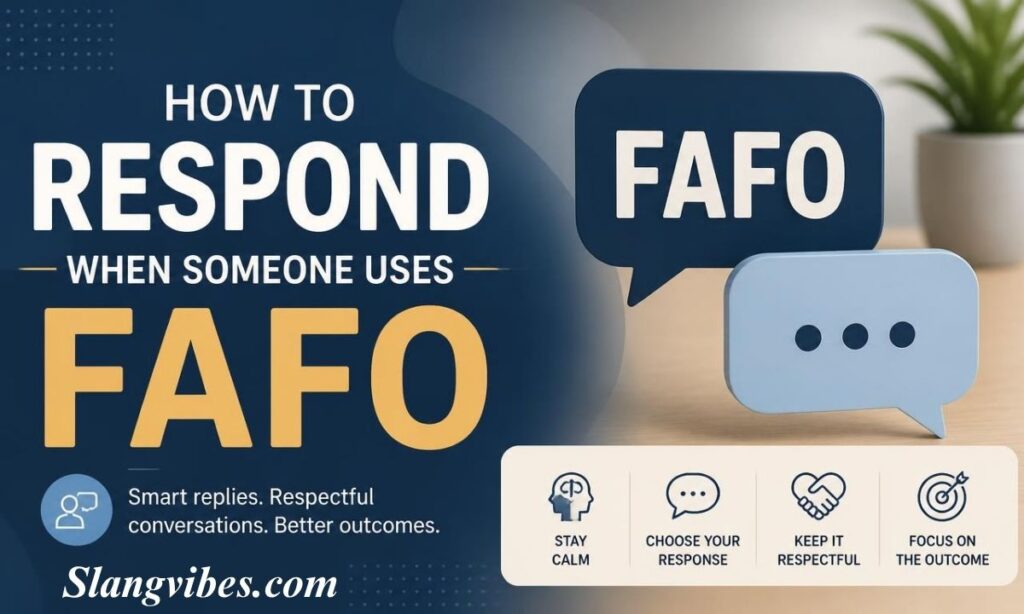
If someone drops FAFO on you, your reply depends on how it was meant.
For a playful jab, matching the energy works best: “Yeah, yeah, I know, lesson learned.” It shows you’re not taking it personally and can laugh at yourself a little.
If it’s aimed at you sincerely, as an actual warning, a mature reply like “Fair point, I’ll rethink it” shows you heard the message without escalating anything.
If it comes across as hostile or threatening, the smartest move is usually to disengage rather than match the tone. Responding to aggression with more aggression rarely helps, online or off.
Read More: What Does NPC Mean in Slang? The Real Meaning Behind It
Other Meanings and Specialized Uses of FAFO
Slang isn’t the only place FAFO shows up. A handful of very different fields have picked up the same four letters, sometimes for reasons that have nothing to do with internet culture at all.
FAFO Meaning in the Military
Wikipedia’s own list of military slang includes FAFO, and the term has roots in that world going back well before its recent viral run. It functions the same way it does everywhere else, as a blunt warning that reckless action gets met with a real response. That’s exactly the tone Defense Secretary Pete Hegseth used in a September 2025 speech to military commanders at Quantico, Virginia, telling potential adversaries that U.S. forces could “show them FAFO” if provoked. In that setting, it wasn’t a joke or a meme reference. It was a plain-spoken warning dressed in slang.
FAFO Meaning for Trump and in Politics
This is probably the biggest driver behind renewed searches for the term. In January 2026, the official White House social media accounts posted a black-and-white image of President Trump captioned “No games. FAFO,” released the same day as the capture of Venezuelan leader Nicolás Maduro. The post was widely read as a warning aimed at other foreign adversaries. Around Capitol Hill, the acronym showed up again in 2025 when Congressman Pat Harrigan introduced the “Foreign Adversary Federal Offense (FAFO) Act,” a bill targeting espionage carried out for hostile foreign governments. Two very different uses, same underlying idea: cross this line, and there’s a consequence waiting.
FAFO Meaning in Law
FAFO has no formal legal standing. It doesn’t appear in statutes, contracts, or court rulings, and no bar association or law school treats it as an actual doctrine. That said, the idea behind it lines up with real legal principles. Tort law has a concept called volenti non fit injuria, which covers someone who knowingly accepts a risk. Criminal law has the aggressor doctrine, which can strip a person’s self-defense claim if they started the confrontation. Legal commentators sometimes use “FAFO” informally as shorthand for these ideas, but it stays out of anything you’d actually file in court.
FAFO Meaning in Medicine
Here’s a genuine surprise: FAFO has a real, documented use in physical rehabilitation, and it has nothing to do with slang. A Functional Ankle Foot Orthosis, abbreviated FAFO, is a type of brace used to support patients with foot drop or spastic gait, often after a stroke. It’s referenced in peer-reviewed medical literature going back decades. If a doctor or physical therapist mentions “FAFO,” this is almost certainly what they mean, not the internet phrase.
FAFO Meaning in Spanish
FAFO doesn’t have an independent origin or meaning in Spanish. Spanish-speaking creators and commenters use the same English acronym, then translate the underlying phrase to match the tone. The most common informal translation floating around social media is “jódete y descúbrelo,” with some users reaching for the older idiom “el que la hace, la paga” (loosely, “whoever does it, pays for it”) to capture the same warning in a phrase that already existed in Spanish.
Other FAFO Meanings (Non-Slang)
A few unrelated organizations and works share the same four letters purely by coincidence. Fafo is also the name of a Norwegian research foundation focused on labor and social studies, unconnected to the slang term. It’s the title of songs by artists Zack Fox and the group @onefive. Researchers in blockchain computing have also used FAFO as shorthand for “Fast Ahead-of-Formation Optimization,” a technical scheduling method with no connection to internet slang at all. None of these overlap with the “consequences” meaning; they just happen to land on the same letters.
Frequently Asked Questions
What does FAFO mean in texting?
FAFO stands for “eff around and find out.” In texts, it’s used as a warning or a comment on someone facing consequences for their own actions.
Is FAFO offensive?
It contains an implied curse word, so it’s not considered appropriate for formal or professional writing. Among friends and on social media, it’s widely accepted as normal slang.
Is FAFO a threat?
It can be, depending on who’s saying it and why. In casual conversations it’s usually a joke or a warning, but in confrontational situations it can carry a genuinely threatening tone.
Why is FAFO popular again in 2026?
Recent use by public officials, including a Pentagon address in 2025 and a White House social media post in January 2026, pushed the term from internet slang into mainstream news coverage.
Can I use FAFO at work?
It’s best avoided in professional emails, client communication, and formal settings. A very casual workplace culture might tolerate it in a chat message, but it’s a risk that rarely pays off.
Does the FAFO meaning change depending on who says it?
The core meaning stays the same everywhere, but the tone shifts a lot. The same four letters can be a joke between friends or a serious warning depending on context.
Is FAFO the same as YOLO?
No. YOLO encourages taking a risk, while FAFO usually shows up after a risky choice has already backfired, or as a warning that it’s about to.
What does FAFO mean in the military?
It’s used as a blunt warning to adversaries that reckless or hostile action will get a real response. Defense Secretary Pete Hegseth used it this way in a 2025 speech to military commanders.
Does FAFO mean anything different in Spanish?
Not on its own. Spanish speakers use the same acronym and translate the phrase behind it, most often as “jódete y descúbrelo,” or lean on the older idiom “el que la hace, la paga.”
Is FAFO a medical term?
In one specific context, yes. FAFO stands for Functional Ankle Foot Orthosis, a type of brace used in physical rehabilitation, and it has nothing to do with the slang meaning.
Bottom Line
FAFO isn’t complicated once you see it in action a few times. It’s an old warning about consequences, shortened for a world that communicates in captions and comments instead of full sentences. The letters don’t change, but the tone around them does all the talking. Next time you see FAFO pop up in a text or a comment section, you’ll know exactly which version you’re looking at, and exactly how to respond.

Alex Carter is a language enthusiast and internet culture expert at SlangVibes. He explains the latest slang terms and text meanings in simple, clear English so everyone stays in the loop.