It’s a Sunday evening, the kind where you’ve done nothing all day but somehow feel drained anyway. A video pops up on your feed: someone lying face down on a bed, string lights blinking above them, caption reading “in my ennui era.” Four hundred comments agree with her. You don’t. You’ve never seen this word before, and typing it into a search bar at 9pm feels like the fastest way to find out what everyone else already knows.If a caption like this brought you here, the ennui meaning you’re looking for is simpler than it sounds and heavier than “bored.” This guide breaks down what the word means, where it came from, and why a French term from centuries ago is suddenly showing up in your comments section.
What Does Ennui Mean?
Ennui describes a state of deep, weary boredom mixed with dissatisfaction. It goes past having nothing to do. The feeling shows up when nothing sounds appealing, even the things you’d normally enjoy.
Regular boredom has an easy fix. Turn on a show, text a friend, go for a walk, and the feeling lifts. Ennui sits heavier than that fix, and even the fix feels pointless when you’re in it.
Dictionaries define ennui as a feeling of weariness and dissatisfaction, often tied to having too much ease or too little to occupy the mind. The mood reads as flat rather than sad, and quiet rather than dramatic. Someone experiencing ennui isn’t crying or panicking. They’re staring at the wall, unmoved by anything in front of them.
Context shapes how the word lands. A literature student citing ennui in an essay points toward French philosophy and 19th century poetry. A friend texting “I have ennui” at midnight means something closer to a stuck, restless mood. Both uses point at the same core feeling: existence, for a moment, feels exhausting rather than exciting.
Read Also: FAFO Meaning Explained: What Does “FAFO” Mean in 2026?
How Do You Pronounce Ennui?
The spelling throws people off before the sound does. Ennui isn’t pronounced the way it looks to an English reader.
Break it into two parts: ahn and WEE, with the stress landing on the second syllable.
American dictionaries list the pronunciation as ahn-WEE (IPA: /ɑːnˈwiː/). British dictionaries lean slightly different, closer to on-WEE (IPA: /ɒnˈwiː/). The gap is small, and either version reads as correct depending on where you learned English.
A simple trick: think of the word “gooey” and swap the G for a soft N sound at the front. Say “on-WEE” a few times out loud and the rhythm sticks fast.
Where Does the Word Ennui Come From?
Ennui comes directly from French, where it still means boredom today. Merriam-Webster and Oxford both trace it further back, to the Old French word “enui” and, before that, to the Latin phrase “in odio,” roughly translating to “it is hateful to me.”
Here’s a detail most people miss: ennui shares a root with the English word “annoy.” Both words grew out of the same Latin source, centuries apart, and landed in English through different paths. One stayed sharp and irritated. The other softened into something quieter and more resigned.
English writers picked up ennui in the 1600s and 1700s, borrowing it because “boredom” didn’t carry the same weight. French poets and philosophers ran with the concept through the 1800s, writing about the specific exhaustion coming from a life with too much comfort and too little purpose. Charles Baudelaire’s poetry, especially his work on urban “spleen,” gets credited often as a reference point for this exact mood. Even Thomas Jefferson used the word in a personal letter from 1787, describing days passing “without an object beyond the present moment.”
The word stuck around in literature for centuries before social media gave it a second life. The meaning has stayed close to the original for centuries. The people using the word, and the platforms carrying it, changed instead.
Read New Article: What Does Surreal Mean In Slang? Definition & Examples
Common Mistake: People often assume ennui is new Gen Z slang, something invented online in the past few years. It isn’t. Dictionaries have listed the word since the 1600s and 1700s, long before hashtags existed. The word is centuries old. Only the spotlight on it is new.
Ennui vs. Boredom, Melancholy, Burnout, and Apathy
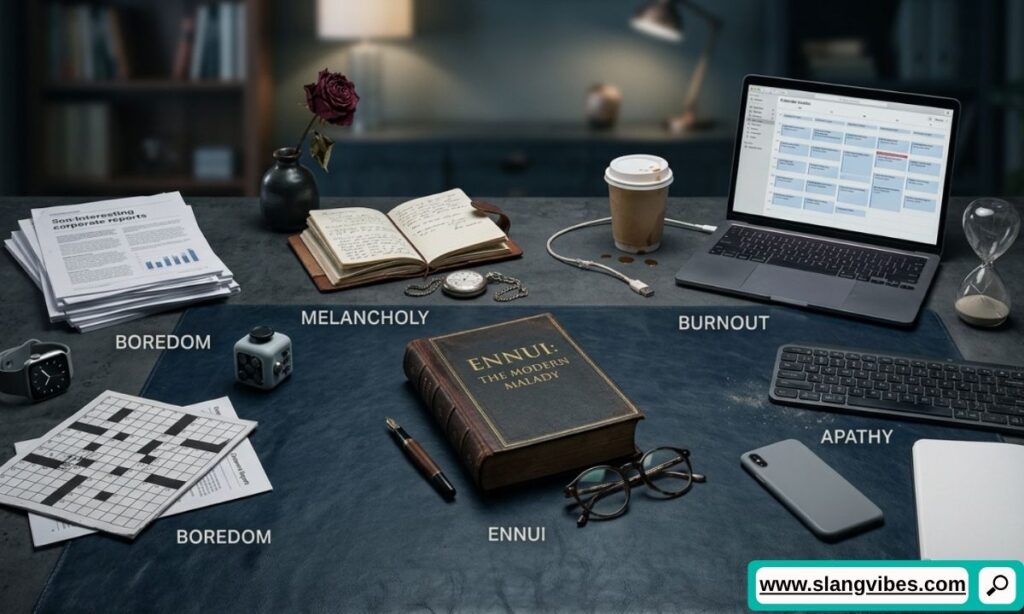
These words circle the same emotional territory, and mixing them up happens often. Here’s how they split apart.
| Term | What it feels like | How it differs from ennui |
|---|---|---|
| Boredom | Restlessness from having nothing to do | Fixes quickly with a distraction, while ennui lingers even through one |
| Melancholy | A gentle, reflective sadness | Carries more sadness, less flatness, than ennui |
| Burnout | Exhaustion from sustained overwork | Has a clear cause, while ennui often shows up without one |
| Apathy | Not caring about outcomes or people | Removes caring altogether, while ennui still notices the dullness |
| Languishing | A flat, joyless middle ground between thriving and struggling | Broader and less tied to boredom specifically |
| Depression | A clinical condition affecting mood, energy, and daily function | Needs professional care rather than a new word |
Languishing became a familiar word in 2021 after organizational psychologist Adam Grant used it in a widely shared New York Times piece, describing a stuck, joyless feeling sitting between depression and thriving. Ennui overlaps with this idea, carrying an older, more literary flavor and tying closer to boredom specifically.
Depression sits in a different category. It’s a diagnosable condition. It needs care from a professional rather than a new vocabulary word. A flat, low feeling sticking around for weeks and affecting sleep, appetite, or daily function is worth raising with a doctor or therapist, not only naming with a French loanword.
How People Use Ennui Online Right Now
The word shows up differently depending on where you’re scrolling.
On TikTok, ennui pairs with a specific visual: someone lying still, gray lighting, rain against a window, a slow zoom. The caption names the mood the video is already showing. You’ll see phrases like “ennui era” or “the Sunday ennui hit different this week” under these clips.
Instagram leans more curated. Captions pairing with black-and-white photos or moody edits use the word to add a literary touch to an otherwise simple post about a slow day.
X and Twitter treat the word with more irony. Posts joke about “ennui” while describing something small and mundane, like refreshing an inbox or waiting for a delivery. The gap between the word’s heavy history and the trivial situation is the joke.
Pinterest and aesthetic mood boards use “ennui-core” as a loose style label, grouping muted colors, film grain, empty rooms, and rainy windows under one visual mood. The word functions less like a caption here and more like a genre tag.
Across every platform, the word borrows weight from its literary past and applies it to ordinary, everyday tiredness. This contrast, a centuries-old term describing a Tuesday afternoon slump, is part of why it spread.
Read More: What Does POV Mean in Slang? The Real Meaning, Explained
Ennui in a Sentence: Real Examples From Texts and Captions

Seeing the word in context makes it easier to use naturally. Here are a few realistic exchanges.
Group chat, Friday evening, plans falling through:
Maya: down for a movie tonight? Jules: hard pass, pure ennui over here Maya: same energy, we’re both useless tonight Jules: cancel on me forever, I’m in my ennui era
Text exchange, early in a new relationship:
Priya: how was your Sunday? Sam: rough, deep ennui, didn’t leave the couch Priya: say less, bring the couch and the ennui to my place Sam: deal, bringing snacks too
Text exchange between siblings, six months after graduation:
Devon: how’s the job hunt Ren: stuck in this weird ennui, applied to zero jobs this week Devon: same last month, it passes eventually Ren: hope so, everything feels pointless rn
Is Ennui a Noun, Adjective, or Verb? Grammar and Spelling
Ennui works almost always as a noun in English. “I feel ennui” and “a wave of ennui” both use it this way, describing a state rather than an action.
The Oxford English Dictionary also records a rare verb form, meaning to bore someone, appearing in writing from the early 1800s. This use never caught on broadly and reads as archaic today, so sticking with the noun form keeps writing natural.
An adjective form doesn’t exist in standard English dictionaries. Some writers stretch it into “ennui-ridden” as an informal descriptor, though this stays a workaround rather than a recognized word form. In French, the adjective “ennuyé” (or “ennuyée” for feminine nouns) means bored, but English speakers rarely borrow this version.
The noun stays uncountable, similar to “boredom” or “sadness.” Dictionaries don’t list a standard plural form, so “ennuis” reads as unusual rather than correct.
Spelling trips people up too, since the double N and silent letters don’t match English patterns. Common misspellings include “on wee,” “anui,” “ennuie,” and “unwee.” Dictionaries don’t recognize any of these spellings, so the original French spelling stays the accurate choice.
Read Also: What Does NPC Mean in Slang? The Real Meaning Behind It
Synonyms and Related Words for Ennui
A handful of words circle the same feeling, each with a slightly different shade.
Malaise leans physical, describing a general unease sitting in the body as much as the mind. Listlessness points at low energy and motivation without the existential edge ennui carries. World-weariness reads as more dramatic, often used for someone tired of people or society broadly rather than a single afternoon. Languishing, the term popularized in 2021, describes stagnation without naming boredom specifically.
Casual alternatives popular right now include “in my flop era,” “bed rotting,” and simply saying “meh,” though none of these carry the same literary weight as ennui. Picking between them comes down to tone. Ennui signals a deliberate, almost poetic choice of words. The casual versions signal the opposite, a shrug dressed up as a caption.
How to Deal With Ennui
Naming the feeling helps more than people expect. Ennui thrives on vagueness, and putting a specific word to a flat mood makes it easier to address instead of sitting in it for hours.
Small, low-effort novelty tends to work better than a big plan. A new route on a walk, a different coffee order, a song outside your usual rotation, these small shifts wake up attention without demanding motivation you don’t have.
Movement helps more than screens do. A short walk outside interrupts the flat mood faster than another hour of scrolling, even when scrolling feels like the easier option in the moment.
Connection matters too. Ennui often thrives in isolation, and a short conversation with someone else, even a low-stakes one, tends to loosen its grip.
If the feeling sticks around for weeks rather than days, or starts affecting sleep, appetite, or the ability to function day to day, it’s worth a conversation with a doctor or therapist. Ennui describes a passing mood. A feeling stuck in place for a long time deserves a closer look, and there’s no downside to asking for support.
When to Use Ennui (and When to Skip It)

Ennui fits well in captions, journal entries, and conversations with people who already know the word. It carries a specific, slightly literary flavor, which works best when precision matters more than simplicity.
Skip it around people unfamiliar with the term, unless a quick explanation fits naturally into the conversation. It also doesn’t fit situations calling for direct, plain language, like explaining a mental health struggle to a doctor or a boss. Save the poetic version for captions, and use plainer words when clarity matters more than style.
Read New Article: What Does SB Mean in Text? Definition, Slang, Usage & Examples (2026)
FAQ
What does ennui mean in simple terms?
Ennui means a deep, tired kind of boredom paired with dissatisfaction. It goes past having nothing to do and shows up when nothing sounds appealing, even things you’d normally enjoy.
How do you pronounce ennui?
Say it as ahn-WEE, with the stress on the second syllable. British dictionaries list a version closer to on-WEE, though both pronunciations read as correct.
Is ennui the same thing as depression?
No. Ennui describes a mood, one which comes and goes. Depression is a diagnosable condition needing professional care. A flat feeling lasting weeks and affecting daily life is worth raising with a doctor rather than naming with a slang word.
Why do Gen Z and millennials use this word so often?
Social media rewards precise, aesthetic language, and ennui fits a specific mood modern life produces: too much stimulation, not enough meaning. The word also carries a built-in irony, a centuries-old French term used to describe a slow Tuesday, which fits how younger generations often talk about their own burnout.
Is ennui considered slang, or is it a real word?
Ennui isn’t internet slang. Dictionaries have listed the word since the 1600s and 1700s. Social media adopted the term rather than inventing it, borrowing an existing word to describe a modern feeling.
Conclusion
Ennui names a specific kind of tired, the kind showing up when nothing sounds appealing and even rest feels like effort. The word carries centuries of literary history, borrowed from French writers who needed a term heavier than boredom, and it landed on social media because this exact feeling never went away. It only found new places to show up.
Next time a caption reads “ennui era” under a rainy window video, the mood behind it makes sense now. Nothing dramatic, nothing especially sad, only a flat stretch where everything feels a little pointless. Naming a feeling doesn’t fix it by itself, though it makes the feeling easier to sit with, and occasionally easier to shake.

Alex Carter is a language enthusiast and internet culture expert at SlangVibes. He explains the latest slang terms and text meanings in simple, clear English so everyone stays in the loop.