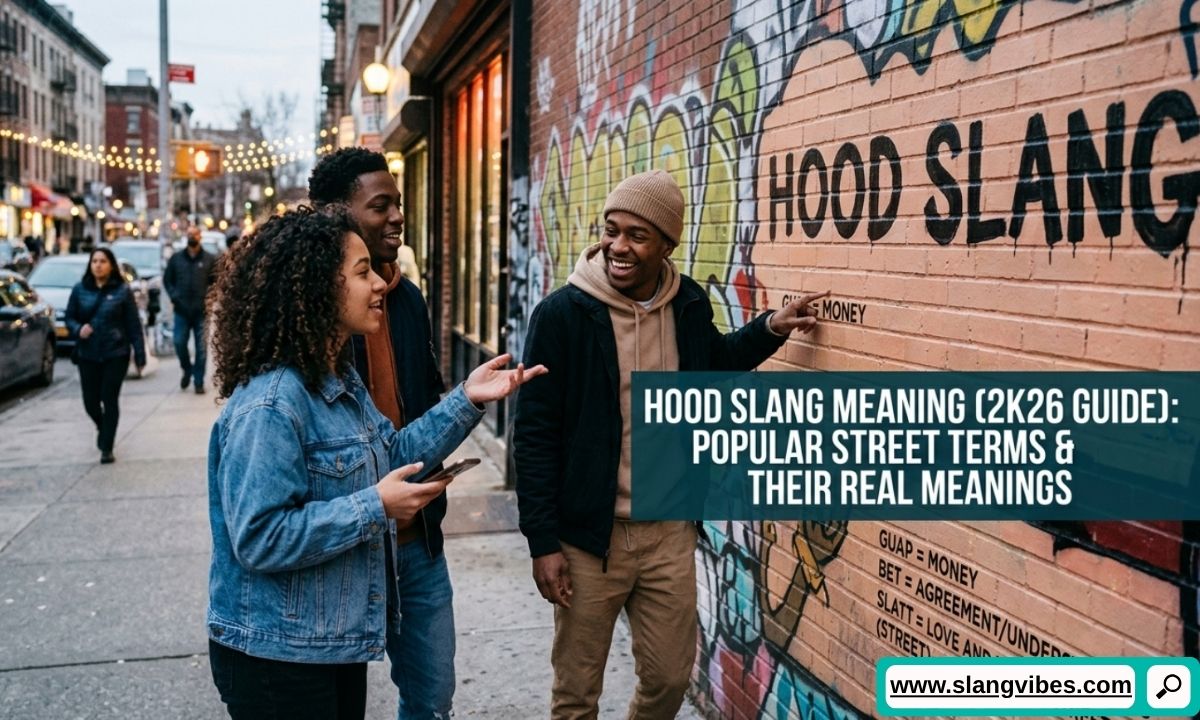
You’ve likely scrolled past it a hundred times. Someone drops “she’s mad hood” under a TikTok, or a cousin texts “stop acting so hood” after you skip the gym for pizza. You catch the vibe, sort of, but the exact meaning stays fuzzy. Here’s the thing: hood slang meaning isn’t a single dictionary line, and this is why so many people search for it every week. The word carries history, region, tone, and context all at once. One person uses it as a compliment. Another uses it as a jab. This guide breaks down where hood slang words come from, what the most common ones mean today, and how to use them without sounding forced.
Quick Answer: Hood slang means informal language born in urban neighborhoods and street culture. It covers words for money, style, friendship, and mood, spreading through hip-hop, social media, and everyday texting.
What Is the Real Hood Slang Meaning?
At the root, “hood” comes from “neighborhood.” Somebody says “my hood” the way another person says “my block” or “my area.” The slang layer builds from there. As an adjective, “hood” describes a look, an attitude, or a way of carrying oneself. “She’s hood” points to street style and confidence, not poverty or trouble.
Context flips the tone fast. Said with respect, it’s a compliment, a nod to authenticity and grit. Said with a sneer, it turns into an insult about class or background. The word carries weight because it ties to real communities and real pride, not a random trend showing up overnight.
So when someone searches for hood slang meaning, they’re often asking two things. First, what “hood” itself signals. Second, what the wider vocabulary tied to street culture and urban slang terms includes. Both matter, and this guide covers both.
One more thing worth knowing early: hood slang isn’t static. New hood phrases show up constantly, especially through Gen Z hood slang trends on TikTok and Instagram. Older terms fade out or shift meaning within a season or two. A word your older sibling used in high school might already sound dated to someone in middle school today, and this gap keeps stretching as trends move faster online.
Where Hood Slang Comes From: A Quick History
Street slang doesn’t appear out of nowhere. Most hood slang words trace back to African American Vernacular English. This dialect holds deep roots in Black communities across the South, and later in cities like New York, Chicago, and Los Angeles.
From Neighborhoods to the Mainstream
Hip-hop turned this vocabulary into something the whole country, and eventually the whole world, heard. Rap lyrics carried words like “fam,” “flex,” and “dope” out of specific neighborhoods and into radio, television, and the internet. Films set in urban communities during the 1990s pushed street culture slang further into the mainstream, giving outsiders a window into language once confined to specific blocks. Music videos and early cable television did the same job for a generation before the internet existed, moving phrases from block parties to national airwaves.
Social media sped the whole process up. A word coined on one block reaches millions within days now, through short videos, captions, and comment threads. This is part of why hip hop slang and internet culture feel so tangled together today. One feeds the other constantly, and the cycle keeps moving faster each year, with new platforms replacing old ones as the main engine.
More Than One Community Shaped It
It’s worth remembering hood slang draws from more than one community too. Terms like “throwing shade” and “reading” someone trace back to Black and Latino queer ballroom culture before hip-hop carried them into the mainstream. The vocabulary people call hood slang today sits at the crossroads of several overlapping communities, not a single source.
Worth noting: when these words travel far from their origin, they often lose the weight and specificity they carried at home. A term tied to real struggle or pride in one community turns into a throwaway caption somewhere else. Knowing the backstory doesn’t stop anyone from using the words. It adds a layer of respect to how they get used, and this stands as a fair trade for borrowing language built by someone else’s lived experience.
Read Also: EMP Meaning in Text: Platform-by-Platform Guide
Hood Slang Meaning in Practice: Popular Words and What They Mean Today
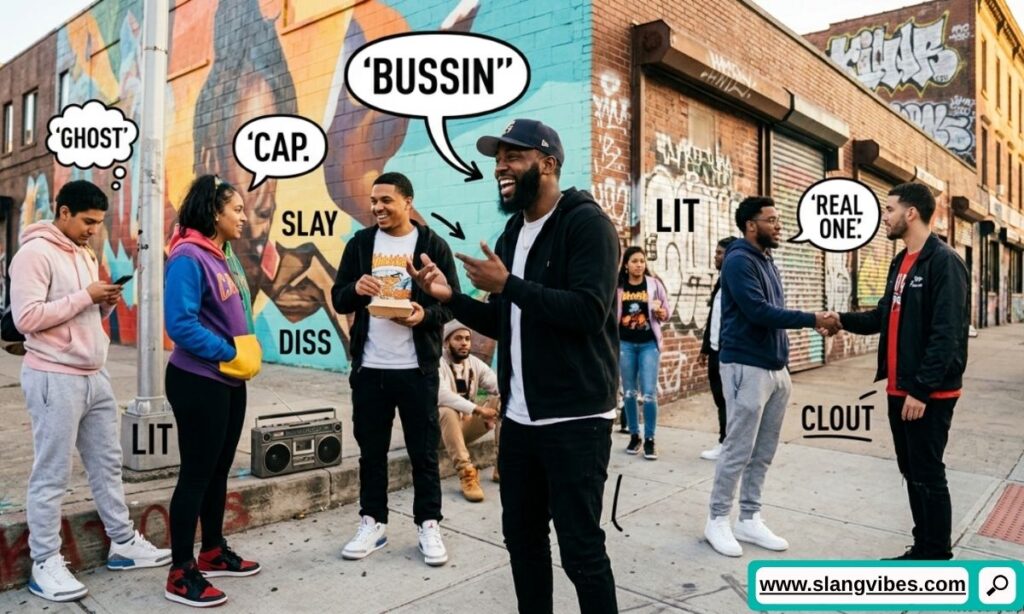
Here’s where the hood slang meaning gets concrete. Below are the terms people search for most, grouped by what they do in a sentence, not a random alphabetical dump.
Money and Style Slang
- Drip – stylish, well-put-together fashion. “New kicks? Pure drip.”
- Flex – showing off money, achievement, or status.
- Bag – money or income. “Trying to secure the bag this year.”
- Clout – influence or fame, especially online.
People and Relationships Slang
- Fam – a close friend, not necessarily blood family.
- Homie – a trusted, loyal friend.
- Squad – a friend group.
- Ride or die – someone who stays loyal no matter what happens.
Approval and Disapproval Slang
- Cap / No cap – a lie / seriously, no lie.
- Bet – agreement, similar to “okay” or “deal.”
- Wack – bad, disappointing, or boring.
- Mid – average, unimpressive, heavily used across Gen Z hood slang right now.
Vibes and Emotions Slang
- Lowkey / Highkey – secretly, mildly / obviously, strongly.
- Bussin – extremely good, usually about food.
- Big mood – a feeling so relatable it needs no explanation.
- Finna – about to do something. “I’m finna head out.”
| Term | Meaning | Example Use |
|---|---|---|
| Drip | Stylish fashion | “He pulled up with the drip today.” |
| No cap | Seriously, honestly | “This test was brutal, no cap.” |
| Bet | Agreement | “Meet at 7? Bet.” |
| Mid | Average, unimpressive | “The movie was kind of mid.” |
| Big mood | Deeply relatable | “Tired but still scrolling. Big mood.” |
Hood Slang in Real Conversations
Seeing these words strung together in real conversation helps more than any list does. Here’s a quick exchange between two friends after a party:
Jordan: yo last night’s party was hood ngl Sam: fr the music was bussin Jordan: no cap, best one all semester
Here’s how the same vocabulary shows up in a dating context, where tone matters even more:
Riley: he pulled up in a whole new fit, straight drip Casey: bet he’s trying to flex for you Riley: lowkey working ngl
And here’s a sibling exchange showing how casual the words sound in everyday family texting, not only among friends:
Marcus: mom said clean your room, she’s not playing Devin: bet, finna do it right now Marcus: fr do it before she gets home, no cap
None of this reads as forced. The words carry emotion and rhythm, which is part of why they spread so fast through texting slang and social media slang in the first place.
Emoji pairings shift meaning too. “No cap” next to a skull emoji usually signals something shocking rather than a plain statement of honesty. “Drip” paired with fire emojis reads as a bigger compliment than the word alone. Reading the emoji alongside the slang word gives a fuller picture of the tone someone’s going for, especially in short comment threads where punctuation barely exists.
Read More: GPI Meaning in Text: Everything You Need to Know in 2026
Hood Slang in the UK vs the US
Street slang doesn’t stay confined to one country. UK youth culture has built its own version alongside American street slang, sometimes borrowing directly and sometimes running its own path entirely.
| UK Term | Rough US Equivalent | Meaning |
|---|---|---|
| Ends | Hood / block | Neighborhood or local area |
| Peng | Fire / dope | Attractive or excellent |
| Bare | Mad / hella | A lot, or to a strong degree |
| Wagwan | What’s good | Casual greeting |
| Creps | Kicks | Sneakers |
| Innit | Right? / fr | Tag added for agreement or emphasis |
A London teenager might say “the food was peng, bare good.” A teenager in the US says almost the same thing: “the food was fire, mad good.” Same energy. Different regional flavor. Neither version sounds strange to someone raised on either side.
Group chats mixing US and UK friends often show this overlap in real time:
Amara (London): copped new creps, they’re peng Devon (Chicago): bro those are fire fr Amara: wagwan with you today though Devon: nothing much, chilling
The gap between the two scenes isn’t as wide as people assume. Both borrow heavily from Black British and Black American communities, both move through music first, and both spread through the same platforms now. TikTok slang in particular blurs the line between US and UK street language almost daily. UK creators popularize terms among American audiences, and the reverse happens within the same week.
Does Hood Slang Change From City to City?
Regional slang differences are real, and they show up fast once someone starts paying attention. New York leans on words like “deadass,” “mad,” and “son” as a term of address between close friends. Chicago carries its own set, including “going up” for celebrating a win and “opp” for a rival or enemy. The West Coast keeps older dope-era vocabulary alive while adding its own laid-back twist to newer terms.
The South, especially Atlanta, contributes heavily to current trends, with words like “finesse,” meaning to cleverly obtain something, moving from local trap culture straight into national hip hop slang. Houston and Philly add their own flavor too, from stretched-out vowel sounds to phrases tied tightly to their own neighborhoods. A term born in one city frequently becomes common hood slang everywhere within a single year, thanks to music and short-form video pushing it well beyond its starting point.
US Cities vs International Hotspots
Toronto brings its own mix into the picture too. It blends Caribbean influence with US hip hop slang into words like “wagwan” and “man dem.” These terms overlap with UK street language, thanks to Caribbean communities on both sides of the Atlantic. The DMV area, meaning DC, Maryland, and Virginia, carries its own go-go music influence, giving rise to slang rarely traveling beyond the region at all.
London works the same way on a smaller scale. Slang shifts from one borough to the next, and a word sounding completely normal in South London might draw a blank stare in North London. Neighborhood slang has always worked like this, tight and hyperlocal until something pushes it outward.
This regional layer matters because using the wrong city’s term in the wrong setting sounds off, even when the meaning lands correctly. Paying attention to where a phrase comes from helps it land the way it’s meant to, and it shows the person using it did more than skim a list.
Hood Slang Meaning vs Ghetto Slang vs Street Slang
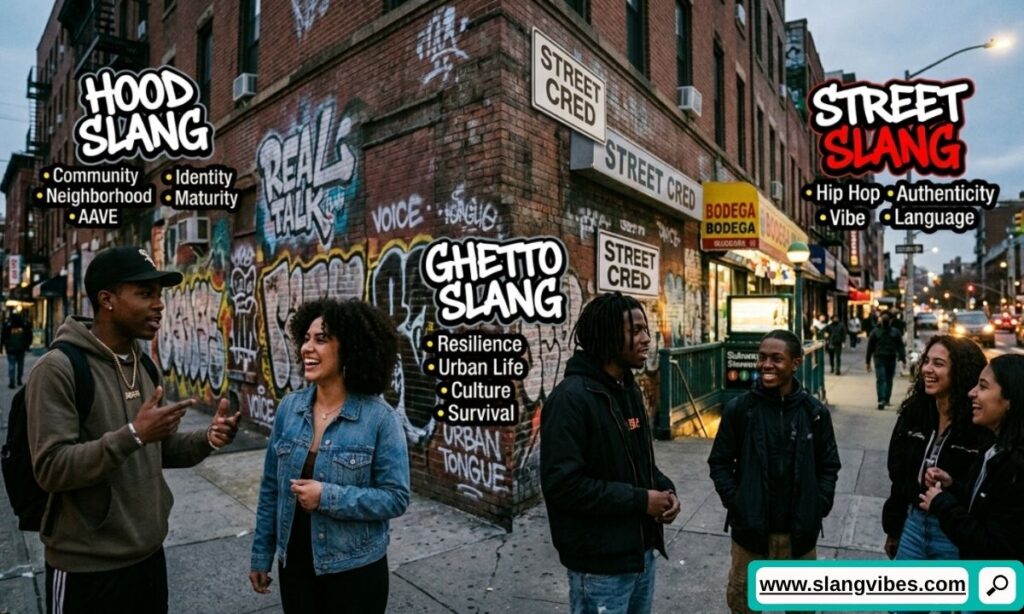
These three terms get lumped together constantly, and the hood slang meaning genuinely differs from the other two, even though people use them interchangeably online.
“Hood” describes identity, pride, and authenticity tied to an urban community. Someone described as hood carries themselves with confidence rooted in where they’re from. This holds true whether they work a corporate job or run a small business from the same neighborhood.
“Ghetto” carries a heavier, more sensitive history. It historically points to a low-income area, and the term gets used in ways which read as dismissive or mocking, especially from outsiders describing behavior they see as low-class. Using this word calls for extra caution, since the line between description and insult sits thin, and intent doesn’t always come across the way the speaker meant it.
“Street” leans toward behavior tied to survival and hustle, things like navigating danger, making money outside traditional paths, or reading a situation quickly. Someone is hood without being street, and someone is street without living anywhere near “the hood” at all. The two words describe different traits entirely, even though people mix them up in everyday conversation.
Keeping these three separate helps you use hood slang words with more precision, and it keeps conversations from sliding into territory sounding careless or uninformed.
How to Use Hood Slang Without Sounding Fake
Timing and audience decide whether hood slang lands naturally or falls flat. A few habits keep it feeling authentic instead of performative.
Match the room first. Casual texts, group chats, and social media captions are where hood phrases thrive. A work email or a formal presentation isn’t the place for “no cap” or “bet,” no matter how comfortable those words feel in daily conversation.
Listen before repeating. Terms picked up from one video or one friend’s text thread sometimes carry local or situational meaning which doesn’t translate everywhere. Sitting with a word for a bit before saying it out loud tends to prevent awkward moments down the line.
Don’t stack too many terms in one sentence. A message like “no cap, this fit is bussin, straight drip, big mood fr fr” reads like a costume rather than natural speech. One or two words per message usually feels smoother than five packed together.
Here’s a quick workplace scenario showing the mismatch when context gets ignored:
Manager: Let’s circle back on the deck after lunch, no cap. Teammate: (polite smile, mild confusion)
The manager isn’t wrong about the word’s meaning. The setting doesn’t fit it. Code-switching, or shifting language style depending on who’s in the room, remains a normal and healthy skill, not a sign of dishonesty or fakeness. Most people already do this without thinking, moving between a texting voice and a work voice several times a day.
Is Hood Slang Offensive? Context and Respect Explained
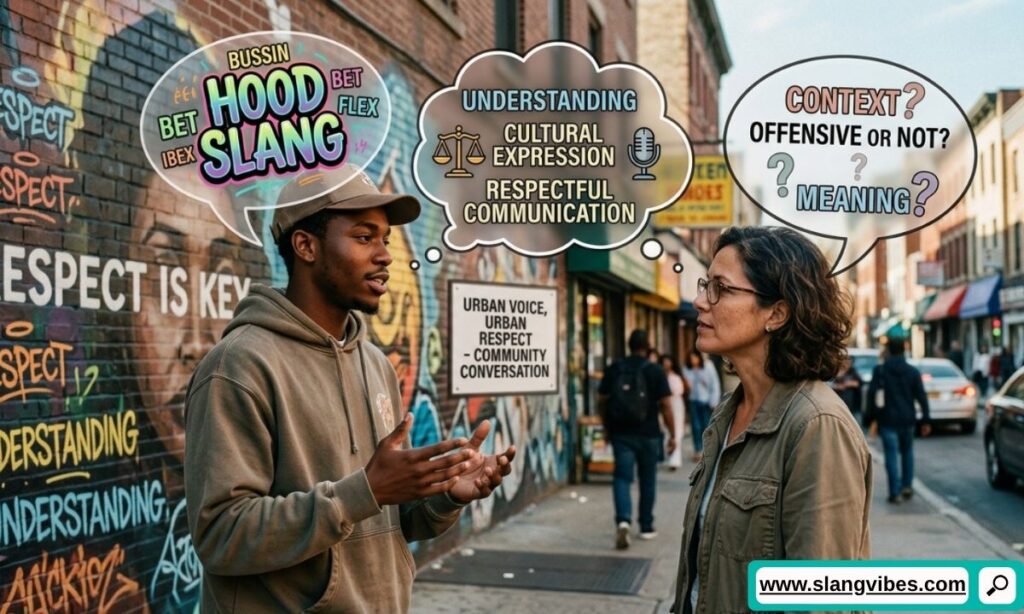
On its own, hood slang isn’t offensive. It’s informal language, the same category as any regional dialect or youth culture vocabulary developing naturally over time and spreading through the people who live it every day.
Trouble starts when the words get used to mock a community rather than participate in its culture. Someone imitating an accent or exaggerating slang to make fun of a group crosses into disrespect fast. Most people sense the difference between genuine use and mockery within a sentence or two, without even thinking it through.
Using these words without any personal tie to the culture they came from still feels fine in most cases. The intent needs to stay respectful, and the delivery shouldn’t turn the language into a punchline. Plenty of people outside Black and urban communities use hood slang daily without issue. They’re using it the way it’s meant to be used: casually, warmly, and without irony.
A handful of hood slang words carry weight tied directly to gang life or violence rather than fashion, mood, or friendship. These terms sit in a different category entirely, and tossing them around casually, especially without knowledge of what they signal, reads as careless at best and alarming at worst. The safe move is treating any word connected to real danger or loss with the seriousness it deserves, rather than folding it into a fun caption.
The safest approach stays simple. Use the words the way the community behind them uses them. Skip the ones tied to serious or painful history unless real understanding sits behind them. And when in doubt, a quick search or a short conversation with someone familiar with the term clears things up faster than guessing ever will.
Read New Article: YNS Meaning in Text: What It Stands For and How People Use It
FAQs About Hood Slang
At its core, hood slang meaning points to informal language from urban neighborhoods, covering everything from money and fashion to mood and friendship.
No. Regional slang differences show up between US cities and even between UK boroughs, so the same word carries a slightly different flavor depending on where it started.
Yes, in most casual settings, as long as the tone stays respectful and the words aren’t used to mock or stereotype anyone.
It does. New hood phrases spread through TikTok, Instagram, and everyday texting within weeks, while older terms quietly fall out of rotation.
Most trace back to specific neighborhoods, then spread outward through hip-hop, social media, and word of mouth until they’re common hood slang nationwide.
Final Thoughts
Hood slang isn’t a fixed list of words to memorize. It’s a living part of street culture, shaped by neighborhoods, hip-hop, and now social media, changing shape every year while keeping its roots intact. Understanding hood slang meaning means knowing where a word comes from and how tone changes its impact. The same term reads as a compliment in one context and an insult in another.
The words in this guide cover the ones showing up most right now, from money and style to mood and friendship. It also covers the regional twists between the US and the UK. None of it calls for memorizing a script. Pay attention to how people around you talk day to day, match your language to the room you’re in, and the rest follows naturally.
Slang keeps moving, and it always will. Some of the words above stay in rotation for years, while others fade within a single summer. Staying a little curious about where hood slang is headed next helps. So does giving credit to the communities shaping it. Together, this is the easiest way to keep up without missing the point.

Alex Carter is a language enthusiast and internet culture expert at SlangVibes. He explains the latest slang terms and text meanings in simple, clear English so everyone stays in the loop.