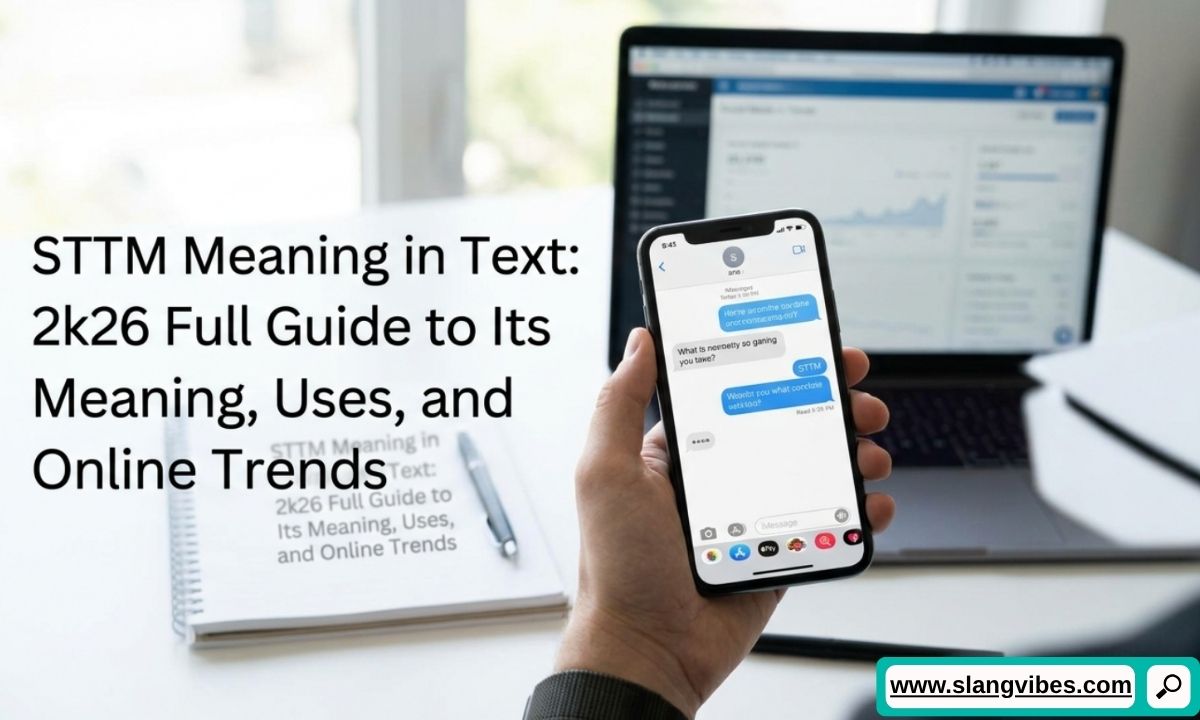
Last week, my group chat went quiet for a second, then one friend sent “STTM” with nothing else attached. I stared at my phone for ten seconds, trying to work out if she was mad at me, asking for something, or being weird. This is the exact moment most people first meet the STTM meaning, mid conversation, with zero warning.
Some people use it to mean “Stop Talking To Me.” Others swear it stands for “Send This To Me.” A few corners of the internet insist it means “Something To Tell Me” or even “Spill The Tea To Me.” This guide breaks down every real STTM meaning circulating right now, where each one shows up, and how to tell which one fits your chat. No guessing required by the end.
Quick Answer: The most common STTM meaning is “Stop Talking To Me,” used playfully among friends. Other common versions include “Send This To Me,” “Something To Tell Me,” and “Spill The Tea To Me.” Context decides which one applies.
What Is the STTM Meaning in Texting?
The most common STTM meaning across chats and comment sections is “Stop Talking To Me.” People use it during teasing, mock arguments, and reactions to something embarrassing or funny.
Tone changes everything here. A friend sending “STTM 😭” after a bad joke isn’t mad. She’s laughing. The same four letters, typed with a period and no emoji, sent during a real disagreement, read completely differently.
Here’s a quick breakdown of how the phrase behaves in casual chats:
- Used after a cringe story or bad joke, usually playful
- Used during a real argument, usually meaning space is needed
- Used in a caption or comment, usually dramatic for effect
Texting slang like this rarely works as a fixed rule. The letters stay the same. The feeling behind them moves around based on who’s typing and why.
Younger texters lean on STTM the way older generations used “ugh” or “whatever,” as a quick stand-in for a bigger reaction. It’s short, a little dramatic, and it fits the pace of a fast-moving group chat.
If someone unfamiliar with texting acronyms sees it cold, “Stop Talking To Me” sounds harsh. Read next to laughing emojis or a string of jokes, the same four letters come across as affectionate teasing instead.
Plenty of people search this phrase right after seeing it mid-conversation, since the four letters offer no clue on their own.
Read More: STSU Meaning in Text: What It Really Means on Facebook, TikTok & Instagram (2026)
Why Do People Disagree on the STTM Meaning?
Search around and you’ll find real disagreement over the STTM meaning. Different sites, different creators, and different online communities each push a different version as the “real” one.
Here’s a look at the four meanings showing up most often, based on where each tends to appear:
| Claimed Meaning | Where It Shows Up | General Vibe |
|---|---|---|
| Stop Talking To Me | Friend group chats, TikTok comments | Playful, sometimes serious |
| Send This To Me | Resale groups, meme pages, Instagram | Direct, low drama |
| Something To Tell Me | Curious or gossip-toned DMs | Inquisitive, casual |
| Spill The Tea To Me | Gossip threads, group chats | Eager, high energy |
Picking the wrong meaning in a reply sends the wrong tone back. A joke turns into an awkward moment. A request turns into confusion.
Each of these four meanings is valid inside its own space. Every one grew inside a different corner of the internet, then spread through whichever app made it visible.
This is normal for slang built from four letters. Short acronyms are easy to reinvent, because there’s little to anchor the “official” version. LOL only means one thing. STTM doesn’t work the same way.
The safest approach: treat STTM as a small family of meanings rather than one fixed phrase. Which version applies depends heavily on the conversation around it.
How to Figure Out Which STTM Definition Fits
Reading the right STTM definition comes down to three things: platform, relationship, and punctuation.
Start with platform. A gaming lobby, a resale group, and a close friend group chat each lean toward a different meaning by default. Relationship matters too. Close friends lean sarcastic. Strangers in a comment section usually mean it at face value.
Punctuation carries more weight than people expect. A period at the end sounds final. An emoji or “lol” attached softens it instantly.
Here’s how this plays out in a real exchange:
Maya: You seriously wore this to the interview?
Priya: STTM 😭 it went fine though
Maya: Okay good, I was stressed for you
Priya isn’t asking Maya to stop talking here. She’s reacting to being called out, half laughing at herself. Swap the emoji for a flat period, and the same three letters read as annoyed instead of amused.
A short checklist helps before replying:
- Does the message end with an emoji or “lol”? Usually playful.
- Is it a single flat line with a period? Read the last few messages for tension.
- Did it show up under a photo, meme, or listing? Likely “Send This To Me.”
- Is it inside a gossip-heavy thread? Likely “Spill The Tea To Me” or “Something To Tell Me.”
Match the setting first, then the tone. Which version applies usually becomes obvious once both line up.
Read Also: TMI Meaning in Text: How Gen Z Uses It on Social Media
Where the STTM Definition First Came From
Nobody has traced a single starting point for STTM. Like most short texting acronyms, it grew out of general shorthand culture rather than one clear invention, and there’s no official full form recognized everywhere.
Instant messaging pushed people toward faster typing for years. Early texting brought LOL, BRB, and IDK into daily use. Group chats and meme culture pushed things further, favoring short, expressive reactions over full sentences.
STTM likely grew out of this same pattern, picked up by different groups for different reasons at different points. This explains why so many competing meanings exist today instead of one settled definition.
A few patterns line up with what’s visible online now:
- Early SMS habits favored short, typing-saving abbreviations
- Meme culture pushed toward dramatic, reaction-based phrases
- Resale and marketplace comment sections favored quick request phrases like “send this to me”
No single article, dictionary entry, or forum post marks the first real use. Based on how the term spreads today, it reads like several groups landing on the same four letters independently, each attaching its own phrase to it.
Gen Z and Gen Alpha texting habits push this reinvention even faster. New slang spreads through short-form video and group chats within days, not years, so acronyms like STTM pick up extra meanings quickly.
This layered origin shows up often with short internet slang. The shorter the acronym, the easier it becomes for different communities to reinvent it without knowing anyone else already had.
How the Meaning Behind STTM Shifts by App
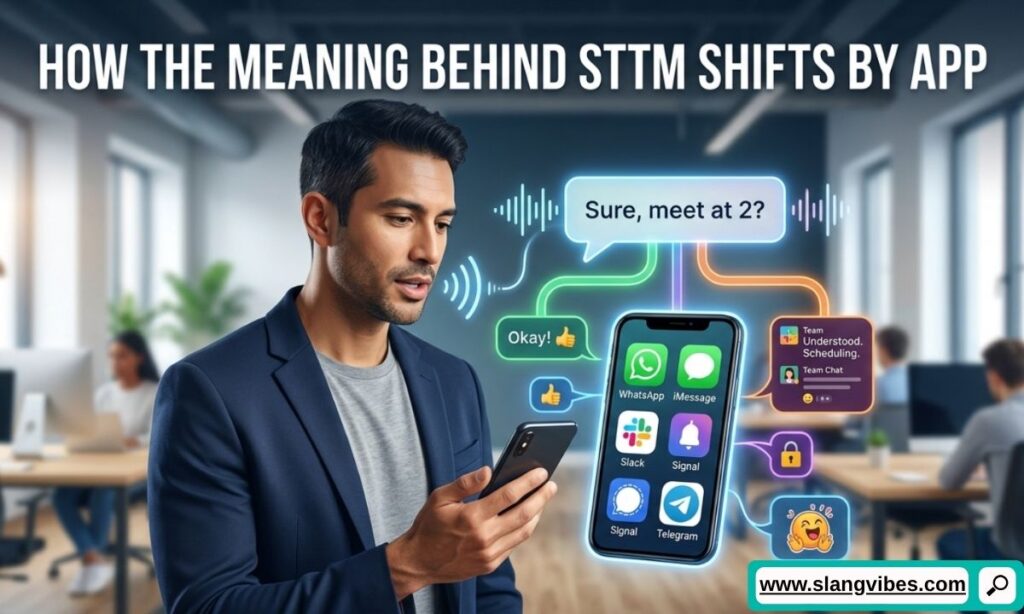
The idea behind STTM stays close to the same set of options everywhere. What changes is which version dominates on each app.
Instagram and TikTok
On Instagram, STTM shows up under photos, memes, and comment threads, often leaning toward “Send This To Me” when someone wants a screenshot or link.
TikTok comments lean more dramatic. A shocking clip or cringe moment tends to pull “Stop Talking To Me” out as an exaggerated reaction.
Snapchat and WhatsApp
Snapchat streaks and quick replies favor the playful, sarcastic version. A friend spoiling a show or sending something embarrassing gets a quick “STTM 💀” in response.
WhatsApp group chats behave similarly, especially among close friends who already share private jokes.
Discord, Gaming Chats, and iMessage
Inside Discord servers and gaming lobbies, STTM turns up after a rough play or a lost match, usually as a joke between teammates rather than genuine frustration.
Group texts on iMessage usually mirror the same tone as whichever app the friend group already uses most.
X (Twitter)
On X, STTM tends toward sarcasm aimed at daily annoyances, like a long meeting or a rough Monday, rather than a real request or reaction to a friend.
Reading the app first narrows things down fast. A resale caption points toward “send it over.” A reaction comment under a wild clip points toward the dramatic version instead.
Read Here: SMD Mean in Text: What It Really Means on Facebook, TikTok & Twitter (2026)
STTM Meaning in Real Text Conversations
Seeing the phrase inside an actual thread makes the real sense of STTM far easier to spot than any dictionary-style definition.
Here’s a sibling exchange where the playful version shows up clearly:
Jordan: I ate the last slice of pizza btw
Casey: STTM. Actual betrayal
Jordan: You would’ve done the same 😂
Casey: Correct. Still mad though
Nobody in this thread wants Jordan to stop talking for real. Casey is annoyed for effect, not asking Jordan to stop texting.
Here’s a different scenario, this time in a small group chat planning a night out:
Alex: anyone have the flyer for tonight
Sam: yeah one sec, STTM to whoever needs it
Riley: me please!
Sam: sending now
In this version, “STTM” works as shorthand inside Sam’s own sentence, standing in for “send this to me” as a request rather than a reaction.
The tone shift between these two threads shows exactly why context carries so much weight. Same letters, same platform style, completely different intent behind them.
Before assuming which version applies, scan the two or three messages around it. A joke right before or after usually points toward the playful reaction. A photo, link, or file mentioned nearby usually points toward the request meaning instead.
STTM Meaning in Gaming Chats, Dating Apps, and Resale Groups
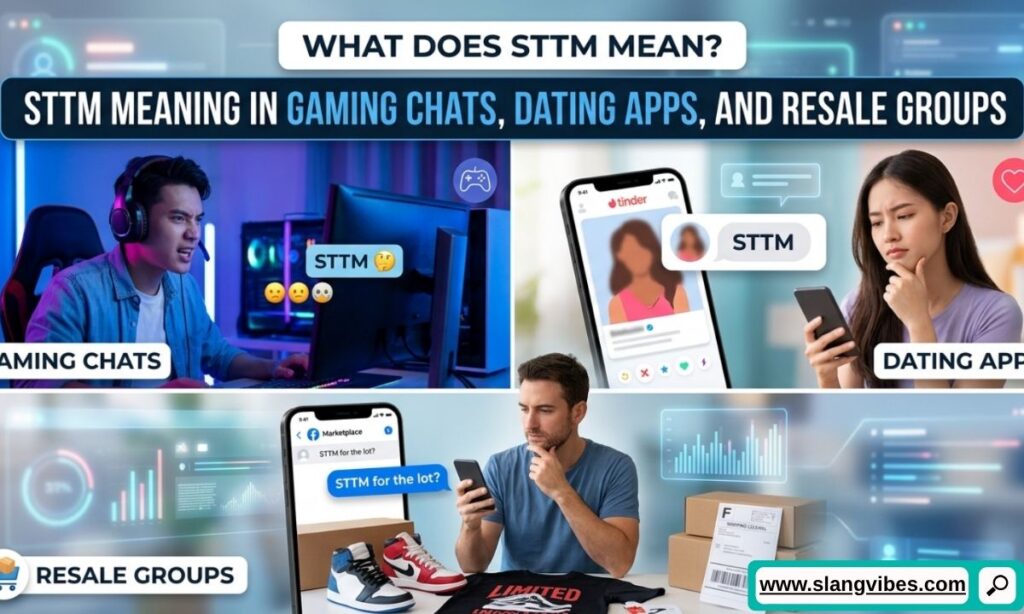
Beyond friend group chats, STTM shows up in a few specific communities worth calling out on their own.
In gaming chats, teammates use it after a missed shot or a lost round, almost always as a joke rather than a real complaint. It works the same way trash talk works between friends who play together often.
Screenshots posted inside fan and hobby Discord servers pull a similar pattern. Someone posts a rare find or a funny screenshot, and “STTM” shows up as a direct request for the file or image rather than a reaction.
On dating apps, a flirtier version shows up. Someone might respond to a compliment or a cheesy line with “STTM 😭,” meaning something closer to playful embarrassment than real annoyance. It signals flustered excitement rather than rejection.
Resale and marketplace spaces tell a different story. Under a listing on Depop, Poshmark, or a Facebook Marketplace group, “STTM” almost always means “Send This To Me.” It’s a fast way to claim an item or request more photos without typing a full sentence.
A shopper commenting “STTM” under a jacket listing wants the seller to follow up directly, usually through a DM. Sellers see this constantly and treat it as a quick heads up signaling interest.
Each of these spaces leans hard toward one meaning over the others. Gaming and dating chats favor the reaction-based version. Resale threads favor the request version almost every time.
Knowing which community a message came from removes most of the guesswork before reading a single emoji.
Read More Articles: What Does BM Mean in Text? What It Really Means on Facebook, TikTok & Instagram (2026)
Common Mistakes People Make With the STTM Meaning
A few mix-ups come up constantly around STTM, and most of them come down to skipping context.
The biggest mistake: assuming it always means something harsh. Most of the time, especially between friends, it’s closer to a laugh than a complaint.
Another common slip is using it somewhere formal. Sending “STTM” in a work email or a professional message reads as unprofessional, regardless of which meaning was intended. This comes down to message etiquette: reading the room before sending four letters, since tone rarely comes through as intended over text.
A few situations where the phrase tends to backfire:
- Sending it during a job-related conversation
- Using it with someone unfamiliar with texting slang, like a parent or older relative
- Dropping it into a serious conversation where the other person is genuinely upset
Parents or older family members decoding a teenager’s texts often assume the worst version by default. Seeing “STTM” without any emoji attached, out of context, understandably reads as rude. Age gaps make this worse: a parent who grew up spelling out full phrases often reads any acronym as colder than the sender intended.
The tone mismatch runs both directions too. Someone raised on the “Send This To Me” version might read a joking “STTM 😭” completely wrong, assuming a request instead of a reaction.
Slowing down for a second before replying solves most of these mix-ups. Reading two or three messages around it, rather than the acronym alone, clears things up almost every time.
How to Reply When Someone Sends You STTM
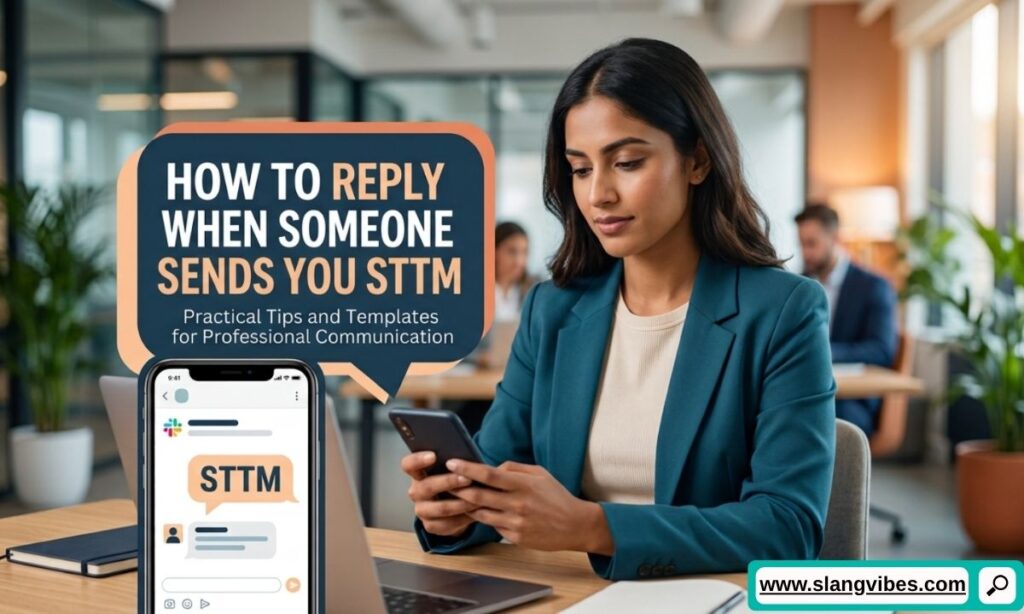
Replying well starts with matching the energy of whatever version was sent your way.
If a friend sends the playful version after a joke, keep it light. A simple “never!” or “you know you love me” works fine, and usually gets a laugh back.
Here’s a coworker-adjacent moment where the mismatch shows up clearly, since one person means it seriously and the other reads it as a joke:
Devon: You’re telling this story again? STTM
Priya: Rude, I’m not done
Devon: Fine, five more minutes
Reading Devon’s line without emoji or “lol” sounds sharp out of context. Inside this exchange, both people clearly know it’s a joke.
Dating apps bring a lighter, flustered version of this exchange:
Jamie: okay you’re way too charming, STTM 😭
Morgan: only if you admit I’m funny too
Jamie: fine, you’re funny AND charming
Here, replying with a tease back keeps the flirty tone going, since the reaction version of STTM doesn’t need anything sent, only the right energy back.
When unsure which version was intended, a quick clarifying question beats guessing. Something like “wait, do you want me to stop or send something?” clears it up in one line without overthinking the reply.
A short guide for replying depending on the version:
- Playful reaction: match the humor, keep it short
- Request version: send whatever was asked for, or confirm you will
- Genuinely annoyed tone: give space, don’t push the joke
Matching tone rather than assuming one fixed meaning keeps most exchanges running smoothly.
Read New Article: OTW Mean in Text: What It Really Means on Snapchat, TikTok & Instagram (2026)
STTM vs Similar Texting Slang
STTM sits next to a handful of other short reaction-based acronyms, though each carries a slightly different weight.
| Term | How It Differs From STTM |
|---|---|
| SMH | Signals disbelief or disappointment, without the playful “stop” framing |
| IDC | Signals a lack of interest, flatter and less dramatic |
| GTFO | Stronger and blunter, rarely used as gently as STTM |
| IKR | Agreement focused, used to back up what someone else said |
| BRUH | A general reaction to something silly, without a request or “stop” meaning |
The overlap with SMH causes the most mix-ups, since both often follow something embarrassing or ridiculous. SMH leans toward disbelief on its own. STTM adds a layer of “stop doing this to me” which SMH doesn’t carry.
IDC works almost the opposite way. Where STTM often reacts with energy, whether playful or annoyed, IDC signals the sender isn’t invested either way.
Each of these terms carries a distinct tone. Swapping one in for STTM changes the feel of the message.
FAQs About STTM
What does STTM meaning in text?
The STTM meaning most people default to is “Stop Talking To Me,” though “Send This To Me” and a few other versions show up often too.
Is STTM always rude?
No. Between friends, it’s usually playful. Without emojis or friendly context, it reads harsher than intended.
Does STTM meaning the same thing on every platform?
Not exactly. Resale groups lean toward “Send This To Me,” while comment sections and group chats lean toward the reaction-based version.
Is it okay to use STTM at work?
It’s better to avoid it there. Casual texting slang like this reads as unprofessional in emails or work chats.
Why do different sites give a different definition of STTM?
Short acronyms like this get reinvented by different groups independently, so more than one meaning sticks around at once.
Wrapping Up STTM
The STTM meaning isn’t one fixed thing, and it doesn’t need to be. “Stop Talking To Me” covers most playful reactions between friends. “Send This To Me” covers resale groups and quick requests. “Something To Tell Me” and “Spill The Tea To Me” show up in gossip-leaning threads.
Context does the real work: platform, relationship, punctuation, and whatever came right before the message. Read those signals first, and the right meaning usually becomes obvious within a few seconds.
Texting slang moves fast, and STTM likely won’t stay locked into these four meanings forever. Gen Z and Gen Alpha communities will keep bending it toward whatever fits their own conversations.
Next time it shows up in a chat, skip the guessing. Check the app, check the tone, and reply to match. Decoding STTM comes down to exactly this.

Alex Carter is a language enthusiast and internet culture expert at SlangVibes. He explains the latest slang terms and text meanings in simple, clear English so everyone stays in the loop.