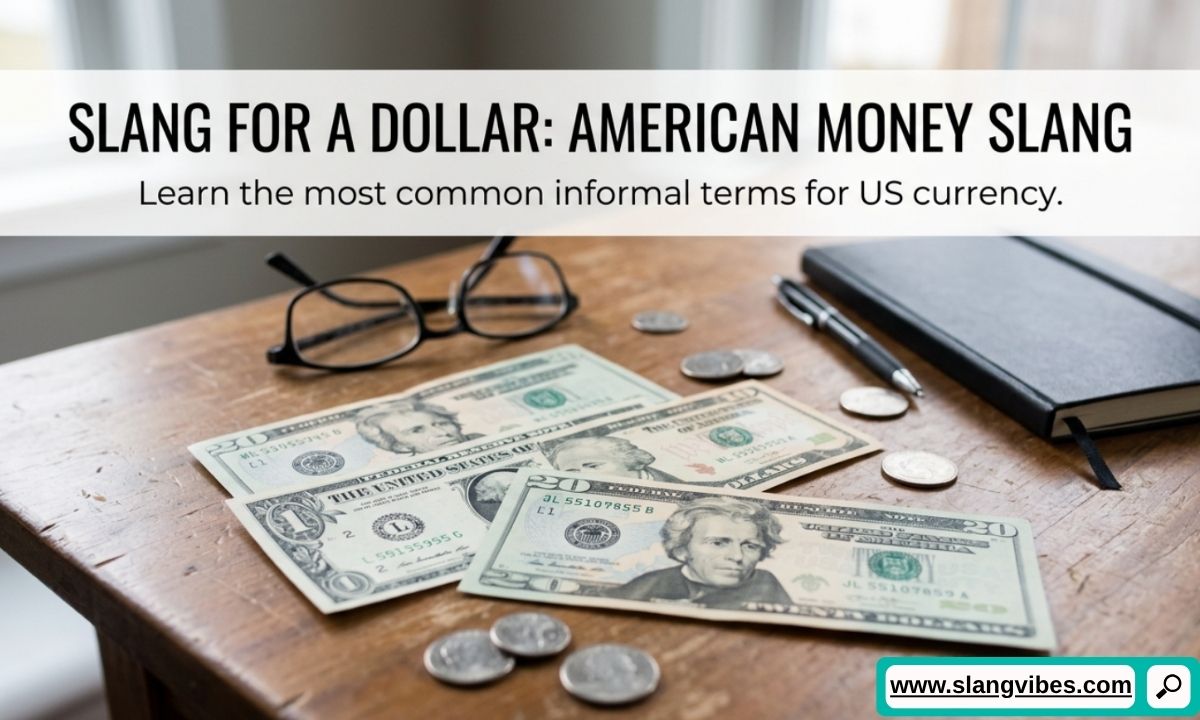
My cousin flew in from London last summer. He asked a food truck guy if he had “a couple quid” for a burger. The guy stared at him blankly. My cousin meant dollars, but back home everyone says quid. The word landed like a foreign language in Austin, Texas. This mix-up got me thinking about how many words Americans use instead of the plain word “dollar.” Slang for a dollar shows up everywhere.
You’ll hear it at the register and in old song lyrics. It shows up in a text from a friend asking you to Venmo them “a few bucks.” Some of these words go back over a hundred years. Others got invented last month on TikTok. This guide walks through the terms you’ll hear most, where they came from, and when each one fits the moment. By the end, translating American money talk should feel a lot less like guesswork.
What Counts as Slang for a Dollar?
Slang for a dollar covers every informal word Americans use in place of “one dollar” or “money” in general. Some terms describe the physical bill. Others describe cash as a whole. The two categories blend together in everyday speech, which is part of why the list gets so long.
English has more synonyms for money than for almost any other everyday object. Part of the reason is history. Waves of immigration, regional trade, and pop culture each added a layer of vocabulary on top of the last one. None of the earlier layers fully disappeared. A word coined during a 19th-century trade route sits right next to a term born on TikTok last year. Both still get used without anyone flagging the gap.
Most of these words trace back to how the bill looks or what it used to be traded for. Sometimes a cultural moment made a term stick instead. Take “buck,” the most common one on the list. Long before paper currency spread across the American frontier, traders used deerskins as a unit of value. People often shortened the word to “buckskins.” Over time, people dropped “skin” and kept “buck,” and the word stuck around long after deerskin trading ended.
Money slang works differently from most slang categories. It rarely disappears completely. Old terms stick around in specific settings, like family sayings, regional dialects, and old movies. New terms keep piling on top of them. This explains why a grandparent, a parent, and a teenager in the same house might each reach for a different word. Nobody has to think twice about it.
Read Also: PMO Meaning in Text: What It Really Means in Chat, TikTok & Snapchat (2K26 Guide)
Everyday Dollar Slang You’ll Hear All the Time
A handful of terms show up so often, most people barely register them as slang anymore.
- Buck – the default word for one dollar, used by nearly every age group
- Single – a literal one-dollar bill, often mentioned when someone needs small bills for a tip or a machine
- One – shorthand version of “single,” heard mostly when talking cash denominations
- Bone – an older, more casual word for a dollar, still used in a joking tone
- Smacker – a playful term for a dollar bill, popular since the 1920s
- Clam – a vintage but still recognizable word for a dollar
Here’s how a couple of these sound in a real exchange:
Maya: Hey, you got a buck for the parking meter? Jordan: Yeah, hold on. I think I’ve got a single in here somewhere. Maya: Perfect, thanks. Jordan: No problem, pay me back with coffee sometime.
Notice how “buck” and “single” work in the same sentence without sounding redundant. “Buck” describes the value. “Single” describes the physical bill. Native speakers switch between the two without thinking. It’s a useful distinction if you’re learning American slang from scratch.
A Few More Worth Knowing
Ace shows up occasionally as slang for a single dollar. The word borrows from card game terminology. There, the ace ranks as the lowest or highest card, depending on the game. Duckets, sometimes spelled “duckets” or “ducats,” traces back to old European coins. Gold and silver versions once circulated across parts of the continent. Neither term appears as often as buck or single. Both still pop up enough in casual speech and older films to be worth recognizing on sight.
Old-School Slang for a Dollar From Past Decades
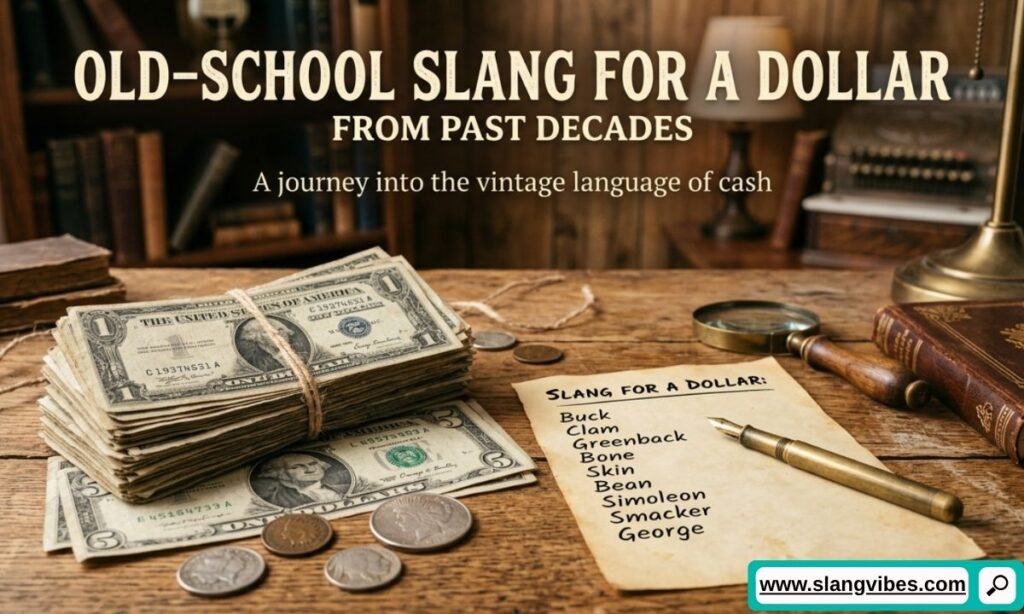
Some dollar slang belongs to an earlier era of American English. A lot of it still survives in movies, older relatives’ speech, and detective novels.
Simoleon dates back to the late 1800s and nobody agrees on where it came from. Some link it to “simon,” an old British slang word for a shilling. Others think it’s a playful mash-up of “Napoleon” and “simon.”
Scratch started as general slang for money around the mid-20th century. The term likely ties to the idea of scratching out a living.
Greenback goes back to the Civil War. The U.S. government printed paper currency with green ink on the back, to distinguish it from earlier notes. The nickname stuck, and people still use it for dollar bills over 150 years later.
Smackeroo is a goofier cousin of “smacker.” It popped up in the 1940s and mostly shows up now as a joke or a callback to old slang.
Moolah floated around mid-20th-century speech with no confirmed origin story. A few word historians speculate a loose connection to Romani vocabulary for money, though nothing about the link is settled. It never referred to one specific dollar amount. This looseness is part of why it faded from daily use faster than more specific terms like “buck” or “sawbuck.”
Picture a black-and-white film scene. A guy in a fedora slides a bill across a diner counter and says, “keep the change, doll.” This is the world this slang comes from, and it still colors how these words feel today, even decades later. A lot of these terms survive mostly because pop culture keeps recycling them. Think throwback playlists, retro-styled shows, and old detective novels people still pick up.
Read Now: Slang Terms for Alcohol: 150+ Popular Drinking Words and Nicknames (2026 Guide)
Gen Z and Internet Money Slang
Newer dollar slang moves fast, and the internet speeds it along even more.
- Bread – a modern word for money, tied to the idea of bread as a basic need
- Coin – often used for smaller amounts, especially in gaming and side hustle talk
- Bag – describes money earned or a good financial opportunity (“secure the bag”)
- Fetti – regional slang, likely from the Spanish word “feria,” meaning loose change
- Guap – hip-hop-rooted slang for a solid amount of cash
These terms move through group chats, comment sections, and short-form video fast. Older slang never traveled through word of mouth at this speed. Group chats speed the churn along even further, since a term spreads nationally within days instead of years.
Priya: bro I need bread for the concert tickets Sam: same, I’ve got zero coin left this month Priya: we’re both cooked lol Sam: payday needs to hurry up already
Where the Newest Terms Come From
Racks, usually tied to a stack of bills, comes from trap and hip-hop culture. It drifted into general Gen Z vocabulary over the past decade. It works loosely for a dollar amount in casual bragging, even when the actual number stays vague.
Platform habits shape how fast these words spread. A term coined in one creator’s caption spreads to comment sections within hours. It reaches group chats by the next morning. Emoji pairings often ride along with the text, especially 💵 and 🤑 next to a money term. The emoji adds tone without adding words.
Not every one of these terms lasts. Some fade out within a couple of years, replaced by whatever a popular creator says next. Others, like “bread,” have stuck around long enough to feel closer to permanent slang than a passing trend.
Read More: Snowball Kiss Meaning: The Truth You Didn’t Expect 😳
How Digital Payments Changed Dollar Slang
Venmo, Cash App, and Zelle reshaped how people talk about a dollar without printing a single bill. “Spot me” now covers a quick digital loan about as often as a handful of cash. “Send me a couple bucks” works the same way either way. The money might move as paper or arrive as a notification on a phone screen.
Some slang adapted directly to the format. People say they’ll “drop” someone a payment. The phrase borrows the language of physically handing something over, even though nothing changes hands physically. Group expense apps also popularized phrases like “settle up.” This phrase pairs naturally with older slang once the actual number comes into the conversation.
Older terms like “greenback” or “clam” sound a little out of place applied to a digital transfer. Both terms lean on the physical bill itself. Newer terms like “bread” and “coin” translate more smoothly, since neither one was ever tied to paper currency specifically.
Slang for Dollar Bills by Denomination
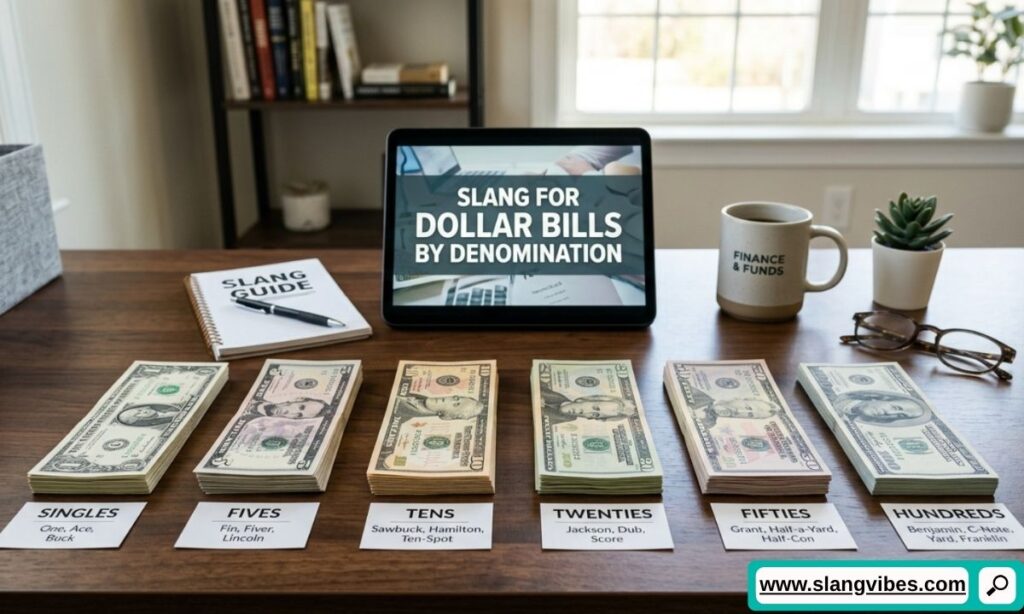
Dollar slang isn’t only about the $1 bill. Nearly every common denomination has its own nickname. Knowing them helps you follow along when someone mentions a dollar amount without saying the number.
$1 to $10 Bills
- $1 – single, one, buck, or ace
- $2 – a deuce, borrowed from the same card game logic behind “ace”
- $5 – a fin, short for the Yiddish word for five, or a Lincoln, named for the portrait on the bill
- $10 – a sawbuck, likely from the Roman numeral X on early bills, which resembled the crossed legs of a sawhorse
$20 and Up
- $20 – a Jackson, named for Andrew Jackson’s portrait
- $50 – a Grant, named for Ulysses S. Grant’s portrait, though this one gets used far less often than Jackson or Benjamin
- $100 – a Benjamin or a C-note, referencing Benjamin Franklin’s portrait and the Roman numeral for 100
- $1,000 – a grand or a stack
Fun Fact: Benjamin Franklin is the only face on U.S. paper currency who never served as president.
This naming pattern makes American cash slang feel almost like a nicknaming system. Portraits and shapes on the bills themselves drive most of it. Learning even a few of these terms makes it easier to follow along in movies, song lyrics, and casual money talk. No translation needed.
Hip-Hop and Pop Culture Money Terms
A big chunk of modern American money slang grew out of music. Hip-hop and R&B culture from the 1980s onward drove much of it.
Cheese has an odd, well-documented backstory. In the 1980s, the U.S. government distributed blocks of processed cheese through food assistance programs. People started calling money “cheese” as a nod to the connection. The word eventually spun off into “cheddar,” a more specific and playful version of the same idea.
Cheddar grew directly out of “cheese” and now gets used on its own. It often reads as the more upbeat, energetic-sounding version of the two.
Paper refers to cash in general. People often use it to describe someone who deals mostly in physical bills instead of cards or digital payments. The phrase “chasing paper” grew into a common way to describe someone hustling hard for money. It shows up across decades of music without belonging to one single song or artist.
Dough predates hip-hop by decades. It traces back to 19th-century slang comparing money to something essential you knead and work for, similar to the logic behind “bread.”
Devon: This gig paid decent cheddar, not gonna lie. Marcus: Nice, you flush with paper now? Devon: Enough to cover rent, at least. Marcus: Living the dream, my man.
These words carry a specific tone. They sound confident and a little playful. This mix is part of why they show up so often in music and casual bragging between friends, even outside hip-hop circles.
Read New Article: Slang for Friends: 100+ Popular Terms People Use in 2026
American Money Slang vs British Slang
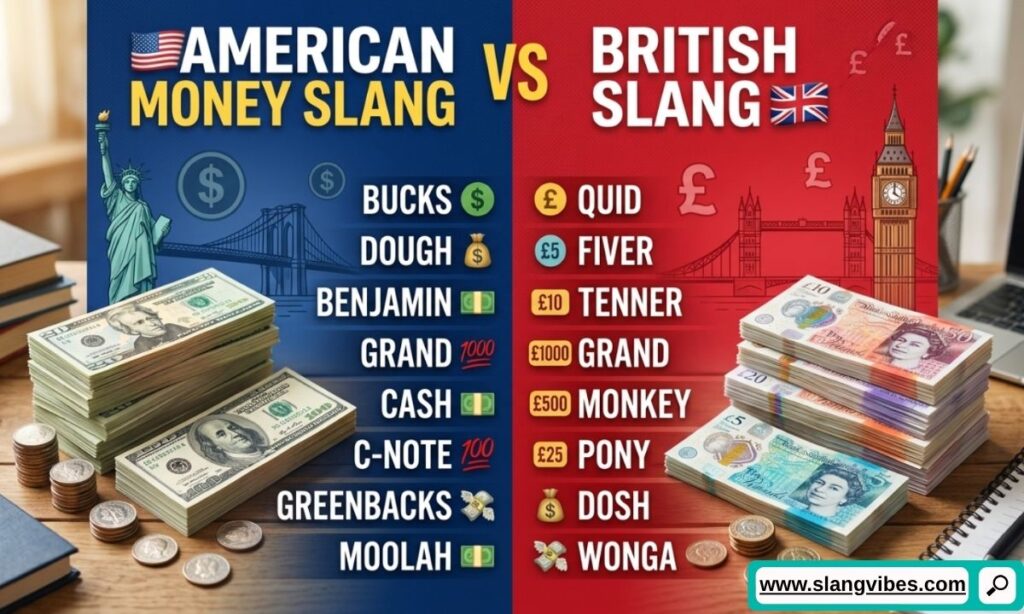
Money slang looks different depending on which side of the Atlantic you’re standing on. English speakers still share plenty of vocabulary otherwise.
In the US, the go-to terms are buck, fin, sawbuck, Jackson, and Benjamin. In the UK, the equivalents sound completely different. Quid covers a pound, a fiver covers £5, a tenner covers £10, and a score covers £20. Older British speakers might also say “brass” for money in general, another reminder these two slang systems evolved independently.
A British reader hearing “sawbuck” for the first time has little chance of guessing the meaning. The same goes for an American hearing “tenner” without context. Neither term describes the bill’s appearance or a portrait. Each one grew out of a completely separate slang tradition.
Canadian and Australian English pull from both worlds. Both lean on American-style terms like “buck” for their own dollar. Each also keeps a few homegrown nicknames, like “loonie” for the Canadian dollar coin or “a note” for paper currency in general.
If you’re a UK reader picking up American slang, buck is the safest word to start with. It works in nearly any casual US setting and rarely sounds forced or dated, unlike some of the older terms on this list.
Even the basic vocabulary around cash differs. Americans call paper currency “bills.” British speakers usually say “notes.” Neither version counts as slang exactly. The difference still trips up plenty of travelers before the money slang even enters the conversation.
How to Use Dollar Slang the Right Way
Knowing the words is half the job. Using them at the right moment is the other half.
Casual settings are where dollar slang belongs: texting friends, ordering food, chatting with coworkers you’re close with. Formal settings call for the plain word “dollar.” This applies to emails, financial paperwork, and conversations with someone you don’t know well. In professional emails or client-facing messages, plain language always reads safer than slang, even when the tone stays friendly overall.
Generational fit matters too. A grandparent reaching for “clam” or “smacker” sounds completely natural. A teenager using the same words on purpose usually sounds like they’re doing a bit, not talking normally. The reverse holds too. An older relative saying “bread” or “guap” out of nowhere tends to land as funny rather than convincing.
Riley: You want to split the bill or you got this one? Jess: I’m short on cash, only got a couple singles on me. Riley: No worries, I’ll cover it, you get the next one. Jess: Deal, I owe you a buck or twenty.
Texting and Emoji Pairings
In texts and social captions, dollar slang often pairs with a matching emoji: 💵 next to “bread” or “paper,” 🤑 next to “bag” or “guap.” The emoji signals tone as much as the word does. It softens a request for money or adds humor to a brag about a payday.
Common Mistakes to Avoid
Mixing eras is the most common misstep. Pairing “smackeroo” with modern slang like “bag” in the same sentence sounds like a costume. It rarely reads as natural speech. Overusing any single term also wears it out fast. A word like “bread” loses its punch when it shows up in every other sentence. It works better landing on the moments where it genuinely fits.
Reading the room stays the most reliable rule. If the people around you speak casually and use slang themselves, dollar slang fits right in. If not, sticking with plain language keeps things clear and avoids sounding out of place.
Read New Article: Slang for Gun (2K26 Guide): 35 Popular Street Names, Nicknames & Urban Terms
Frequently Asked Questions
What is the most common slang for a dollar?
“Buck” wins by a wide margin. Nearly every generation understands and uses it, from casual conversations to store transactions. It rarely sounds out of place in any setting.
Why do people call a dollar a buck?
The word comes from the colonial-era practice of using buckskins, or deer hides, as a trading unit. “Buck” stuck around long after the trade itself faded away, outlasting most of the slang from the same period.
What do Gen Z call a dollar now?
Bread, coin, and bag show up most often in Gen Z conversations, especially online and in group chats. The exact favorite term shifts from year to year though.
Is American dollar slang used outside the US?
Some terms, like “buck,” travel well and get understood internationally. Others, like regional slang such as “fetti,” stay closer to home. These rarely make sense outside the specific community using them.
What’s the slang term for a hundred-dollar bill?
People call it a Benjamin or a C-note, both references to Benjamin Franklin’s portrait on the bill and the Roman numeral for 100.
Bottom Line
Dollar slang says a lot about American culture without anyone meaning it to. A single word choice hints at your age, your region, or the decade you grew up watching movies in. “Buck” survives because it works everywhere, quiet and dependable. “Bread” and “coin” show how quickly online culture reshapes ordinary vocabulary. Terms like “greenback” and “smackeroo” stick around mostly for flavor, a wink toward an older era of American English.
These words aren’t required knowledge. Standard English works fine without any of them. But recognizing a handful makes conversations, song lyrics, and old films easier to follow. Picking the right one at the right moment adds a little personality to everyday small talk.
Pay attention the next time money comes up in conversation. Count how many different words show up in a single day. Think a coworker asking for coffee money, or a caption bragging about a payday. Chances are good you’ll spot more than half the terms covered here. Next time someone asks if you’ve got a buck to spare, you’ll know exactly what they mean. You might even have a few words of your own to answer back with.

Alex Carter is a language enthusiast and internet culture expert at SlangVibes. He explains the latest slang terms and text meanings in simple, clear English so everyone stays in the loop.