You get a Snapchat notification. A new username you don’t recognize adds you, then sends one message: “WYF?” No context, no explanation, no punctuation beyond the question mark. Your first instinct is to type “wyf???” back, half confused and half curious. If this sounds familiar, you’re one of thousands of people who search WYF mean in slang every month. You’re trying to decode a message showing up out of nowhere.
The short version: WYF is not one fixed phrase. It shifts depending on where you see it, who sent it, and which platform you’re on. This guide breaks down every real meaning. It shows you how it plays out on Snapchat, TikTok, and Instagram, and gives you the exact words to send back.
What Does WYF Mean in Slang? (Quick Answer)
WYF stands for three letters carrying more than one meaning. In most chats, it stands for “Where You From,” a quick way to ask someone about their location or hometown. On TikTok and Instagram, it sometimes flips to “What’s Your Favorite,” especially in comment sections and polls. Less often, people use it to check in on someone’s mood, closer to “What You Feeling.”
Quick Answer: WYF most often means “Where You From.” On TikTok and Instagram, it sometimes means “What’s Your Favorite.” Context and platform decide which one fits.
The letters stay the same, but the meaning bends around the conversation. A stranger sliding into your DMs with “WYF?” wants your city or country. A creator asking “WYF drink?” under a video wants your go-to order. Reading the sentence around WYF tells you which version fits the moment. It sounds small, but this one habit clears up almost every confusing WYF message you’ll get.
Where Did the WYF Slang Meaning Come From?
Texting abbreviations like WYF grew out of a simple problem: typing full sentences on a phone keyboard takes time. Shortcuts like BRB, TTYL, and IDK showed up decades ago on early messaging platforms and flip phones. WYF followed the same pattern once smartphones and social apps made messaging constant.
The location-based version rose alongside dating apps and social platforms built to connect strangers instead of only friends. Snapchat, Tinder, and Discord created spaces where people meet users outside their existing circle, and knowing someone’s location became a common first question. WYF turned this question into three letters.
The “favorite” version came later, tied to how TikTok and Instagram built comment culture around fast reactions. Polls, trend videos, and reaction comments favor short prompts, and WYF fit the format neatly for creators asking about favorite songs, shows, or products.
No single moment marks when WYF started trending. It spread the way most internet slang does: through repetition across group chats, comment sections, and screenshots passed between friends. By the time it reached wider messaging apps and Discord servers, it had already settled into the multiple meanings people use today.”That mix of origins is exactly why WYF mean in slang forums and comment threads today points to more than one answer.”
WYF Meaning in Slang: The 3 Real Definitions
WYF carries three real definitions, and the one which applies depends heavily on where the message lands. Here’s a breakdown worth keeping in mind before you reply.
| Meaning | Most Common Platform | Example |
|---|---|---|
| Where You From | Snapchat, texting, dating apps | “WYF? I’m in Chicago.” |
| What’s Your Favorite | TikTok, Instagram comments and polls | “WYF movie of the year?” |
| What You Feeling | Group chats, close friends | “WYF today, good or rough?” |
“Where You From” shows up the most, especially between people who don’t know each other yet. It works as an icebreaker, a way to find common ground before the conversation moves anywhere else.
“What’s Your Favorite” lives mostly in public spaces. Creators drop it under a video to spark replies, and it works because it’s short enough to type fast without breaking the scroll.
“What You Feeling” shows up the least, mostly among people who already know each other well. It reads as a mood check, softer and more personal than the other two versions.
If you’re unsure which one someone means, look at the words sitting next to WYF. A location word nearby (city, country, hometown) points to the first meaning. A category word (song, show, food, filter) points to the second.
Read Also: EVB Meaning in Text: What It Means and How People Use It (2026)
How WYF Usage Differs Between Gen Z and Millennials
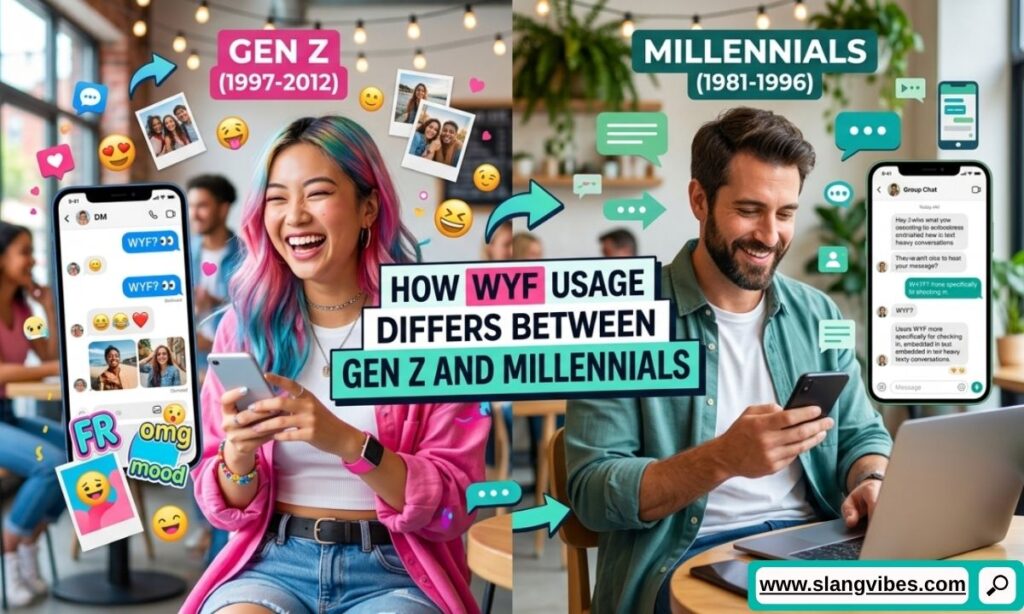
Gen Z drives most of the newer WYF usage, especially the “What’s Your Favorite” version tied to TikTok comment culture. Younger users move between meanings without thinking twice, switching from location to favorite to mood depending on the app they’re using this week.
Millennials tend to stick closer to the original “Where You From” meaning. Many grew up with early texting abbreviations like BRB and TTYL. WYF slots naturally into the same category: a location-based question rather than a content prompt.
Neither group treats WYF as outdated. It shows up across age groups on Snapchat and in regular texting. The platform-specific versions, favorites on TikTok and mood checks in close group chats, lean younger. Someone in their late 30s texting a friend is far more likely to mean “Where You From” than “What’s Your Favorite.” The comment-culture version grew up alongside short-form video apps many older users check less often.
The gap matters most when a Gen Z creator and a Millennial follower cross paths in the same comment section. A Millennial replying with a city name to a “WYF drink?” prompt reads as a small mismatch, though a friendly one. Recognizing which generation set the context helps avoid the mix-up entirely.
WYF Meaning on Snapchat
Snapchat treats WYF almost like a digital handshake. When someone adds you and sends a streak request, “WYF?” often follows within the first few messages. It works as a fast way to figure out whether you have anything in common before the conversation goes further.
Priya: hey added you lol Priya: WYF? Marcus: Austin, you? Priya: Miami! small world, we’re both south lol
On Snapchat, the question almost always means “Where You From.” The platform’s culture leans toward quick, casual exchanges. Location is one of the fastest ways to build a connection with someone new. Streaks add pressure to reply fast, so short questions like WYF fit the pace of the app.
The tone stays friendly rather than formal. Adding “lol” or an emoji softens it further, which is common among Snapchat users who don’t want the question to read as an interrogation. Skip the emoji entirely and it still reads as harmless, though slightly more direct.
WYF also shows up mid-friendship on Snapchat, not only during the first few messages. Someone you’ve snapped with for months might drop it after a story mentions a trip or a new city, curious whether you’re still in the same place. In this setting, the question works less as an icebreaker and more as a casual catch-up.
WYF Meaning on TikTok
Rework opener to: “The WYF mean in slang sense shifts fast once you land on TikTok, where the question usually points to favorites instead of location.” A creator posts a video ranking coffee orders and captions it “WYF drink?” Within minutes, the comment section fills with replies naming lattes, cold brews, and energy drinks. This is WYF at its most public: a prompt built to pull engagement rather than start a private conversation.
TikTok comment sections favor this version of WYF because it turns a broadcast video into a two-way exchange without slowing anyone down. Viewers don’t need context beyond the video itself, and the three letters read instantly to anyone active on the platform.
WYF shows up less often as “Where You From” on TikTok. It still happens in livestream chats, where hosts sometimes ask viewers where they’re watching from. The difference comes down to format. Comments under a video lean toward “favorite,” while live chat leans toward “location,” since livestreams feel closer to a real-time conversation between people.
Either way, replying takes almost no effort. A one-word answer works fine in both cases. This is part of why WYF spreads so easily across TikTok’s comment culture and keeps showing up on new videos every week.
Creators sometimes pin a top comment repeating WYF back to viewers. Pinned comments get seen by everyone scrolling through, which pushes even more replies. The format rewards short, quick answers over detailed ones, so most replies stay under five words no matter which version of WYF started the thread.
Read More: LMAO Meaning in Text: What It Really Means on Snapchat, TikTok & Instagram (2026)
WYF in Texting, Instagram DMs & Dating Apps
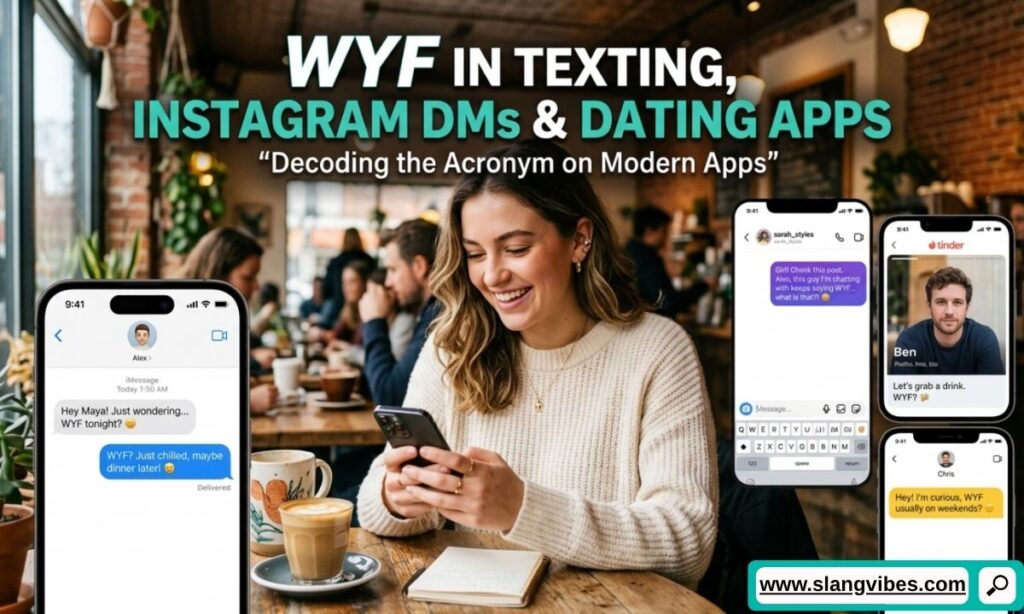
Outside Snapchat and TikTok, WYF shows up across texting, Instagram, and dating apps, though the tone shifts depending on where the conversation starts.
In Texts and DMs
In regular texting and Instagram DMs, WYF usually opens a conversation with someone outside your close circle. The sender might be a new follower, a friend of a friend, or someone from a shared group chat.
Devon: saw you in the group chat, WYF? Riley: Seattle! you? Devon: Denver, we’re not too far off
The exchange stays casual and short. Neither person expects a long answer, and the question mostly works as a starting point for more conversation later.
On Dating Apps
Dating apps push WYF toward something closer to flirting. Location matters more here, since it factors into whether two people are close enough to meet up in person.
Alex: WYF? trying to see if you’re close by Sam: Brooklyn, and you? Alex: Jersey, so not too far off lol
On dating apps, WYF often leads directly into a question about meeting up. The location isn’t only conversation filler; it’s practical information both people genuinely need before planning anything further.
Is the WYF Slang Meaning Flirty?
WYF on its own doesn’t carry a flirty tone. Three letters and a question mark read as neutral, closer to small talk than a pickup line. Tone comes entirely from what surrounds it.
A message like “WYF? 👀” or “WYF, trying to see if we’re close” leans flirty, especially on a dating app or right after a compliment. The same three letters sent in a group chat between longtime friends read as nothing more than curiosity.
Timing matters too. WYF sent right after someone follows you or matches with you on a dating app usually signals interest beyond friendly conversation. WYF sent mid-conversation with someone you’ve talked to for weeks reads as ordinary catching up instead.
If you’re unsure how to take it, look at the rest of the message. Compliments, emojis, and quick follow-up questions about meeting up point toward flirting. A flat, standalone “WYF?” with no other context usually signals someone being straightforwardly curious, nothing more.
Emoji and Punctuation Cues
Punctuation changes the read almost as much as wording does. “WYF?” with a single question mark feels neutral. “WYF???” with extra question marks feels more like genuine confusion than flirting, often from someone who received an unexpected message and wants an answer fast.
Emojis do most of the heavy lifting. Eyes (👀), a wink, or a heart next to WYF push the message toward flirting almost every time. A laughing emoji or “lol” tacked onto the end softens it into friendly small talk instead. No emoji at all, sent by someone you already know, usually means the sender wants a fast answer. Tone likely isn’t on their mind one way or the other.
Reading tone through text takes practice, and WYF works well as a small test case. It carries almost no built-in emotion. Whatever mood surrounds it comes entirely from the rest of the conversation, the punctuation, and the timing of when it lands in your inbox.
How to Reply to the WYF Slang Meaning (5 Example Responses)
Replying to WYF doesn’t take much thought once you know which meaning applies. Here are five response styles depending on the situation you’re in.
Jamie: WYF? Taylor: LA, born and raised. you? Jamie: Chicago! never been to LA though
- Direct answer: “Chicago, you?”
- Playful deflection: “Somewhere cold and tired of it.”
- Favorite-version reply: “Currently obsessed with iced matcha.”
- Mood-check reply: “Honestly kind of drained today, you?”
- Dating app reply: “Brooklyn, close enough to grab coffee sometime.”
Match the reply to the version of WYF sitting in front of you. A location question deserves a location, a favorite question deserves whatever you’re currently into, and a mood check deserves an honest one-liner. Overthinking the reply isn’t necessary, since the question itself is low-stakes by design and rarely expects more than a sentence back.
Platform changes the length people expect too. Snapchat and texting replies stay short, often five words or fewer. TikTok comments run even shorter, since scrolling past a long reply takes effort viewers rarely give. Dating apps allow a little more room, since the reply often sets up the next question about meeting in person.
WYF vs WYA vs WYD: What’s the Difference?
These three abbreviations get mixed up constantly since they look similar and show up in nearly the same kinds of conversations.
| Term | Stands For | Common Use |
|---|---|---|
| WYF | Where You From | Asking about location or hometown |
| WYA | Where You At | Asking about current location, often for meeting up |
| WYD | What You Doing | Asking what someone is doing right now |
WYF asks about origin, a hometown or country. WYA asks about present location, useful when friends are trying to meet up somewhere specific. WYD asks about activity, the most open-ended of the three, and often the opener for a longer back-and-forth.
The mix-up happens because all three follow the same letter pattern. They show up in nearly identical contexts: a new match, a friend texting, a group chat coordinating plans. Reading the rest of the sentence clears up which one applies. “WYF, I want to know where you grew up” points to origin. “WYA, we’re already here” points to present location instead.
The three abbreviations often show up together in the same conversation as it moves along. A new match might open with WYF, then shift to WYA once plans start forming. WYD tends to show up once the two people are talking regularly. Each one marks a different stage of getting to know someone, from background, to logistics, to daily life.
Common Mistakes People Make With WYF

A few patterns trip people up when WYF shows up in conversation.
Manager: Hey team, quick update on the client call Intern: WYF on the deadline lol Manager: let’s stick to email for scheduling questions
- Using it in professional settings: WYF reads as casual internet slang, so it doesn’t belong in work emails, client messages, or formal group chats.
- Confusing it with WYA: Sending “WYF” when you mean “where are you right now” leads to a mismatched answer, since WYF points to origin rather than a present location.
- Reading too much into a neutral message: A standalone “WYF?” isn’t automatically flirty. Reading in meaning nobody intended leads to awkward replies on both sides of the chat.
- Sending it without context: WYF sent as a first message with zero introduction reads as abrupt. A short greeting before it softens the ask and makes the question feel less random.
- Repeating it after already getting an answer: Sending “WYF” again after someone already shared their city reads as though the first reply went unnoticed, which comes across as careless rather than curious.
Read New Article DND Meaning in Text: What It Really Means on Snapchat, TikTok & Instagram (2026)
Frequently Asked Questions
WYF mean in slang texting mostly points to “Where You From,” a quick way to ask someone’s hometown or location. Some texts use it to mean “What’s Your Favorite,” depending on the topic already on the table. Checking the sentence around it usually settles which version fits.
No, though it’s the most common version by far. On TikTok and Instagram, WYF sometimes shifts to “What’s Your Favorite,” especially in comment sections built around polls and quick reactions. Close friends occasionally use it as a mood check instead.
On its own, WYF reads as neutral. Tone comes from what surrounds it: emojis, compliments, or timing right after a match on a dating app push it toward flirting. The same message in a group chat between friends rarely carries any romantic weight.
No. WYF is casual internet slang, best kept for friends, group chats, or social media rather than work emails or client messages. Sticking to plain language in professional settings avoids confusion and keeps the tone appropriate.
Yes. WYF remains common across Snapchat, TikTok, and texting, especially as an icebreaker between people who haven’t talked before. Its short length and easy typing keep it in regular rotation alongside newer slang.
Bottom Line on WYF
WYF carries more than one meaning, and the version in front of you depends entirely on where it shows up. On Snapchat and in most texting, it asks about your hometown. On TikTok and Instagram, it often flips to asking about favorites. In tighter group chats, it sometimes checks in on how you’re feeling in the moment.
Replying doesn’t take much thought once you know which version fits. A short, honest answer covers nearly every situation, whether it means naming your city, your go-to coffee order, or how your day is going.
The next time WYF lands in your notifications, check the platform and the sentence around it before typing a reply. Those two clues answer the question almost every time, and you won’t freeze up over three letters again.

Alex Carter is a language enthusiast and internet culture expert at SlangVibes. He explains the latest slang terms and text meanings in simple, clear English so everyone stays in the loop.