I still remember the exact moment. A friend sent me a string of messages about her terrible Monday at work, and right at the end she typed: “GMFU.” I read it three times. I typed “lol” back because I had no idea what else to do. Turns out, “lol” was the absolute wrong response. She wasn’t laughing. She was furious. That little four-letter acronym had sailed right over my head, and I’d made things awkward without even trying. If you’ve ever had a moment like that, wondering what GMFU mean in text is, you’re in the right place. By the end of this article, you’ll never have to guess again.
What Does GMFU Mean in Text?
Quick Answer: GMFU stands for “Got Me F***ed Up.” It’s a slang expression used to show strong emotions like shock, disbelief, frustration, or irritation.
GMFU mean in text is pretty straightforward once you know it. The full phrase is “Got Me F***ed Up,” and it’s used when something or someone has left you emotionally thrown off. Think of it as a stronger, more personal version of “I can’t believe this.” It’s not a greeting., It’s not a compliment. It’s a reaction, and it almost always carries weight.
People write it as an acronym for a good reason. Texting out the full phrase feels like a lot, and it includes a word many people prefer not to type in full, especially in screenshot-able group chats. The four letters get the point across with zero explanation needed, at least between people who know the slang.
Here’s the thing: GMFU isn’t always aggressive. It sits on a wide emotional spectrum. Someone hearing surprising news, seeing an unexpected price tag, or finding out a friend did something wild might all reach for GMFU. The tone around it does a lot of the heavy lifting.
| Situation | What GMFU Communicates |
|---|---|
| Friend asks you to cover a $200 dinner | Shock and mild anger |
| Someone shares wild gossip | Disbelief mixed with excitement |
| A joke lands harder than expected | Playful exaggeration |
| A real betrayal or serious situation | Genuine emotional distress |
Where Does GMFU in Text Come From? Origin and History
Understanding GMFU mean in text gets a lot richer when you know where it came from. The acronym didn’t appear out of nowhere; it has real cultural roots.
The full phrase “Got Me F***ed Up” comes from African American Vernacular English (AAVE). AAVE has given mainstream internet slang a huge number of its most expressive terms, and this one is no exception. The phrase itself was circulating in conversation, music, and comedy long before it ever became a texting shorthand. Hip-hop and rap culture played a big role in pushing it into the mainstream. Artists used variations of the phrase in lyrics throughout the 2000s and early 2010s, which planted it firmly in everyday speech for a generation of listeners.
By the mid-2010s, online communities on Twitter and Tumblr started using the full phrase in posts and replies. As texting and social media messaging got faster and more casual, people naturally shortened it. GMFU became the go-to acronym version, following the same pattern as WTF, SMH, and FML before it.
Platforms like Snapchat, Instagram, and TikTok pushed GMFU into even wider use. Short, punchy reactions fit perfectly into comment sections and story replies. The acronym also sits comfortably in the long tradition of censoring profanity in text while keeping the emotional punch intact. You get the feeling without the full word, which makes it more socially flexible than typing the phrase out completely.
By 2026, GMFU is a well-established piece of digital communication vocabulary, especially among Gen Z and Millennials.
How GMFU Is Used in Real Conversations (With Examples)
Knowing what GMFU mean in text is one thing. Seeing it in action is another. Here are real-style conversation examples that show the different ways this internet slang shows up, and what tone each one carries.
Example 1: Shock over money
Alex: “Hey, so the concert tickets are $300 each. You in?” Jordan: “GMFU. I thought they were like $80.”
Jordan isn’t joking here. That’s genuine shock hitting all at once.
Example 2: Playful use between close friends
Sam: “I accidentally liked a photo from 2019 on his profile.” Riley: “GMFU 💀 how deep were you scrolling???”
Same acronym, completely different energy. Riley’s reaction is equal parts horrified and entertained.
Example 3: Serious frustration in a relationship context
Taylor: “So I found out he told everyone we broke up before he even told me.” Morgan: “GMFU. That’s genuinely awful.”
Here it’s empathetic shock. Morgan isn’t dismissing it; they’re amplifying it.
Example 4: Group chat reaction to news
Group Chat: “Did you guys hear that our flight got cancelled AND rebooked for 6am?” Dana: “GMFU I have to wake up at 3am now” Chris: “Same. GMFU.”
Shared frustration. It bonds people over a mutual bad situation.
Example 5: Sarcastic/humorous use
“My dog ate my AirPods for the second time this month. GMFU.”
This one’s solo, probably a tweet or Instagram caption. The person isn’t in crisis; they’re venting with humor. The self-awareness makes it funny.
What these examples show is that GMFU mean in text shifts based entirely on context. The words around it, the tone of the conversation, and the relationship between the people involved all change what it’s really saying.
Read Also: IIRC Meaning in Text: What It Actually Means and How to Use It Correctly!
What GMFU Means in Text Across TikTok, Instagram and Snapchat
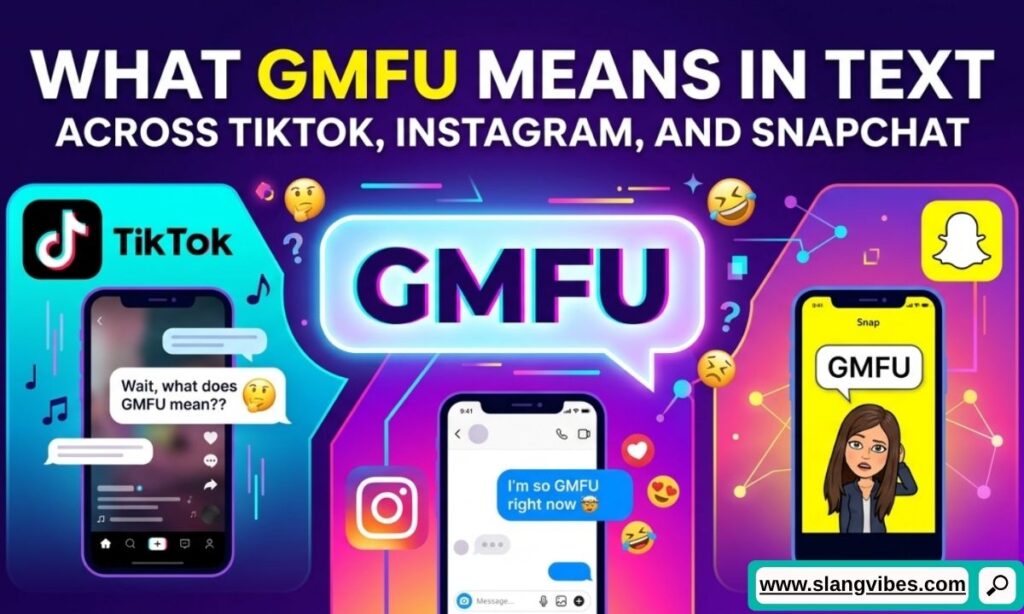
GMFU mean in text looks slightly different depending on where you’re seeing it. Social media platforms each have their own culture, and that shapes how people drop this slang expression into their communication.
On TikTok, GMFU appears constantly in video captions and comment sections. When a creator posts something shocking or embarrassing, comments fill up with GMFU reactions almost immediately. It’s a fast, high-energy platform, and GMFU fits that pace perfectly.
Instagram uses it more in DMs and comment replies. You’ll see it under posts where someone shares surprising news or a bold opinion. It tends to feel slightly more personal there, since Instagram conversations are often between people who actually know each other.
read also:FS Meaning in Text: What It Actually Means in 2026 (Don’t Get Confused!)
plies and direct snaps are private, quick, and unfiltered. People say things in snaps they wouldn’t put in an Instagram comment. GMFU slides in easily when reacting to someone’s story.
WhatsApp and iMessage group chats bring a different vibe. Here, GMFU often reacts to shared articles, screenshots, or plans going wrong. It works perfectly in group settings because it’s a universally understood reaction that everyone can immediately respond to.
The common thread across all these messaging apps and platforms: GMFU works best when the reaction is immediate. It’s a gut-check response, not a considered one.
GMFU Text Slang vs. WTF, SMH and FML: What’s the Real Difference?
A lot of people treat GMFU, WTF, and SMH as interchangeable. They’re not. Each one carries a distinct emotional weight, and using the wrong one can make your reaction feel off. Here’s how they actually compare.
| Slang Term | Full Form | Core Emotion | Who It Centers |
|---|---|---|---|
| GMFU | Got Me F***ed Up | Shock + personal disbelief | The sender’s emotional state |
| WTF | What The F*** | General shock or outrage | The situation itself |
| SMH | Shaking My Head | Mild disappointment | A judgment on someone else |
| FML | F*** My Life | Self-directed frustration | The sender’s bad luck |
| ISTG | I Swear To God | Intense sincerity or frustration | A personal declaration |
| NGL | Not Gonna Lie | Honest admission | A confession about feelings |
The key thing that separates GMFU from the rest is how personal it is. WTF comments on a situation. GMFU says the situation has gotten inside your head. It’s introspective in a way the others aren’t. When someone uses it, they’re telling you this didn’t just surprise them; it actually affected them on some level.
Similar terms like WTF can feel more external and detached. GMFU is messier, more honest, and more emotionally specific. That’s why it hits differently when someone sends it to you.
When NOT to Use GMFU: Context, Audience and Mistakes to Avoid
Knowing GMFU mean in text is only half the picture. Knowing when to keep it in your pocket matters just as much.
Professional communication is the obvious one. No work emails, No Slack messages to your manager. No Teams chats in a formal thread. Even if your office culture is casual, GMFU carries implied profanity and that’s a line most professional settings won’t forgive easily.
Read also:STG Meaning in Text: What This Popular Acronym Really Means 📱💬
New friendships or people you’ve only just started texting are risky territory too. Slang builds familiarity fast, but it also assumes shared context. If the other person doesn’t know what it means, you’ve either confused them or offended them, and you won’t always know which.
Texting family members who aren’t deep into internet slang is another spot to avoid it. Grandparents, aunts, uncles, or even parents who aren’t plugged into digital culture won’t receive GMFU the way your friends would.
Common Mistake: Using GMFU in a serious conversation as a reaction to someone’s real pain. If a friend is telling you something genuinely difficult and you reply “GMFU,” it can come across as flippant or dismissive, even if you meant it sincerely. In those moments, actual words serve the person better than a chat abbreviation.
The decision is simple. If you’d feel fine saying the full phrase out loud in that setting, the acronym is probably fine. If saying “Got Me F***ed Up” out loud would feel wildly out of place, skip the text version too.
How to Reply When Someone Sends GMFU in a Text
Getting a GMFU text and freezing up is normal, but these response examples make sure you always know what to say back.
So someone just sent you GMFU in a text. Now what? Your response depends entirely on reading the room correctly, and getting it wrong can make a conversation feel a lot more awkward.
If the tone is playful, match that energy. These are the easy ones. When a friend drops GMFU after something funny or absurd happened, you’re safe to laugh with them, pile on the reaction, or add your own commentary.
“GMFU omg I would have lost it too 😭”
If the tone is genuine frustration, acknowledge it before anything else. Don’t jump to jokes. Don’t respond with your own GMFU as if you’re both equally shocked. Focus on what they’re actually going through.
“That’s genuinely messed up. Are you okay?”
If you’re honestly not sure whether it’s serious or playful, ask a follow-up question rather than guessing wrong.
“Wait, what happened? Are you actually upset or is this a funny story?”
Here are a few ready-to-use response examples based on common situations:
- Playful/funny context: “GMFU same though, I can’t believe it either 😭”
- Frustration/venting: “That’s so unfair, I’d be heated too.”
- Shock about news: “Wait, seriously? When did this happen?”
- Empathy for a bad situation: “That’s a lot. I’m sorry you’re dealing with that.”
- Sarcastic use: “Honestly same, your life is a lot.”
The one response to avoid in almost every case: ignoring the emotional weight and changing the subject. Even a quick acknowledgment goes a long way.
Is GMFU Still Relevant in 2026?
Slang has a shelf life. Some terms burn bright and disappear fast. Others settle into the language permanently. Where does GMFU mean in text land in 2026?
It’s still very much in active use. Unlike some acronyms that feel dated the moment you type them, GMFU has held its ground because it fills a specific emotional gap that nothing else covers in quite the same way. The feeling it describes, that particular mix of shock, disbelief, and personal offense, doesn’t go away just because the year changes.
Gen Z users still reach for it regularly, especially on TikTok and in group chats. Among Millennials who grew up with its cultural roots, it carries a kind of nostalgic familiarity while still feeling current. That crossover appeal keeps it alive.
What’s worth noting is that newer Gen Z slang is layering on top of it rather than replacing it. Terms like “delulu,” “no cap,” and “understood the assignment” have taken over different emotional territory, but none of them replaces what GMFU does. It remains the go-to for that specific gut-punch reaction.
Bottom line: GMFU isn’t fading. It’s earned a stable place in casual digital communication for the foreseeable future.
Frequently Asked Questions
GMFU mean in text is the same regardless of who sends it: “Got Me F***ed Up.” The gender of the sender doesn’t change the meaning. Context, tone, and the conversation around it tell you everything you need to know about whether it’s playful, serious, or somewhere in between.
GMFU contains implied profanity since it stands for a phrase with a strong swear word in it. It’s not a slur and it’s not directed at anyone personally, but it’s absolutely informal and inappropriate in professional or formal settings. Whether it offends someone depends on the audience, so read your crowd before using it.
On TikTok, GMFU mean in text translates directly into video comment culture. You’ll see it in comment sections reacting to shocking clips, embarrassing moments, or unexpected plot twists in someone’s story. It’s one of the fastest ways to express genuine shock in a TikTok comment without writing a full sentence.
Yes. If you want to express the same emotion without the implied profanity, some natural alternatives include “I can’t believe this,” “This is wild,” “That’s impulsive,” “No way,” or even “SMH” for disappointment. None of them hit with the exact same force, but they get the general idea across in settings where GMFU would feel out of place.
The next time you see GMFU pop up in a text, a comment, or a group chat, you’ll know exactly what someone’s feeling, and more importantly, you’ll know exactly what to say back.

Alex Carter is a language enthusiast and internet culture expert at SlangVibes. He explains the latest slang terms and text meanings in simple, clear English so everyone stays in the loop.