My friend Dana texted me last week: “Traffic was awful. Nevertheless, I’m still coming.” I stared at my phone for a second. Was she annoyed? Was she being formal on purpose? If you’ve ever paused over a message like this, you’re not alone. Let’s clear it up. Nevertheless meaning is simpler than it looks, and it shows up in texts, captions, essays, and speeches. The word signals one idea: something got in the way, but the outcome stayed the same. This guide walks through what it means, where it comes from, how to punctuate it, and when it sounds a little too stiff for a casual chat.
Read Also: K Meaning in Text: What It Really Means in Chats, TikTok, Snapchat & Instagram (2K26 Guide)
Nevertheless Meaning in Plain English
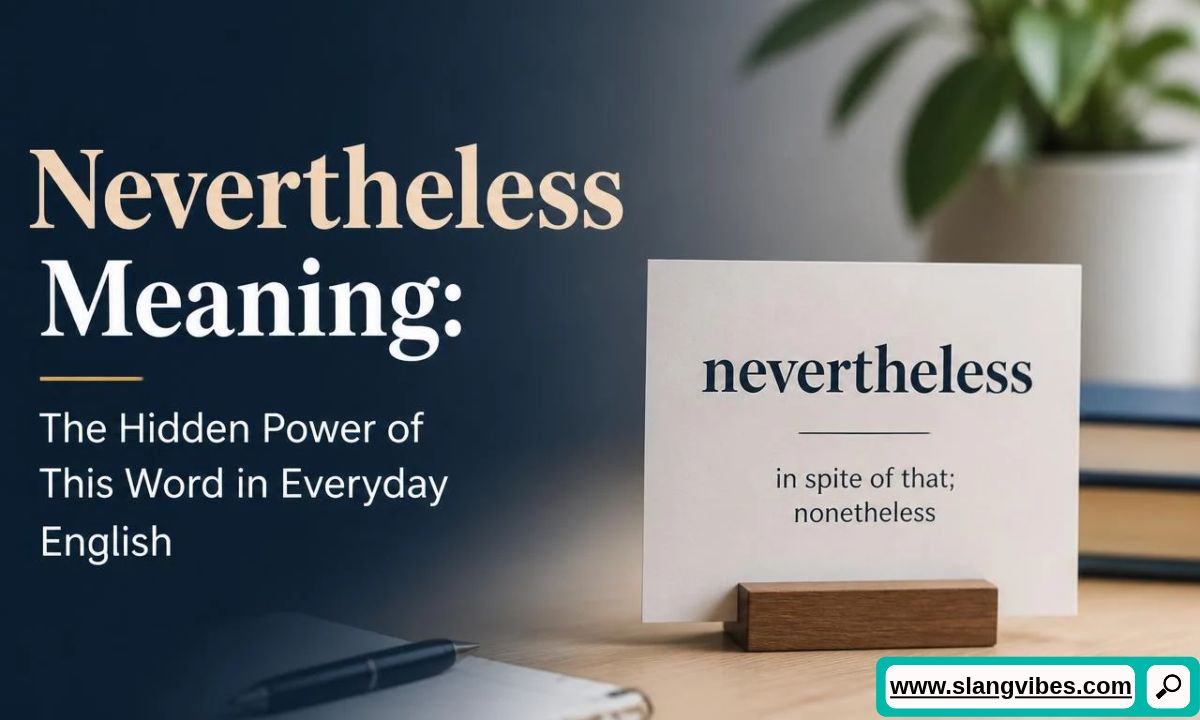
The nevertheless meaning boils down to two words: “in spite of.” You use it after you state a problem, and then you show the problem didn’t change the result. Think of it this way. You say what went wrong, then you say what happened anyway.
Quick Answer: Nevertheless means “despite what I said a moment ago.” It links two ideas, and the second one wins.
Grammar fans call it a conjunctive adverb. It works like a bridge between two sentences. The first sentence sets up an obstacle. The second sentence shows the result. Here are three short examples:
“The test was hard. Nevertheless, she passed.”
“We missed the bus. Nevertheless, we got there on time.”
“He felt nervous. Nevertheless, he spoke first.”
Notice how each pair has real contrast. Something difficult comes first, and something hopeful or stubborn follows. Without contrast, the word falls flat. It also carries a little more weight than “but,” so it fits moments worth noting. Here’s how it looks in a real chat:
Maya: How was the interview?
Chris: Rough, honestly. I blanked on two questions.
Maya: Oh no. Did you panic?
Chris: Nope. I was nervous. Nevertheless, I finished strong.
Maya: Proud of you!
The word gives Chris’s reply a calm, steady feel. He admits the struggle and keeps moving.
Where Nevertheless Comes From
The nevertheless meaning makes more sense once you see how the word came together. It started as three small pieces in Middle English: never, the, and less. People often wrote it as “never the less,” with spaces between each part. Over time, the three pieces fused into one word.
Here’s the thing about the middle piece. In older English, “the” meant “by so much.” So the original phrase worked like “never by so much less.” In plain terms, the situation wasn’t any smaller or weaker because of the obstacle. The word has kept this core idea for centuries.
You’ll still spot a cousin of this word today. “None the less” appears in some British writing, usually as three words. Dictionaries treat it as a match for “nonetheless” and “nevertheless.” Most readers notice no difference in meaning.
Essays, speeches, and news reports still use the word often. It fits formal writing well, since writers need a clean way to link a problem to an outcome. Based on how the term is typically used online, it has also moved into captions, replies, and group chats. A word built from three tiny parts now does a big job in a short text. This mix of old roots and modern use explains why the word feels both classic and current.
Read More: DND Meaning in Text: What It Really Means on Snapchat, TikTok & Instagram (2026)
How to Use Nevertheless in a Sentence
Once you know the nevertheless meaning, the next question is punctuation. The word moves around a sentence, and each spot has its own comma rule. Here are the three spots you’ll see most.
At the start of a sentence, put a comma right after it. Picture yourself writing to a coworker: “The budget got cut. Nevertheless, we hit our goal.” The comma gives the reader a short pause before the result.
In the middle of a sentence, you have two options. Use a semicolon before the word and a comma after it: “The hike was steep; nevertheless, we reached the top.” Or set the word off with commas on both sides: “We reached the top, nevertheless, before sunset.” The semicolon version feels more formal. The comma version feels lighter.
At the end of a sentence, the word adds a soft, afterthought tone. Imagine telling a friend, “I was scared to sing. I did it, nevertheless.” It sounds a bit old-school, and it works well for dry humor.
One quick rule helps with semicolons. Make sure both halves stand on their own as full sentences. If one half feels incomplete, swap the semicolon for a period.
Try this test on your own writing. Swap in “even so.” If the sentence still makes sense, you’ve used nevertheless correctly.
Read Also: SYBAU Meaning in Text: What It Really Means and How People Use It (2026)
Nevertheless Meaning in Texts, Captions, and DMs
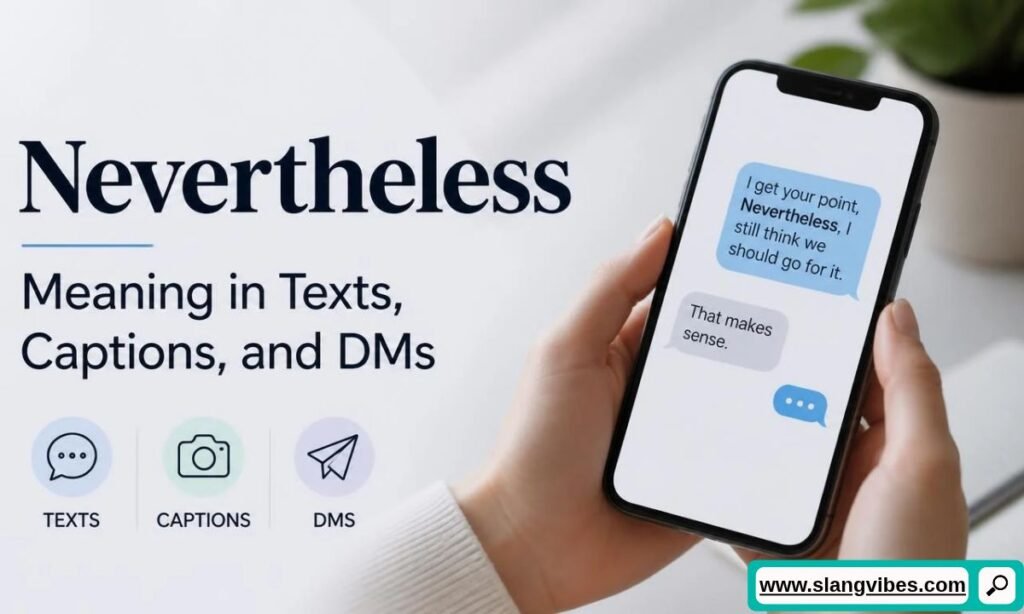
The nevertheless meaning stays the same on a phone, but the tone shifts. In a text, the word sounds a bit dramatic, and many people use it on purpose for a wink. It’s common to see younger users play it for laughs, while others use it with a straight face. Based on how the term is typically used online, both styles are easy to spot.
Captions are the easiest place to spot it. A caption like “Rough week. Nevertheless, brunch happened.” packs a small struggle and a small win into one short line. It works well on photo posts, because the image shows the outcome.
Group chats work differently. Here, the word often plays as mock-formal humor:
Riley: Parking was a nightmare. Nevertheless, I’m here.
Jess: Nevertheless?? Who are you, a lawyer?
Riley: A lawyer with snacks. Nevertheless.
Jess: Okay, I respect it. Saving you a seat.
Notice how Jess teases the formal tone, and nobody takes offense. Dating chats add a softer layer. A single well-placed nevertheless sounds confident without sounding pushy:
Sam: I’m terrible at planning dates.
Ava: Same. Nevertheless, I’d love dinner on Friday.
Sam: Deal. I’ll even pick the place.
Ava: Brave. I’m in.
Both chats show the same pattern. Someone names a flaw, then moves forward anyway. Match the other person’s energy, and skip the word in rushed chats.
Read Here: Aura Slang Meaning: What It Means on TikTok & Social Media
Nevertheless vs. Nonetheless vs. However
The nevertheless meaning overlaps with several other words, so a side-by-side view helps. Here’s the short answer. Nevertheless and nonetheless are twins. Dictionaries treat them as synonyms, and you’ll see both in the same kinds of writing. However sits nearby, but it plays a softer role. Here’s a quick comparison:
| Word | Meaning | Tone |
|---|---|---|
| Nevertheless | Despite what came before | Firm, a bit formal |
| Nonetheless | Despite what came before | Firm, a bit formal |
| However | On the other hand | Neutral, flexible |
| Even so | Despite this | Relaxed, spoken |
| Still | Despite this | Casual, short |
| But | Contrast | Plain, everyday |
Notice the tone column. Nevertheless and nonetheless feel identical, so pick the one you like best. However works for almost any contrast, even a mild one. “I love cats. However, I’m allergic.” shows a plain conflict. Nevertheless fits better when the second idea wins in spite of the first.
In texts, many people reach for “still” or “even so” instead. “Still” feels casual: “It rained. Still, we went.” “Even so” sounds spoken and warm. Both save you from sounding stiff when a chat feels relaxed. Save nevertheless for moments with a little more weight.
Here’s a simple way to choose. Ask yourself one question: does the second half beat the obstacle? If yes, nevertheless works. If the second half simply offers another side, however works better.
Read New Articles: RS Meaning in Text: The Complete Guide for Beginners (2026)
How “Nevertheless, She Persisted” Shaped Nevertheless Meaning Today
The nevertheless meaning picked up a famous extra layer in February 2017. During a debate over Jeff Sessions’s nomination for attorney general, the Senate barred Senator Elizabeth Warren from speaking further. She had been reading a letter from Coretta Scott King. Afterward, Senate Majority Leader Mitch McConnell explained the decision. He said the Senate had warned her and given her an explanation. Then he added, “Nevertheless, she persisted.”
The line spread fast. Many people adopted it as a slogan for pushing on despite pushback. It showed up on T-shirts, mugs, posters, and social feeds under the hashtag #ShePersisted. Three words carried a whole story. Someone faced an obstacle, and someone kept going.
It’s common to see the full line today in captions and bios. Picture a friend finishing a 10K with a sore ankle and posting, “Nevertheless, I finished.” She borrows the same rhythm. Readers get the whole story before the line ends. Use the full phrase when the story fits, such as someone pushing through a setback. Keep it light when the moment feels small.
This moment also teaches a grammar lesson. McConnell placed nevertheless at the start, followed by a comma and a short, punchy clause. The structure is worth copying. Lead with the word, state the action in plain terms, and stop. Short endings hit hardest.
When Nevertheless Sounds Too Formal
The nevertheless meaning works everywhere, but the tone doesn’t always match the room. In a quick text to a close friend, the word sounds like a speech. Skip it in rapid-fire chats, voice memos, and playful banter unless you want the mock-formal effect.
Three situations call for a lighter word. First, when the contrast is tiny: “The coffee was cold. Nevertheless, it was fine” feels heavy for a small thing. Use “but” or “still.” Second, when you’re writing for kids or new English learners, where simple links work better. Third, when you’ve already used the word once in the same message.
Work chats are a middle ground. Here’s how a colleague might use it:
Priya: Budget got cut again.
Marcus: Ouch. Nevertheless, the client still wants the launch.
Priya: Fair. Nevertheless, we need a plan B.
Marcus: Agreed. I’ll draft one today.
Two nevertheless lines back to back make the chat feel stiff. One would have done the job.
What if someone uses the word on you? Reply to the point, not the style. Try “Fair point,” “Makes sense,” or “Okay, I hear you.” For a playful chat, “Okay, professor” gets a laugh. For a serious message, match the tone and answer in full sentences. A thoughtful reply shows you read the whole message, and it keeps the conversation warm.
Read More Articles: IIRC Meaning in Text: What It Actually Means and How to Use It Correctly!
Common Nevertheless Mistakes to Avoid
Even when the nevertheless meaning feels clear, small slips sneak into real writing. Here are the four mistakes you’ll spot most.
Mistake one: no contrast. Picture someone writing, “I love pizza. Nevertheless, I eat it weekly.” Nothing pushes against the second sentence, so the word has no job. Swap in “so” or “and” instead.
Mistake two: doubling up. Writers sometimes stack “but nevertheless,” which says the same thing twice. Pick one. “It was late, but we stayed” or “It was late. Nevertheless, we stayed” both work.
Mistake three: the comma splice. Look at this line: “The road was closed, nevertheless we arrived.” Two full sentences sit together with only a comma between them. Fix it with a period or a semicolon, and add a comma after nevertheless.
Mistake four: overuse. Imagine an email with the word in every paragraph. Readers start to hear a lecture. Once or twice in a piece is plenty.
A bonus slip involves spelling. Modern English writes the word as one piece, not “never the less.” Typing “nevertheles” with one s also happens often. A quick spell check catches it.
Here’s a fast self-check before you hit send. Does the first sentence name a problem or doubt? Does the second show a result or a choice? If both answers are yes, the word fits.
Frequently Asked Questions
What does nevertheless mean in simple words?
The nevertheless meaning is “despite what came before.” It links a problem to a result, and the result wins.
Is nevertheless the same as nonetheless?
Yes. Dictionaries treat them as synonyms, so you’re free to swap one for the other.
Is it okay to start a sentence with nevertheless?
Yes. It’s the most common spot, and a comma should follow it.
Do you put a comma after nevertheless?
Yes, when it opens a sentence. In the middle of a sentence, set it off with commas or use a semicolon before it.
Is nevertheless too formal for texting?
It sounds formal in casual chats, so many people use it with a wink. Try “still” or “even so” for a relaxed tone.
Putting Nevertheless to Work
The nevertheless meaning comes down to a simple promise: something got in the way, and the result stayed the same. You’ve seen how the word grew from three Middle English pieces into one polished connector. You’ve also seen how it moves through a sentence and how it differs from nonetheless and however. One Senate moment even gave it a second life.
In texts and captions, it carries a calm or playful tone. In essays and emails, it adds weight. The word works best when real contrast exists, a comma follows it, and you use it sparingly. Skip it when the moment feels too small or the chat feels too casual. Reach for “still” or “even so” in those spots. Next time a friend writes “Nevertheless, I’m still coming,” you’ll know exactly what they mean. Try the word in your next message, pick a moment with a real obstacle, and let the second half win.

Alex Carter is a language enthusiast and internet culture expert at SlangVibes. He explains the latest slang terms and text meanings in simple, clear English so everyone stays in the loop.