Last spring, my friend Dani dropped one word into our group chat. “Nymphology.” I guessed it was a bug-collecting hobby, since nymphs show up in insect guides. Dani laughed and sent a song title instead. I felt a little silly for guessing wrong, so I looked it up properly. If you’re landing here after a similar moment, the nymphology meaning is simpler than the internet makes it sound. Nymphology is the study of nymphs, the nature spirits from Greek mythology. This guide walks through where the word comes from. You’ll also see why a pop song put it on everyone’s screen, and which mix-ups to skip.
Read Also: Type Meaning in Slang: What It Really Means in Text (2026)
Nymphology Meaning in Plain English
The nymphology meaning starts with two small parts. A nymph is a minor female nature spirit from ancient Greek folklore. The ending “-logy” means the study of something. Put them together and you get the study of nymphs. This covers their myths, their art, and the ideas they stand for.
Quick Answer: Nymphology is the study of nymphs, the female nature spirits of Greek mythology. It’s a formal word, not modern slang.
Think of it this way. Zoology studies animals. Mythology studies myths. Nymphology narrows the lens to one group of mythical beings. A writer working on river spirits, tree spirits, or ancient poetry might use the word to describe the focus.
Most people meet the word in one of two places. Some see it in a classics or folklore setting. Many more see it online, tied to a 2023 pop album. Both uses point back to the same root idea, which is the nymph.
Picture a student writing a paper on water spirits in Greek poetry. She says her topic falls under nymphology. Now picture a friend scrolling music comments who spots the same word. The setting changes, but the word still points at nymphs.
Here’s the thing about spelling. It’s common to see people type “nymphology” while hunting for “nymphomania,” a different word with a different history. We untangle those two later in this guide.
Where the Word Nymphology Comes From
The word nymphology comes from nymph plus the study ending. The nymph part has a long paper trail. It traces to the Greek word nymphē, which first meant bride or young wife. Later it meant a beautiful young woman, and finally a semi-divine maiden. Latin borrowed it as nympha, and Old French as nimphe. English took the word up in the late 1300s.
Scholars don’t agree on the deeper roots. Many sources link nymphē to the Latin nubere, meaning to marry. The etymologist Beekes suggests a pre-Greek origin instead.
English added two more senses along the way. By the 1570s, nymph named the young stage of certain insects. By the 1580s, it also meant a young, attractive woman. The mythology sense came first, and the other two followed within about two centuries. All three meanings share one family tree, which explains why one short word carries so many uses.
Because nymphology uses standard parts, you work out the nymphology meaning without a dictionary. Here’s how a study group might handle it.
Maya: Did you see Leo’s essay title? “Nymphology in Greek Poetry.”
Priya: I figured it meant bugs.
Maya: Nope. Nymph comes from a Greek word for bride.
Priya: And the “logy” part is the study of it?
Maya: Right. Same ending as biology.
Priya: Okay, now it makes sense.
Greek Mythology Behind Nymphology
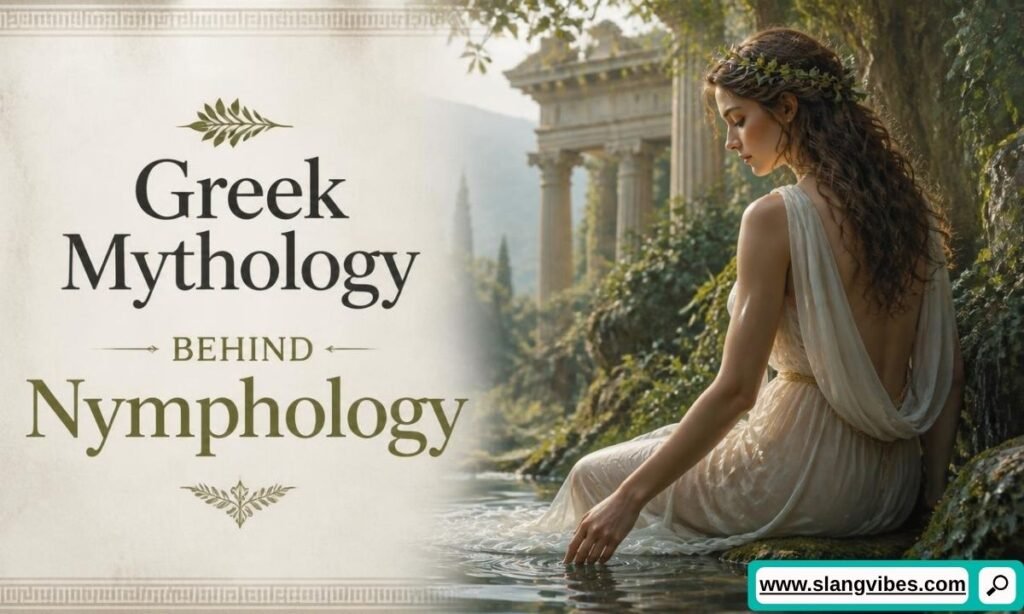
Nymphs sit at the center of nymphology. In ancient Greek folklore, a nymph is a minor female nature deity. Storytellers imagined them as young, beautiful, and long-lived. Many tales show nymphs attending a larger god, as part of a hunting party or a dance.
Each nymph belongs to a specific place. Here’s a short guide to the main groups:
- Dryads watch over trees, and hamadryads live inside one particular tree.
- Naiads guard fresh water, such as springs and rivers.
- Nereids belong to the sea.
- Oreads roam the mountains.
Think of the groups as a field guide to the wild: each spring, tree, and peak gets its own resident. Poets wrote about nymphs in ancient times. The Roman poet Horace, for example, described nymphs dancing with satyrs. A modern songwriter borrows the figure too, which sets up the next section.
I picture myself hiking past a mountain spring in an old Greek story. A scholar of nymphology would tell me a naiad lives there. Climb higher and the spirit changes to an oread. Walk into a forest and a dryad takes over. The map of the wild becomes a map of personalities.
Many readers see these figures as a way old storytellers gave a face to wild places. This reading explains why nymphs keep returning in art, poetry, and music.
Read Also: Ghetto Slang Meaning (2K26 Guide): 30 Popular Terms, Origins & Real Usage
Nymphology Meaning in Melanie Martinez’s Song
Based on how the term is typically used online, much of the buzz around the word traces back to one source. Melanie Martinez released Portals, her third studio album, on March 31, 2023. “Nymphology” is the eleventh track. Portals closes her Cry Baby trilogy.
In the song, Martinez casts herself as a nymph. Reviewers read it as a pushback against playing the muse in a past relationship. Another sees it aimed at people who expect feminine partners to act as healers or caretakers. The chorus spells the word out letter by letter.
The track ends by flowing into a short interlude called Amulet. Martinez has said the last note of one is the first note of the other. Portals holds thirteen songs, so Nymphology sits near the end of the record, right after Moon Cycle.
So the nymphology meaning in the song stays close to the mythology. Martinez uses the nymph as a symbol, not as an academic topic. The song gives the old figure a modern voice. Here’s how it looks in a group chat.
Jess: Why’s everyone commenting nymphology under this clip?
Omar: It’s a Melanie Martinez song from Portals.
Jess: So it’s not an insect thing?
Omar: Nope. She plays a nymph who’s done being someone’s muse.
Jess: Okay, adding it to my playlist.
Nymphology Meaning vs. Nymphomania
Two words share a root and a similar spelling, so people mix them up. The nymphology meaning has no link to desire or diagnosis. This quick comparison keeps the terms apart.
| Term | Meaning | Context |
|---|---|---|
| Nymphology | The study of nymphs | Mythology, folklore, music references |
| Nymphomania | A historical term for excessive sexual desire in women | Older medical writing, now seen as dated |
| Nympholepsy | A frenzy or rapture said to seize someone who sees a nymph | Literary and rare |
Nymphomania entered English in 1775, through a translation of a 1771 medical work by the French doctor Bienville. Merriam-Webster dates its first use to 1702, so sources disagree on timing. They also disagree on the root. Etymonline points to the Greek word for bride. Merriam-Webster points to a Latin anatomical term. Medical writers from the 1500s to the 1700s more often used another name for it, furor uterinus.
By definition, nymphomania describes women only. Many people today find the word judgmental and dated. This explains the sting it carries online. Richard Chandler coined nympholepsy in 1775 in his Travels in Greece, and it stays a rare literary word.
Nymphology, by contrast, names a field of study and says nothing about anyone’s behavior. A reader who types the wrong word while chasing the medical term lands on the wrong page. Check the spelling, and you’ll get the right answer faster.
Read Here: Addy Slang Meaning: What “Addy” Means in Text, TikTok & Snapchat (2K26 Guide)
Common Misunderstandings About Nymphology
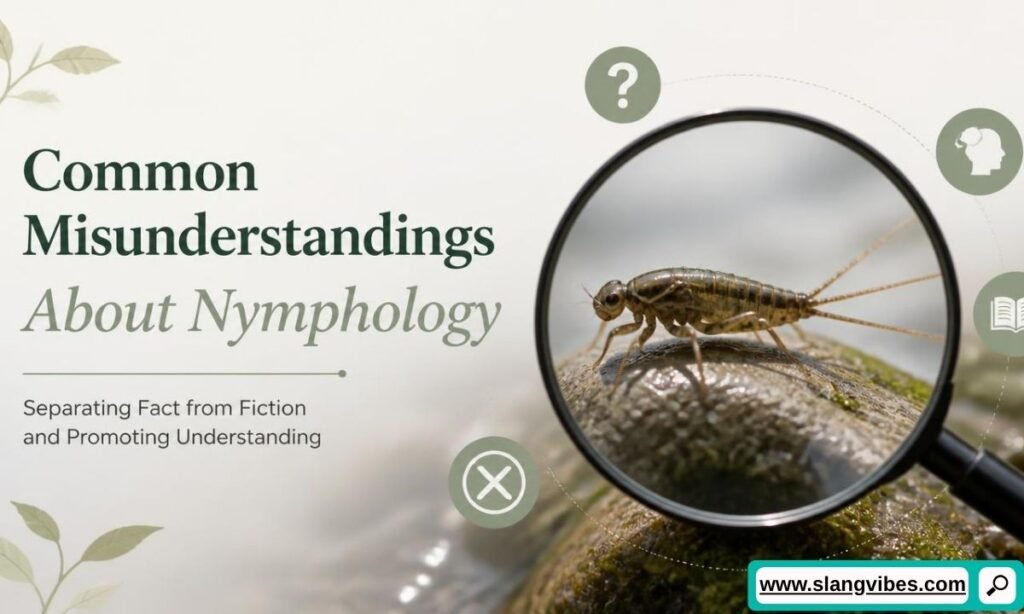
The core nymphology meaning stays narrow, so most errors come from borrowing the wrong sense of a nearby word. Four mix-ups come up again and again:
- Nymphology is slang. It isn’t. It’s a formal-sounding word with a classical root.
- It describes a personality. It doesn’t. It names a field of study, never a trait.
- It’s about insects. The insect sense belongs to the plain word nymph, which names the young stage of dragonflies and similar insects. Nymphal is the matching adjective.
- It means the same as nymphomania. It doesn’t. The section above lays out the difference.
Spelling adds to the trouble. Nymph, nymphal, nymphology, and nymphomania look alike on a screen, so a quick glance blurs them together. Reading slowly and checking the ending of each word keeps them straight.
Why do these errors spread? Short comments and song captions strip out context. Someone sees the word once, guesses from the sound, and passes the guess along. Each retelling drifts further from the original.
Here’s how one slip plays out between siblings.
Ravi: I told my boss her tone had nymphology vibes.
Anika: Please tell me you’re joking.
Ravi: Why? It sounded mystical.
Anika: Because it’s the study of Greek nature spirits, not a vibe.
Ravi: Oh. Awkward.
Anika: Apologize before Monday.
A quick look at the root fixes most of these errors.
Using Nymphology Correctly in Conversation
Knowing the nymphology meaning helps you pick the right moment for the word. Match the setting to the use.
In formal writing, spell the word out and define it once. A line like “Her thesis sits within nymphology and Greek poetry” works well in a class or a paper. In music chats, a plain reference is enough. “I’m obsessed with the nymphology track on Portals” makes sense to anyone who knows the album.
Skip the word when you describe a person. It names a subject of study, never a trait. Skip it in work emails too, unless the topic is classical studies or music.
A simple habit helps in every setting. Define the word once, then use it naturally. Readers who learn the meaning early never feel lost later, and listeners who already know the song nod along.
You might also hear someone misuse it. Here are three replies for a friend who mixes it up.
- Friendly: “It’s the study of nymphs, like the spirits in Greek myths.”
- Playful: “Nope, no bugs involved. Think Greek myths.”
- Clarifying: “I think you’re picturing nymphomania, which is a different word.”
Keep the tone light. Most people who misuse the word picked it up from a comment section, not from a textbook. A short, kind correction usually ends the confusion in one message.
Read More: Jody Military Slang Meaning (2K26 Guide): Origin, History & Real-Life Military Use
Words Related to Nymphology

A few neighbors share the same root or the same world. Learning them makes the whole topic easier to follow and remember:
- Nymph: a minor nature spirit, or the young stage of certain insects.
- Nymphal: relating to a nymph, often in the insect sense.
- Dryad: a tree spirit.
- Naiad: a fresh water spirit.
- Nereid: a sea nymph.
- Oread: a mountain nymph.
- Nympholepsy: a frenzy or rapture said to seize someone who sees a nymph.
- Mythology: the study of myths, the wider field around nymphology.
Notice how the list sorts itself into layers. Nymph and nymphal sit at the center. Dryad, naiad, nereid, and oread name the groups. Mythology and folklore describe the wider fields around them, and nympholepsy sits off to one side as a rare literary term.
Folklore studies and classical studies also overlap with nymphology. All three treat spirits as part of a bigger story world. Knowing the neighbors helps when you read a poem or hear a song reference. Here’s how this vocabulary helps at a trivia night.
Chris: Trivia night needs a mythology round.
Dana: Put in a question on nymphs.
Chris: Like naiads and dryads?
Dana: Yes. Naiads live in fresh water. Dryads live in trees.
Chris: Perfect. Does nereid fit too?
Dana: Sea nymph. Add it.
Read New Articles: K Meaning in Text: What It Really Means in Chats, TikTok, Snapchat & Instagram (2K26 Guide)
Quick Answers About Nymphology
What does nymphology mean?
Nymphology means the study of nymphs, the female nature spirits of Greek mythology. This is the core nymphology meaning.
Is nymphology a real word?
Yes. It’s built from nymph plus the study ending, the same way zoology and mythology are built.
Is nymphology the same as nymphomania?
No. Nymphology names a field of study, while nymphomania is a dated medical term for desire in women.
What is the Melanie Martinez song Nymphology about?
Reviewers read it as Martinez casting herself as a nymph and refusing the muse role from a past relationship.
Is nymphology slang?
No. It’s a formal-sounding word, and much of its online use points back to the Portals track.
Final Thoughts on Nymphology
The nymphology meaning is straightforward once you split the word. Nymph points to the female nature spirits of Greek folklore, and the ending marks the study of them. Online, the word travels mostly with Melanie Martinez’s Portals track, which borrows the nymph as a symbol. Older medical terms like nymphomania look similar but carry a different, dated history, so keep them apart.
Use the word when you talk about myths, poetry, or the song. Skip it when you describe a person. A quick root check settles most doubts, and the related terms above give you a ready vocabulary for any conversation.

Alex Carter is a language enthusiast and internet culture expert at SlangVibes. He explains the latest slang terms and text meanings in simple, clear English so everyone stays in the loop.