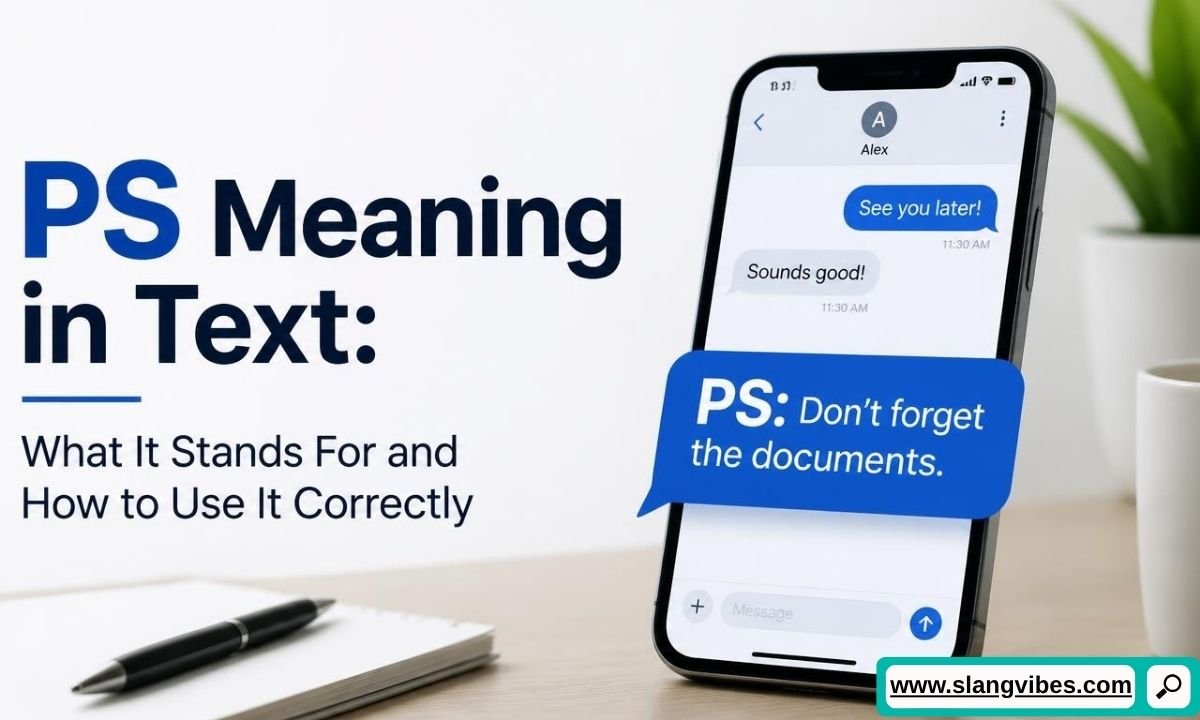
My cousin sent me a long message about her weekend plans. The last line read, “PS bring snacks.” I stared at my screen for a full minute. Did she mean PlayStation? Were we gaming? I asked, and she laughed for five minutes. The PS meaning in text is far simpler than my guess. It stands for postscript, an extra thought added after the main message. This guide explains what PS means, where it comes from, and how to use it so your texts sound natural. Along the way, you’ll see real examples, a few mix-ups to avoid, and some related abbreviations. Let’s clear up the confusion.
Read Also: WTW Meaning in Text: What It Means on TikTok, Snapchat & Instagram (2026)
What Is the PS Meaning in Text?
PS stands for postscript. It marks a short note added after the main message ends. Think of it as the thought you remember right as you finish typing.
Here’s the thing: people write it as PS, P.S., or even ps. All three versions share one meaning. The PS meaning in text stays the same whether the note is serious, silly, or sweet.
A postscript usually does one of three jobs. It adds a forgotten detail, drops a joke, or saves the best news for last. Readers tend to notice a PS because it sits apart from the main message.
Here’s how it looks in a real chat:
Maya: Dinner is at 7 on Friday. I’ll text the address tonight.
Maya: PS wear something comfy, we’re walking after.
Jordan: Perfect. Thanks for the heads up!
In this exchange, Maya’s PS adds a practical tip after the plan is set. Jordan reads it as a helpful extra.
The note often feels friendly and a little personal. It tells the reader, “One more thing before I go.” A small touch like this makes a plain message sound warmer.
Think of it this way: a PS gives one idea its own spotlight. Writers use it for a laugh, a reminder, or a sweet closing line. It also works well for good news, since the reader reaches it last.
Where Does PS Come From?
The PS meaning in text starts long before phones existed. The abbreviation comes from Latin, where post scriptum means “written after.”
Picture a handwritten letter, long before email. The writer signs the bottom and then remembers one more detail. Starting over meant rewriting the whole page. So the writer added a short note below the signature and marked it P.S.
Fun Fact: Writers sometimes stacked notes with PPS, short for post post scriptum. A PPPS shows up now and then too.
Email and texting carried the habit forward. Typing a message makes edits easy, yet many people keep the PS for its personal feel.
You delete and retype a message in seconds, so nobody needs a PS anymore. People still use it because it adds personality.
Over time, the format shrank too. Handwritten letters used the full P.S. with periods. Texters often drop the periods and type PS in capitals or lowercase letters.
The meaning stays the same, but the mood shifts a little. A lowercase ps feels relaxed and casual. A capital PS feels a bit more deliberate.
Think about how a friend might text you. A quick ps after a funny story sounds like a wink. The same note in a polished email sounds like a thoughtful closing line. Either way, readers know exactly where the extra thought begins.
Read More: Aura Slang Meaning: What It Means on TikTok & Social Media
How to Use PS in a Text Message
Once you know the PS meaning in text, using one takes seconds. Type your main message first. Then add PS, a space, and your extra thought, either on a new line or in a second text.
A good PS stays short. One sentence works best. Keep the tone close to the rest of your message.
Here are four common ways people use it:
- Reminder: PS bring your charger, the outlets are far away.
- Joke: PS I still think pineapple belongs on pizza.
- Sweet note: PS you made my whole week better.
- Flirty twist: PS I saved you the last slice.
Here’s a quick exchange between coworkers:
Priya: The slides are ready for Monday’s meeting.
Priya: PS I added the budget chart on slide six.
Marcus: Great catch. I’ll review it tonight.
Notice how Priya sends the PS as a second text. It works well because a new bubble draws the eye. You’ll see the same habit in group chats, where a PS often carries a reminder for everyone.
Keep one more rule in mind. Use a single PS per message. Stacking several notes makes the original point hard to find.
Placement matters too. Put the PS at the end, never the start. A note placed at the start loses its afterthought feel and confuses the reader. Bottom line: end with your PS and keep it light.
PS Meaning in Text on Social Media and Email
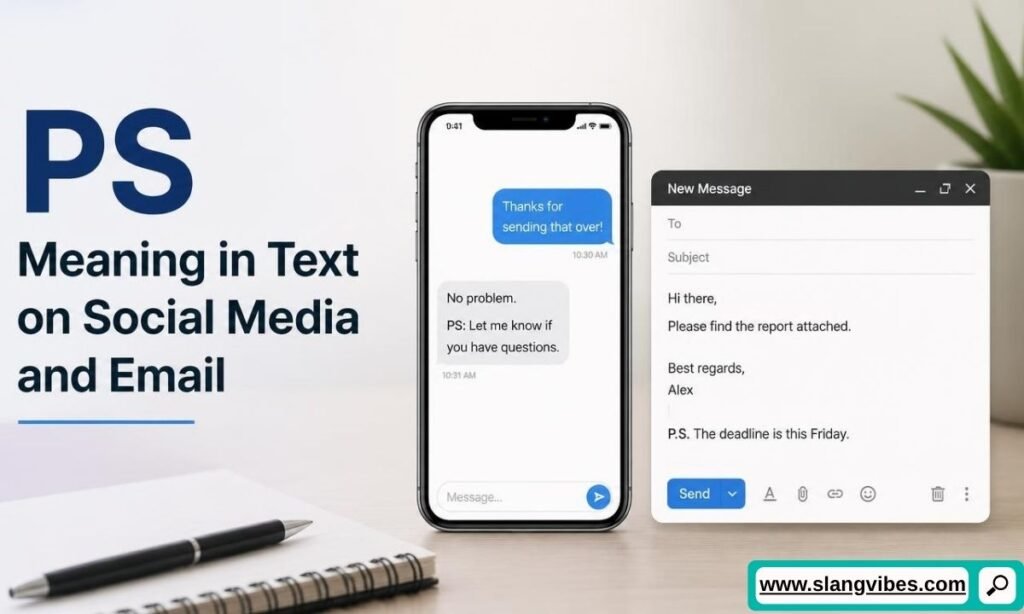
A PS shows up well beyond private chats. Each platform gives it a slightly different feel.
Here are a few scenes where you’ll spot one:
- Instagram caption: A travel photo ends with “PS the sunset was even better in person.”
- Direct message: A friend sends a long apology and adds, “PS I’m buying lunch next time.”
- Newsletter: A small business closes its update with a PS about a weekend sale.
- Email: A coworker signs off a meeting recap with “PS the pastries are in the kitchen.”
The PS meaning in text stays steady across all four spots. What changes is the job it does. In casual chats, it adds charm. In marketing emails, it spotlights an offer or a deadline.
Generations tend to treat it a little differently. Based on how the term is typically used online, many Millennials write PS in capitals with a clear purpose. Many Gen Z texters lean toward a casual lowercase ps, often with a joke attached. Neither style is wrong.
Writers in the US and UK share the habit. Both groups read it the same way, so a PS never needs a translation.
A quick note on length. Social posts reward short endings, so keep a caption PS to one line. Email gives a bit more room, yet two sentences is plenty. Short and sweet wins.
Read Also: RS Meaning in Text: The Complete Guide for Beginners (2026)
Other Meanings of PS in Chats
You might be wondering what else PS stands for. Several things, and context tells you which one the writer means. Check the words around it before you decide.
The PS meaning in text usually points to postscript when the letters open a closing line. This table sorts the usual suspects:
| Meaning | Where You’ll See It | Example |
|---|---|---|
| Postscript | End of messages and emails | PS call me tonight |
| PlayStation | Gaming chats | Did you get a PS5 yet? |
| Photoshop | Design and photo talk | Please PS my photo before posting |
| Public school | School names, often in New York City | PS 101 hosts a fair Friday |
Postscript is the meaning you’ll meet in message endings. PlayStation shows up in gaming chats, where PS4 and PS5 name the consoles. Photoshop turns into a verb for editing photos. Public school appears in New York City, where many schools carry a P.S. number.
Here’s a mix-up between siblings:
Tori: PS tonight at 8?
Eli: PlayStation or postscript? I’m confused.
Tori: PlayStation, obviously. Bring snacks.
Eli: Perfect. I’m in.
Eli asks for clarity instead of guessing. Smart move.
Three habits help you decode any PS fast. Check where the letters sit in the message. Look at the topic of the chat. When doubt remains, ask. A quick question beats a wrong guess. My cousin laughed, but I got my answer.
Read Here: SMS Meaning in Text: What It Really Means and How People Use It
When Not to Use PS in Text
A PS adds charm, but timing matters. Some moments call for a clean, direct message with no afterthoughts.
The PS meaning in text signals a casual extra thought, so it fits best where a relaxed tone belongs. Skip it in these situations:
- Job applications and formal emails to hiring managers
- Serious talks, like apologies or bad news
- Legal, medical, or financial messages where every detail needs clarity
- Quick messages already short enough for two lines
Imagine I’m writing to my landlord about a broken heater. I tack on a PS about a dripping sink. Now the second problem looks like a casual aside, and my landlord might miss it. A clear second message works better.
Think about tone, too. A PS carries a playful, personal feel. In a tense moment, it softens what should stay firm. If a topic is heavy, skip the extra note and say everything in the main message.
Work chats deserve a quick word. Many teams use short, direct messages, so a PS might feel out of place in a fast channel. In a friendly team thread, it fits fine. Read the room before you add one.
Formal versus informal sums it up. Informal chats welcome a PS. Formal writing prefers a tidy structure where every point has its place. The short answer is: when in doubt, leave it out.
Common Mistakes With PS Meaning in Text
Small PS slip-ups happen to everyone. Here are the ones to watch:
- Burying the main point in the PS. Extras belong there, key requests do not.
- Writing two or three PS lines. One note keeps the message clean.
- Mixing it up with PlayStation. Read the context before you reply with game talk.
- Starting a message with PS. The abbreviation signals an afterthought, so it belongs at the end.
- Adding PPS when no PS exists. PPS only follows an earlier PS.
See how a misplaced PS plays out between two people planning a date:
Dana: PS don’t forget the tickets!
Leo: Forget them for what? You skipped the plan.
Dana: Oops, I typed the PS first. The show starts at 8 sharp.
Leo: Got it. Tickets in my pocket.
Dana’s opening PS left Leo puzzled. Putting the note last would have prevented the confusion.
Punctuation trips people up too. P.S., PS, and ps all work. Pick one style and stay consistent within a single message. A colon after PS looks tidy. Skipping it feels more casual.
Tone mix-ups matter as well. A jokey PS after a sad message lands badly. Match the PS to the mood of everything above it.
Get these basics right, and the PS meaning in text works in your favor. Your messages sound warm, clear, and easy to read. Small edits like these keep every text polished.
Read New Articles: IIRC Meaning in Text: What It Actually Means and How to Use It Correctly!
PS vs. PPS, BTW, and Similar Abbreviations
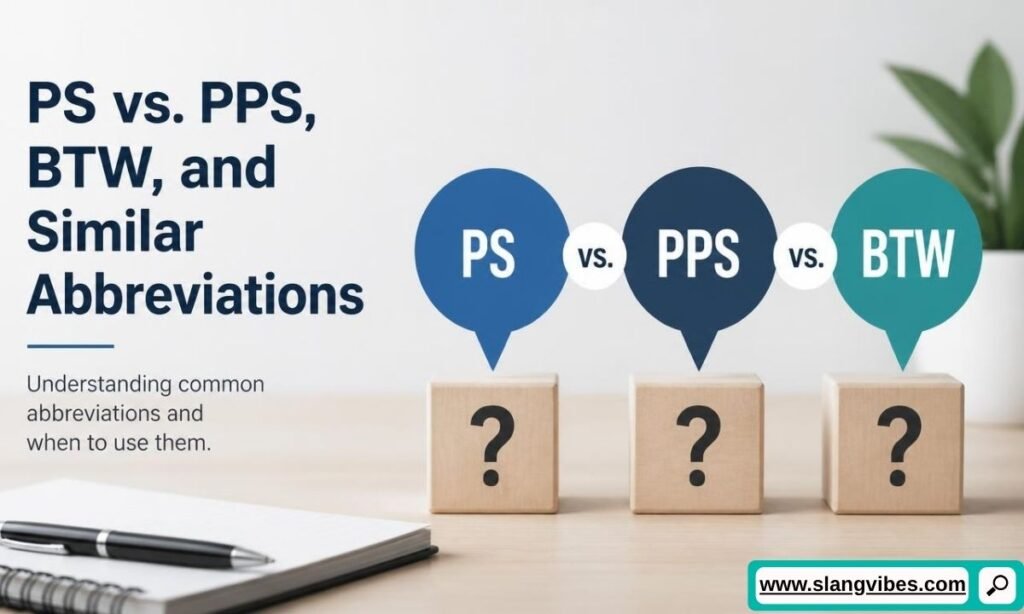
PS belongs to a family of abbreviations built for extra context. Knowing how each one differs keeps your texts clear. This quick table lines them up:
| Abbreviation | Meaning and Use |
|---|---|
| PS | Postscript, a final extra thought |
| PPS | Post-postscript, a second note after a PS |
| BTW | By the way, a casual side comment mid-message |
| FYI | For your information, a helpful heads up |
| TBH | To be honest, an honest opinion |
PPS deserves a closer look. It stands for post-postscript, a note added after your first PS. Use it sparingly, since two afterthoughts in one message start to feel like a pile-up.
BTW works differently. People type it mid-message, as in “BTW the store closes early today.” A PS waits until the end.
FYI shares a helpful fact, often with a work flavor. TBH adds honesty to an opinion. Neither one signals an afterthought the way a PS does.
Here’s a simple way to choose. Use BTW for a side comment inside your message. A final thought at the bottom calls for PS. PPS fits only when a second extra thought follows the first. For a useful fact, reach for FYI, and for an honest opinion, TBH.
What this means for you: each abbreviation is a different kind of aside, and PS is the one saved for last.
Frequently Asked Questions
What does PS stand for in a text?
PS stands for postscript, a short extra thought added after your main message. The Latin root, post scriptum, means “written after.”
Is PS the same as P.S.?
Yes. Both versions mean postscript, and the PS meaning in text stays identical with or without periods.
Does PS always mean postscript?
No. PS also names PlayStation, Photoshop, and public schools in New York City, so context tells you which meaning fits.
Where does a PS go in a message?
Place it at the end, after your main point. Keep it to one short sentence.
Is it okay to use PS in a work email?
Yes, in friendly or marketing emails. Skip it in formal messages like job applications.
Final Thoughts
The PS meaning in text comes down to one idea: an extra thought added after your main message. It started on handwritten letters as post scriptum, and it still carries the same friendly, personal feel on phones today. You’ve seen how it works in texts, captions, emails, and newsletters. You’ve also seen which messages should skip it, and how PPS, BTW, FYI, and TBH each play a different role.
My cousin’s snack reminder taught me a useful lesson. Check the context, read the tone, and ask when something looks unclear. A PlayStation joke and a postscript look identical until the conversation fills in the rest.

Alex Carter is a language enthusiast and internet culture expert at SlangVibes. He explains the latest slang terms and text meanings in simple, clear English so everyone stays in the loop.